Introducing the Alumio Route Builder
Now connect, orchestrate, and govern integrations at scale from one visual interface

Dimension-tagged transactions from Sage Intacct arrive already shaped for Microsoft Power BI, so a report slices by entity, department and project without a lookup table rebuilt inside it.


























Sage Intacct tags transactions with dimensions rather than burying them in a segmented account code, which is its main advantage and the first thing most reports throw away. An analyst exports a trial balance, rebuilds the dimension lookups inside the report, and the two drift apart by the next close. Pointing a report straight at the ledger instead means every visual calls a metered cloud API. The Sage Intacct to Microsoft Power BI integration keeps the structure intact: dimension-tagged transactions arrive shaped for a report model, on a cadence you set rather than on demand.
DATA THAT FLOWS BETWEEN THEM
Journal entries
Dimension tags
Account balances
Vendor invoices
Customer invoices
Budget figures


Dimension tags travel with each Sage Intacct transaction, so a Microsoft Power BI report slices by entity, department or project with no lookup maintained inside the report.
Instead of every visual calling Sage Intacct, Alumio collects on a schedule and Microsoft Power BI reads the prepared set, keeping a metered cloud API off the critical path.
The trial balance export and the reassembled dimension lookups both disappear, so an analyst spends the close explaining variances rather than putting the same model back together.
Budget figures held in Sage Intacct arrive alongside actuals, so a Microsoft Power BI report shows variance from one delivered set rather than from two files joined by hand.
Alumio delivers Sage Intacct transactions with their dimension tags separated into the tables a Microsoft Power BI model expects, so the report is built on a proper schema rather than on one wide flattened extract.
Multi-entity balances from Sage Intacct land in Microsoft Power BI already tagged by entity, so a group view and a single-company view both come from the same delivery instead of a separate export for each one.
Budget and actual figures move from Sage Intacct on a set cadence, so a Microsoft Power BI report shows the variance developing through the month rather than appearing only once the close pack has been circulated.
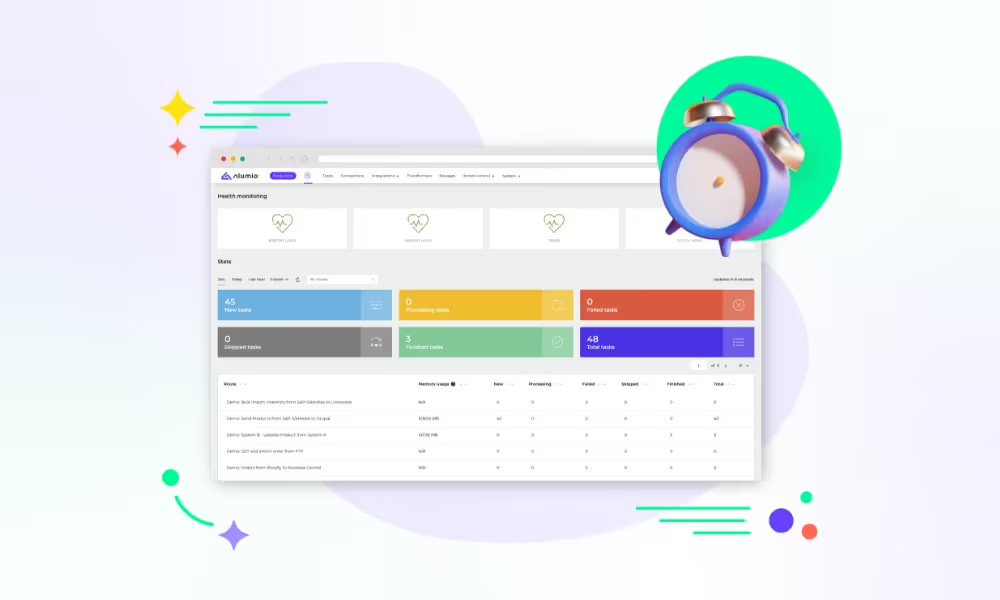
Alumio sits between sales channels and fulfillment systems as a governed integration backbone. Orders are routed, transformed, and validated, while status updates return to every channel.

Authenticate your systems using Alumio's pre-built connectors. Choose from 200+ connector packages in the marketplace, plus unlimited custom integrations.

Define how data fields map between systems in a visual interface. Adjust formats, enrich records, and apply business logic, no custom code required.

Configure flows to run in real time on events, on a schedule, or both. Reduce manual data entry and let Alumio handle movement and transformation between systems.
.svg)
Once your first integration is live, adding your ERP, PIM, WMS, or CRM connects to the same hub. Existing flows keep running. No rebuilding from scratch.

A subscription billing system is often the next source. Finance teams reporting on Sage Intacct in Microsoft Power BI want revenue by plan and cohort, and that detail sits upstream of the ledger rather than inside it. Alumio holds both connections, so billing detail arrives shaped like the accounting figures and joins in the model instead of in a spreadsheet.
On a schedule, and that is the right pattern for a cloud ledger. Alumio collects journal entries, balances and dimension tags from Sage Intacct at the cadence you set, shapes them, and delivers them for Microsoft Power BI to import. Pointing DirectQuery at a metered cloud API instead means report interactivity eats the same allowance your integrations need.
No, this is configured rather than coded. Shaping Sage Intacct output for a report model is interface work rather than a build, and the ledger itself is reached over its available API, the way any reachable system is. Dimension structures get defined per organization, so the Code Transformer handles what mapping will not, such as deriving a reporting hierarchy out of tags never designed as one.
As their own tables related to the facts, not as columns on them. Sage Intacct tags transactions with dimensions instead of encoding them in an account string, which maps naturally onto a star schema, and flattening them into one wide table throws that away. Bring each dimension across as a table with its own key and the report slices without measures being rewritten per view.
The failure to watch is a refresh that finished while the period was still being posted, because it looks identical to a good one. Alumio watches each delivery live and records the position it collected, so an incomplete or refused load from Sage Intacct alerts immediately and retries automatically where configured. The log carries the reason and the cut-off, so nothing part-closed quietly passes as final.
Talk to an Alumio integration specialist. We'll map the right architecture for your systems, at the right scale, so your operations stay reliable through every change.














.svg)


