Introducing the Alumio Route Builder
Now connect, orchestrate, and govern integrations at scale from one visual interface

A price change shouldn't take a day to reach your webshop. Alumio syncs product data, prices, and stock from your ERP and PIM to every sales channel automatically, with every update landing in real time or on a schedule.
Alumio is a cloud-native integration platform (iPaaS) that keeps product data, prices, and stock synchronized between ERP, PIM, and ecommerce systems. Updates reach every sales channel automatically, real time or on schedule, monitored and logged end-to-end.
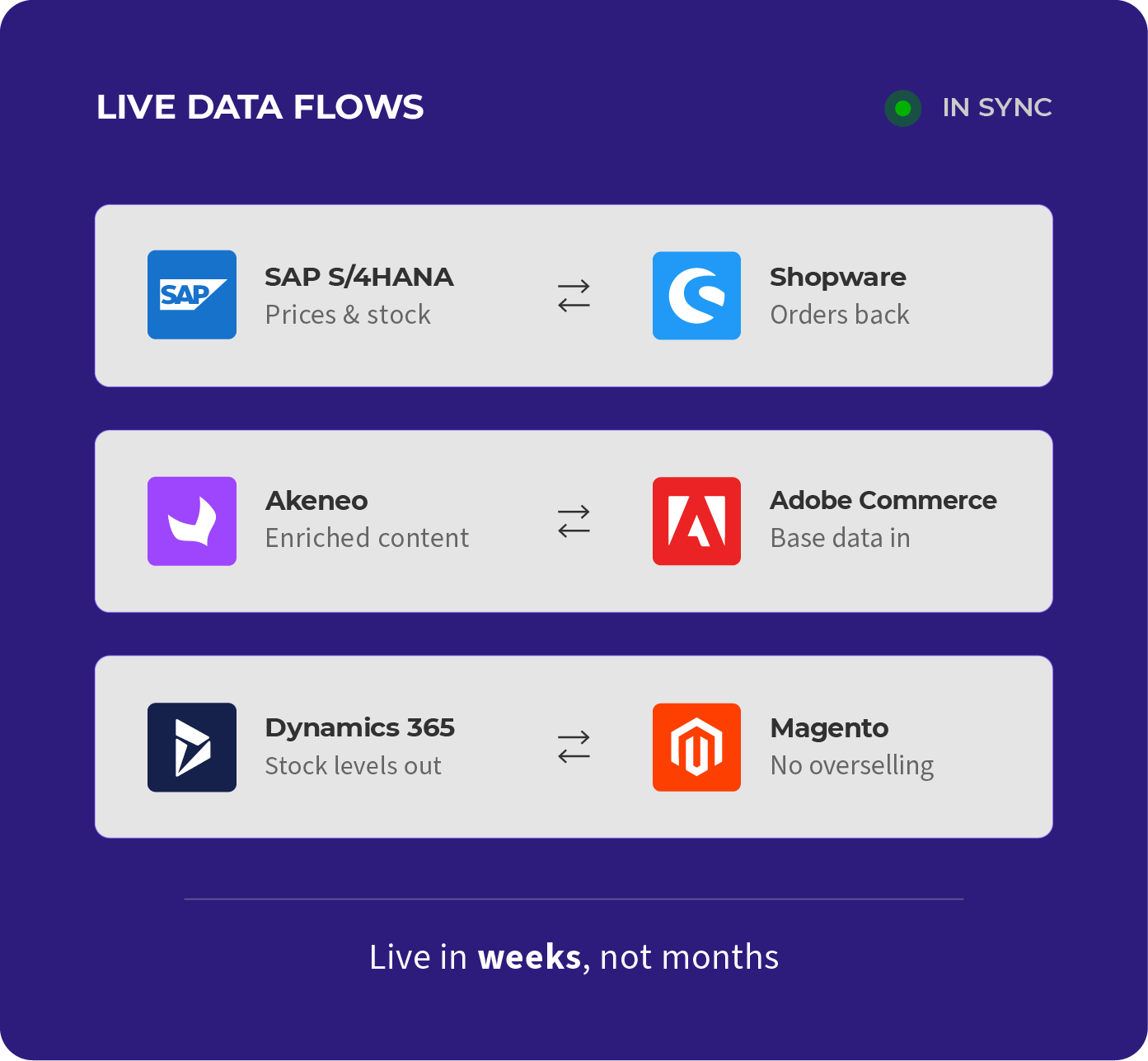

Verified outcomes from businesses that run their data flows on Alumio.
Three problems every commerce and wholesale team recognizes. Each gets worse as channels, markets, languages, and SKU counts grow.
Price changes are exported, reformatted, and re-imported by hand. One update can take a full day to reach every webshop and marketplace, and every manual step along the way is another chance for errors.
A price drops in the ERP on Monday and the webshop still sells at the old price on Wednesday. Stock runs out, but every channel keeps selling it. Canceled orders, refunds, and support tickets follow.
Custom point-to-point scripts work until a platform update or a developer's departure breaks them. Every connection is a hidden liability, and replatforming becomes a project you avoid instead of taking.
Alumio sits between sales channels and fulfillment systems as a governed integration backbone. Orders are routed, transformed, and validated, while status updates return to every channel.
Source systems
ERP: SAP, Dynamics 365, Odoo
PIM: Pimcore, Inriver, Akeneo
WMS and pricing engines

ALUMIO
Integrate systems via connectors or custom config
Transform data between formats without custom code
Validate and enrich data before it moves on
Route every record to the right system automatically
Monitor every flow with real-time logging
Sales channels
Webshops: Shopware, Adobe Commerce, Magento, Shopify
Marketplaces and shopping feeds
POS and customer portals
200+ purpose-built connector packages plus unlimited custom integrations.
New connections typically go live in weeks, not months, and your own team manages changes through a low-code interface instead of waiting on developers.
Alumio goes beyond lightweight automation tools and beyond heavyweight enterprise suites. Built for organizations where integrations are business-critical.
A low-code interface means your own team can build, change, and manage order flows. No waiting on external developers for every routing rule or field mapping. Fairphone cut integration change cycles from months to days this way.
From ERP and ecommerce platforms to WMS, EDI, and carriers.
Monitoring and logging show exactly which order moved, when, and where something failed. Errors are caught before customers notice.
Alumio decouples your systems, so you can replace your webshop or upgrade your ERP without rebuilding every connection.
ISO 27001 certified, GDPR-aligned, and built to European security standards, with role-based access and audit logging on every integration.
AI is only as reliable as the data behind it. Alumio connects and governs data across your ERP, PIM, e-commerce, and CRM systems:

Clean data: Models read validated, standardized data from systems, not from exports.
AI endpoints: Integrate any AI service, agent, or model like any other system to enrich work.
More than dashboards: AI translates products, enriches attributes, and updates prices across your systems.
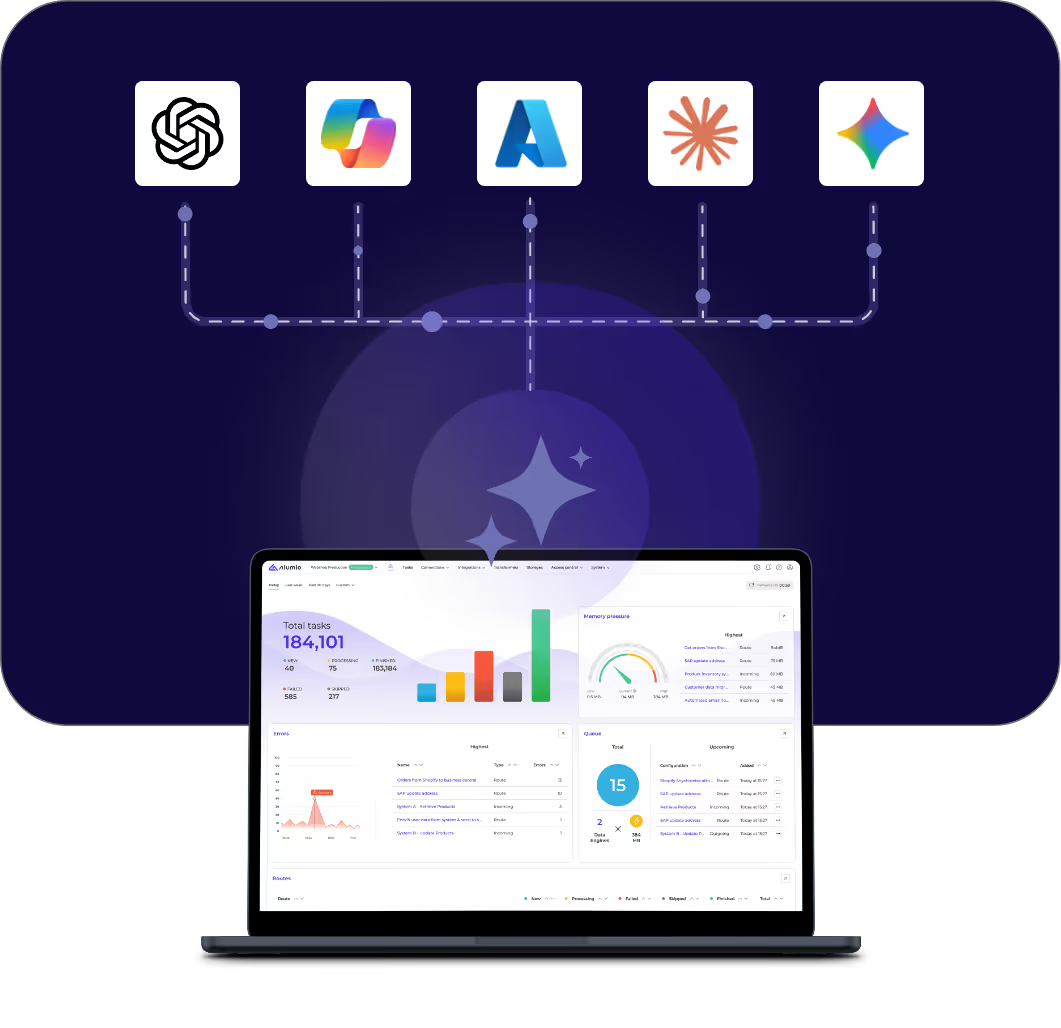

Alumio connects your ERP, PIM, and commerce platforms through one central integration layer. When data changes in the source system, Alumio transforms it to the format each channel needs and delivers it automatically, with monitoring and logging on every flow. Customers like Selfmade cut update times from 24 hours to 30 to 60 minutes this way.
Typical connections go live in weeks, not months. P4 Markets had Dynamics 365 Business Central and Akeneo synchronized in two weeks, with full implementation in four. Timelines depend on the number of systems and the complexity of your data model, and your own team manages changes after go-live through the low-code, config-first interface.
Not for day-to-day changes. Alumio's low-code, config-first interface lets your own team manage mappings, rules, and changes directly, with the Code Transformer available when configuration cannot express a requirement, so nothing waits on a developer. Fairphone reduced integration change cycles from months to days with internal teams managing all changes without developers. That independence matters most for product data, where prices, attributes, and assortments change constantly.
Yes. Most customers start with the flows that hurt most, often prices and stock, and expand to orders, shipments, and customer data on the same platform. Integrations built in Alumio are modular and reusable, so every new flow builds on the last instead of starting from scratch as a separate project.
Yes. PIM integration is one of the most common Alumio use cases. Alumio connects Pimcore, Inriver, and Akeneo to ERP and commerce platforms, so enriched product content flows from the PIM to every channel automatically. Selfmade (Inriver) and De Bosrand (Pimcore) run exactly this setup in production today.







.svg)
.svg)
.svg)
.svg)
.svg)
.svg)