
A Alumio vivid purple arrow pointing to the right, a visual representation of how to access more page material when clicking on it.
Go back

Optimize the value chain with an integration platform

By
Saad Merchant
Published on
March 15, 2023
Updated on
June 24, 2026
IN CONVERSATION WITH
Email icon
Email icon

The Value Chain of an organization offers a framework for how to curb inefficiencies and boost process optimization across each area of an organization. However, with digital transformation starting to virtually define business automation, this translates to organizations implementing various SaaS solutions or cloud apps at every touchpoint of a business’s Value Chain. Yet, to get these disparate software solutions to work together and streamline processes, most modern businesses are resorting to a next-gen solution called the iPaaS (integration Platform as a Service). The Alumio integration platform (iPaaS) is a next-gen middleware solution that helps integrate new software and technology with seamless data exchange and workflow automation, redefining Value Chain optimization.

What is the Value Chain and how can it help modern businesses?

Evolving from physical automations to digitally powered automations

If there is an effective, step-by-step model that categorizes all the various business processes that go into creating and delivering value with a product or service, it is the “Value Chain”. Proposed by Michael Porter in his 1985 book, “Competitive Advantage: Creating and Sustaining Superior Performance”, the framework essentially consists of five primary activities and four support activities, namely:

Primary activities - inbound logistics, operations, outbound logistics, marketing and sales, and customer service. Essentially, everything that ensures a product or service is delivered successfully.

Support activities - procurement, technology development, human resource management, and infrastructure. In other words, everything that ensures all the primary activities are able to function effectively.

By encompassing all these areas for business development, the Value Chain helps organizations optimize their overall efficiency and maximize value while minimizing cost. Most importantly, it gives businesses a clear overview of all the areas they need to employ, improve, supply, and enhance with technology and automations.

Each of the divisions on the Value Chain were until recently powered by human resources, manual processes, and physical automations. However, the advent of digital technology and cloud solutions have led to modern businesses taking a “Digital First” approach in improving their Value Chain, with the help of software-based automations.

For instance, now entire product lifecycles in retail are governed across online omnichannel e-commerce experiences. B2B transactions and supply chain in manufacturing are streamlined and enabled digitally. Even customer relationship and marketing efforts are seeing an ever-increasing implementation of digital transformation.

Digitally transforming the Value Chain with integrations

Harnessing SaaS, cloud apps, and data sources with system integrations

"Executives say digital transformation benefits include improving operational efficiency (40%), faster time to market (36%), and meeting customer expectations (35%)." - PTC Digital Tranformation Survey

As the name indicates, digital transformation involves integrating digital technology with all the business processes of a company, from Operations, Logistics, Marketing, Sales, Customer service, Procurement, HR, and all other departments. The reason this helps develop the Value Chain so well is because now there is a software solution or cloud app to digitalize and automate processes of nearly every businesses division. For instance, businesses can implement:

  • ERP (Enterprise Resource Planning) systems like SAP, Microsoft Dynamics 365, or Exact Globe help track and manage inbound and outbound logistics, as well as human resource management.
  • E-commerce platforms like Adobe Commerce (formerly Magento), Big Commerce, and Shopify enable businesses to build web shops to digitally sell and market their products.
  • PIM (Product Information Management) systems like Akeneo and Pimcore help centralize, store, enrich, and update product information.
  • CRM (Customer Relationship Management) systems like Salesforce and Hubspot help track customer data, improve customer support, and automate marketing initiatives at every business touch-point.
  • EDI (Electronic Data Interchange) helps with the paperless exchange of B2B information for procurement or sales in a standard electronic format, ensuring data accuracy and faster transactions.
  • Channel Marketing Software like ChannelEngine and Channable help simplify the process of managing and optimizing e-commerce product listings across multiple channels like Amazon, Alibaba, and Bol.

There’s also WMS (Warehouse Management System), AI solutions like OpenAI being leveraged for e-commerce, BI (Business Intelligence), and many more systems that businesses can connect with to improve each area of their Value Chain.
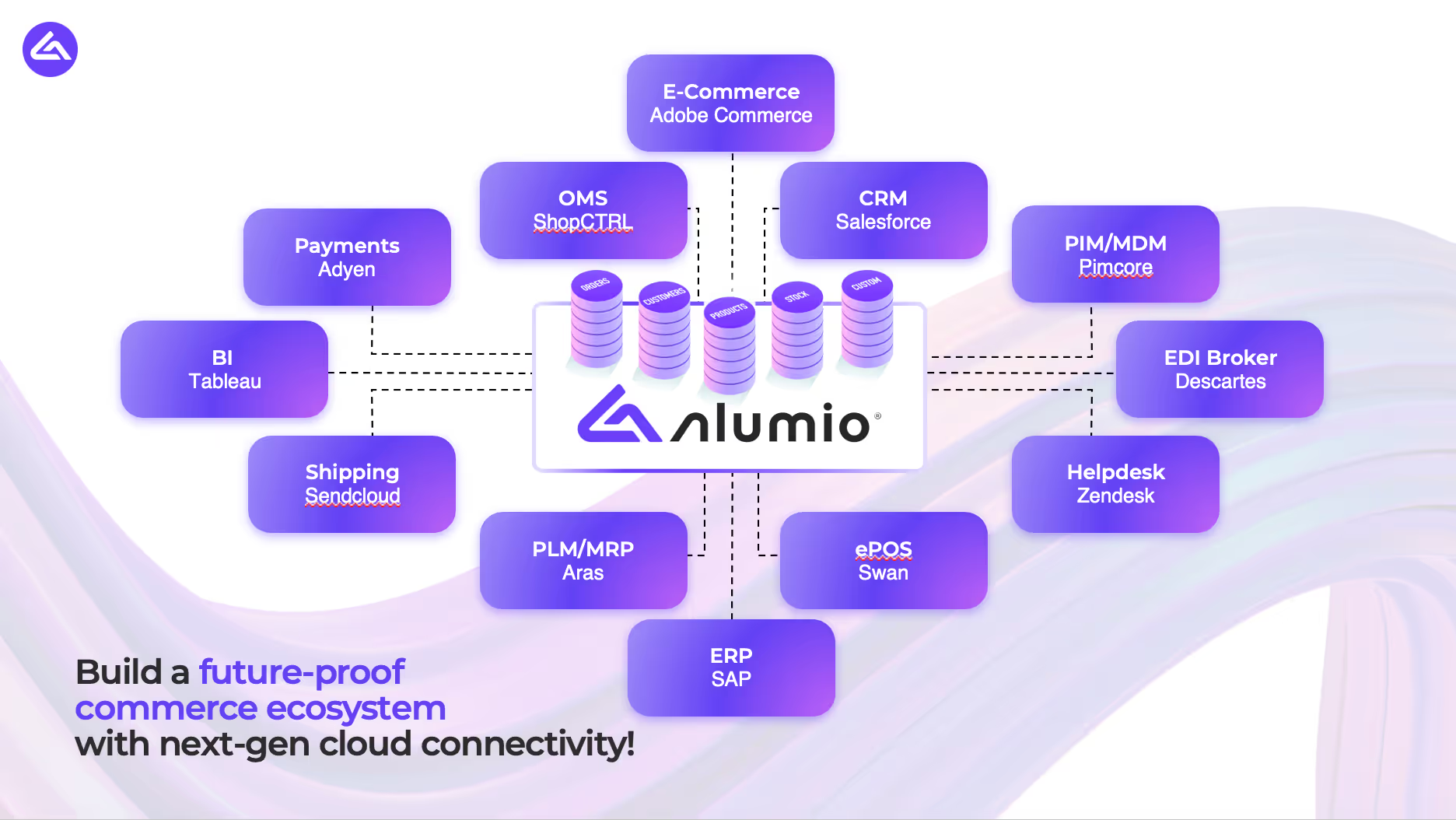
Building an IT ecosystem with Alumio


Connecting with these applications helps optimize a plethora of costly, time-consuming and manual repetitive work processes on the value chain. This includes digitally automating product optimization, order management, shipping, inventory updates, returns, procurement, emailing, and much more. And, it also includes digitalizing recruitment, emailing, invoicing, customer support, and a thousand odd more processes for nearly every business department on the Value Chain.

However, contrary to how easy it seems to implement these SaaS (Software as a Service) and cloud apps to expedite digital transformation on the value chain, the real challenge lies in getting these disparate solutions to work together and share data seamlessly. Thus, although a seemingly small part of it, at the heart of digitally transforming the Value Chain lies “integrations,” i.e. integrating these various business systems, software solutions (SaaS), applications, and data sources.

That’s where the Alumio iPaaS comes in!

Turn AI ambition into action

Portrait of Leonie Becher Merli, Business Development Manager at Alumio

Get a free assessment of your integration needs and next steps

Portrait of Leonie Becher Merli, Business Development Manager at Alumio

Integrating and optimizing the Value Chain with the Alumio iPaaS

Building fast, flexible, and future-proof system integrations


Traditionally, system integrations are created with custom code. However, this method is time-consuming, expensive, and it’s only good for creating single point-to-point connections between two software solutions, such as an ERP to e-commerce integration. The moment you start attempting to connect more software or applications across the Value Chain with custom code, the harder it gets to share and sync data accurately. Additionally, such integrations can only be managed and modified with senior developers or coding experts, and replacing connected systems can cause data integrity issues.

According to a report by Gartner, "By 2023, over 50% of large and midsize organizations globally will have deployed at least one iPaaS offering, up from approximately 35% in 2020."

The Alumio iPaaS (integration Platform as a Service) is a next-gen connectivity solution. It enables businesses to quickly and cost-effectively integrate two or multiple systems, software, apps, or data sources, across on-premises and cloud environments.

As a cloud-native, low-code platform it provides a user friendly interface that developers and business users (project managers, data experts, C-Level) can collaborate on to create, manage, and monitor these integrations. Most importantly, it provides organizations with one central cloud environment to seamlessly share data between connected software solutions, throughout the Value Chain. This makes it easy for businesses to automate workflows between departments and organize a scalable IT ecosystem from one intuitive dashboard, in a fast, flexible, and future-proof way.

Here’s some of the many key advantages the Alumio iPaaS offers to automate the Value Chain of a business:

  • Move to the cloud: integrate on-premises systems on cloud environments, connect modern cloud-based software via industry standard APIs, and migrate data from old systems to new ones.
  • Get faster time to Market: rapidly integrate new software or cloud app within weeks, build swift proof of concepts and deploy products or services significantly faster.
  • Increase operational efficiency: reduce manual processes and data entry work by automating workflows and streamlining business process through the entire Value Chain.
  • Lower operational costs: work with junior developers, free up senior developers to develop advanced solutions, and save on troubleshooting with automated monitoring and logging.
  • Improve data management: implement Alumio platform features to flexibly map, sync, modify, and validate data across multiple systems, improving data quality and eliminating costly errors.
  • Be secure and compliant: centralize all your integrations and data on one secure, dedicated cloud space with regular security updates, and comply with privacy legislations like GDPR.
  • Get 360-degree customer insight: centralizing all connected systems and data on one platform, the Alumio iPaaS can providing valuable customer insights from every touchpoint of your business.

To summarize, the Alumio iPaaS helps optimize the Value Chain to increase your margins, enhance customer experience, and reduce operational costs with improved digital connectivity. It does so by providing right cloud-based platform to seamlessly integrate multiple software solutions and cloud apps that digitalize business processes, boost productivity, and increase market access. It also enables seamless data sharing and the automation of workflows between connected systems, streamlining business processes and reducing manual labor and data entry.

In other words, it can be said that while the Value Chain provides the blueprint for all the areas that a business can generate value in, the Alumio integration platform works as a central hub that can connect, develop, and optimize each area on the Value Chain with fast, flexible, and future-proof integrations.

No items found.
Topics in this blog:
No items found.

FAQ

Integration Platform-ipaas-slider-right
What is the value chain and how does an integration platform optimize it?

The value chain describes all the activities through which a business creates, delivers, and supports its products and services, from procurement through production, sales, and customer service. An integration platform optimizes the value chain by connecting the systems that manage each activity (ERP for procurement and finance, WMS for logistics, PIM for product management, e-commerce for sales, CRM for customer service) into a governed data backbone where information flows automatically between stages. This eliminates the information delays and manual handoffs between value chain stages that add cost without adding value.

Integration Platform-ipaas-slider-right
How does digital transformation change what value chain optimization means?

Digital transformation changes value chain optimization by making data the primary optimization lever: where traditional value chain optimization focused on physical process efficiency, digital transformation enables information-driven efficiency through real-time visibility and automation. Demand signals from e-commerce flowing automatically into production planning, inventory status from WMS visible to sales in real time, customer feedback from CRM informing product development: each represents a value chain optimization that is only possible when the systems holding each data type are integrated and exchanging information continuously.

Integration Platform-ipaas-slider-right
What are the most valuable integration points in a typical e-commerce value chain?

The most valuable integration points are: demand capture (e-commerce order data flowing to ERP and WMS immediately), inventory visibility (ERP and WMS stock levels flowing to all customer-facing channels in real time), product data distribution (PIM feeding all sales channels with consistent, enriched content), customer intelligence (all channel interactions flowing to CRM for unified customer understanding), and financial reconciliation (order, payment, and fulfillment data flowing to ERP for accurate, timely financial reporting). Each integration point removes a stage where value is lost to manual handoff, delay, or data inconsistency.

Integration Platform-ipaas-slider-right
How does the Alumio integration platform help businesses identify and close value chain gaps?

Alumio helps identify value chain gaps through the integration landscape audit process: documenting all current system connections, identifying where data flows are manual or batch-delayed when real-time is needed, and mapping the operational consequences of each gap (inventory inaccuracy rate, order processing delay, reconciliation time). Once identified, Alumio closes these gaps by building governed Routes that automate the previously manual or delayed flows, with monitoring that confirms the gap is closed and alerts if it reopens due to system changes.

Integration Platform-ipaas-slider-right
How does integrating the value chain improve customer experience outcomes?

Value chain integration improves customer experience by eliminating the consequences of information delays between stages: a customer orders an in-stock item that is actually out of stock because inventory did not sync, or receives incorrect tracking information because fulfillment data did not flow from WMS to e-commerce automatically. When all value chain systems are integrated, the customer's order experience reflects accurate operational reality at each stage rather than information that is delayed, incomplete, or inconsistent with what is actually happening in the warehouse or logistics network.

Integration Platform-ipaas-slider-right
What is the connection between value chain integration maturity and competitive advantage?

Value chain integration maturity is a direct source of competitive advantage because it determines how fast the organization can respond to demand signals, how accurately it can fulfill customer expectations, and how efficiently it can operate at scale. Organizations with mature value chain integration respond to stock-outs faster (automated replenishment signals), fulfill orders more accurately (real-time WMS to ERP to storefront sync), and scale more cost-effectively (automation rather than headcount for increased volume). These operational advantages compound over time as competitors managing value chain stages through manual handoffs fall further behind in speed, accuracy, and cost efficiency.

Get a free assessment of your integration needs

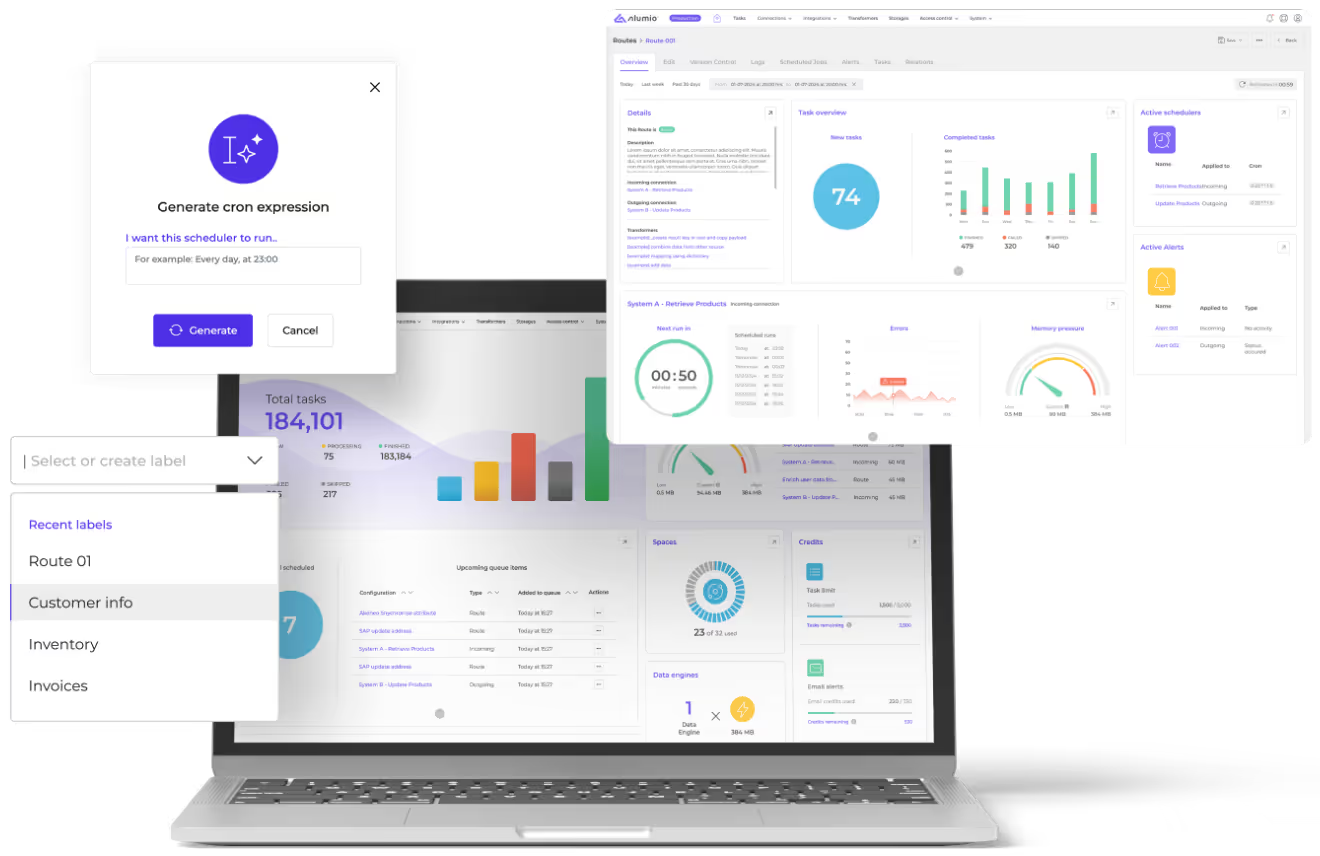
Laptop screen displaying the Alumio iPaaS dashboard, alongside pop-up windows for generating cron expressions, selecting labels and route overview.