




.svg)



Why are businesses investing in digital transformation?
While a business can embark on its digital transformation journey for many reasons, it is most commonly fueled by a survival instinct. To understand why, we needn’t look further than the recent Covid-19 pandemic and how it affected businesses worldwide, especially the ones that weren’t digitally equipped. In the aftermath of the pandemic, the ability of organizations to adjust to supply chain disruptions, Time to Market pressures, and rapidly transforming customer expectations has come under the lens.
"The worldwide market for digital transformation is expected to surge from $521.5 billion (in 2021) to a staggering $1,247.5 billion (in 2026)."
Yet, survivability factors aside, the kickstart to any digital transformation effort aims to improve business processes, enhance customer experience, ease business friction, push productivity limits, and boost profitability. Today, there’s a software solution or application to digitalize nearly every business process, from Marketing, Sales, HR, Logistics, Customer Service, you name it! Some of the most popular SaaS solutions, cloud apps, or systems that businesses integrate to digitalize these operations are e-commerce platforms, ERP systems, PIM, CRM, WMS, POS, channel marketing, and many such applications.
However, Implementing multiple new technologies in an organization is a minor part of the plot; getting them to all work together and seamlessly exchange data is a major part of the digital transformation story. To accomplish this, modern enterprises are implementing next-gen integration solutions like the Alumio iPaaS (integration Platform as a Service) to accelerate digital transformation across the value chain.
What is the Alumio iPaaS, and how does it help accelerate digital transformation?
The Alumio iPaaS (integration Platform as a Service) is a next-gen middleware solution. It enables businesses to quickly and cost-effectively integrate two or multiple software, apps, or data sources across on-premises and cloud environments.
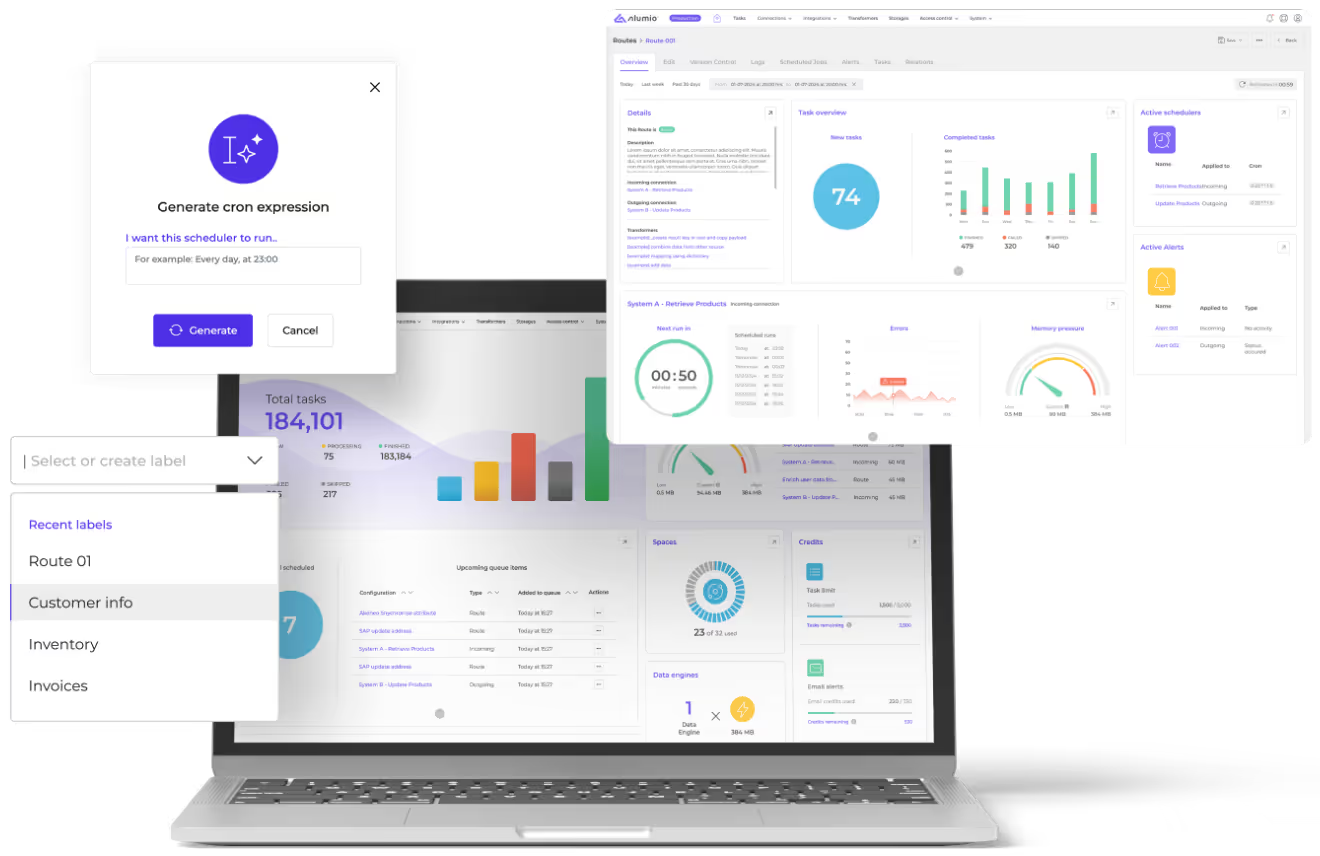
It is a cloud-native, low-code integration platform that both developers and non-developers (project managers, data experts, C-Level) can collaborate on to create, manage, and monitor integrations from one user-friendly interface. It also provides advanced developer-friendly features to transform data flexibly and automate workflows across all integrated systems. Most importantly, providing a centralized, dedicated cloud environment to manage all integrations and business data, it gives organizations a clear overview of their IT ecosystem through one intuitive dashboard.
Forbes recently showcased a study conducted by the Boston Consulting Group, which found that 70% of digital transformation projects fail to achieve their goals despite a green light from leadership. One of the key reasons can be attributed to complex integration and scalability metrics. To reiterate, digital transformation isn't just about integrating multiple new technologies; it's about integrating it all within one IT ecosystem. The Alumio iPaas helps centralize all integrated software, systems, and data sources on one scalable, dedicated cloud space with seamless real-time data sharing and synchronization.
“At least 40% of all businesses will die in the next ten years… if they don’t figure out how to change their entire company to accommodate new technologies.” — John Chambers, Cisco.
However, before we speed into the future of integrations with the Alumio iPaaS - let’s backtrack to explore the benefits of digital transformation. Why do organizations really need it, and why is it such a big deal?
Also, to learn more about achieving sustainable digital transformation, read our white paper on how the Alumio iPaaS helps businesses create future-proof IT ecosystems →
What are the digital transformation benefits of software integration?
As indicated before, digital transformation plays a crucial role in customer experience, operational agility, culture, leadership, and workforce enablement. Yet, it also involves integrating SaaS, cloud apps, and business systems. In this regard, some key business benefits of pursuing digital transformation with software integration are:
1. Digitalized and improved business process automation
Integrating software solutions or applications for digital growth isn’t just about remotely automating repetitive manual tasks. Instead, apart from freeing employees for higher-value work, one of the significant advantages of these digital solutions is that they provide valuable, real-time data insights for improvement.
For instance, using an integration platform like the Alumio iPaaS to integrate a WMS (Warehouse Management System) with your business means automating inventory tracking, predicting product availability, shipping calculations, and delivery dates. Using the iPaaS to integrate such a WMS solution with an ERP or an e-commerce platform can help significantly improve real-time inventory management and forecasting product availability.
Read more about the businesses advantages Verfwinkel.nl, a leading paint and suppliers retailer in The Netherlands, experienced by integrating their WMS system with their PIM, e-commerce, and ERP →
2. Get 360-degree data insights with integrated digital transformation
One of the key advantages of digital transformation is that it entails implementing software solutions like the Alumio iPaaS (integration Platform as a Service), which gathers customer data from all business touchpoints through software integrations. The iPaaS provides a visual analysis of the data that can be effectively used to improve customer experiences and discover new opportunities and areas for improvement.
By enabling businesses to integrate all their systems, software, and data sources on one platform, the Alumio iPaaS enables seamless data sharing and 360-degree data insights. It helps unlock data silos and organize all disparate data stored across departments into data lakes. This holistic control of integrated data that the Alumio iPaaS provides can be used to optimize the targeting of marketing activities, ad spends, and budgets for business improvements. The platform can also be used to make digitally transforming companies ready for Business Intelligence, AI, and ML technology, which are systems that thrive on holistic data collection.
Read more about the business benefits of integrating OpenAI with e-commerce →
3. Elevate customer experiences with CRM digital transformations
One of the core reasons why businesses need digital transformation is the rapidly evolving standard for customer experience. The expectations and demands of customers for digital and real-time services are increasing by the day. They progressively expect immediate results and simplified processes. CRM (Customer Relationship Management) is where digital transformation has seen critical developments in the past decade, from highly advanced chatbots to full-fledged CRM cloud applications.
"Reports show that 54% of transformation efforts are modernizing customer touchpoints through digital transformation."
By enabling enterprises to integrate any CRM solution quickly, the Alumio iPaaS helps make customer service touchpoints available anywhere, anytime, and from any device. CRM systems provide valuable data insights on customers, trends, or troublesome areas that can turn into opportunities. It enables businesses to generate targeted marketing campaigns and effective sales follow-ups. By building customer profiles, past purchase logs, and interaction history, a CRM system significantly boosts businesses efficiency with customer queries or problems. It also helps automate reminders on abandoned checkouts and informative email sequences to customer inquiries.
Heusinkveld, developers of racing products, used the Alumio iPaaS to rapidly integrate WooCommerce and the Odoo ERP, building monitoring alerts to automatically detect any errors in data transactions. Read more →
Explore digital transformation with the Aulmio iPaaS
The Alumio iPaaS doesn't just help enterprises integrate aforementioned systems and software for digital growth and facilitates transforming, scheduling, and modifying the combined data to improve automation. In other words, apart from enabling businesses to integrate new digital technology seamlessly, it allows companies to leverage the full potential of different software working seamlessly together.
To read the full story on how the Alumio iPaaS helps businesses achieve integration success, download the full white paper - Simplifying digital transformation with the Alumio iPaaS.





.svg)
.svg)
.svg)
.svg)
.svg)
.svg)
