




.svg)



What is digital transformation?
Short answer: digital transformation is all about integrations!
The long answer: digital transformation involves integrating the Value Chain of a business with digital technology to digitalize and connect company culture, customer experiences, and business processes. This helps adopt a 'Data-driven, Digital First’ approach with any new solution that's introduced. In other words, digital transformation isn’t a one-time thing and it involves successive transformations of business processes at different stages.
"As per a recent Gartner survey, 72% of Data & Analytics leaders are heavily involved in digital transformation initiatives."
However, is it enough to make services available online or modernize legacy systems to achieve digital transformation successfully? Implementing multiple new technologies in an organization is now a minor part of the plot; getting them to all work together and seamlessly share data is a major part of the larger digital transformation story.
How do software integrations help digitally transform organizations?
Nearly all new digital technologies are implemented or accessed through software or cloud apps that need to be integrated with business processes. Getting these technologies to communicate and combine their services via these software (and their respective APIs) is significantly easier. Thus, although a seemingly small part of it, at the heart of achieving digital transformation lies “integrations”, i.e. integrating business systems, software solutions (SaaS), and cloud apps, across the Value Chain.
"86% of companies believe cloud technology is critical to digital transformation."
The Value Chain of a business is essentially a framework that maps every department of a business, from primary activities such as inbound and outbound logistics, marketing, sales, operations, and customer service, to support activities like procurement, HR, infrastructure, and technology. Today, there’s hundreds of software solutions or apps that can be implemented to digitally transform each of these businesses processes. The most popular SaaS solutions or cloud apps that businesses integrate include e-commerce platforms, ERP, PIM, CRM, WMS, POS, channel marketing, and many such systems.
However, while connecting all these software for digital transformation may sound great at first, it can fairly also turn into an implementation nightmare from a C-level point of view. Why should business leaders risk attempts to evolve long-standing working processes that laid the foundation for their company? Why favor adopting newer practices and technologies that are still being defined?
This calls for a faster and more flexible solution for building quick POCs with these new cloud apps and software integrations to accelerate digital transformation.
That’s where the Alumio iPaaS comes in!
Read more about the Value Chain and how it can benefit digital transformation efforts.
What is the Alumio iPaaS, and how does it help accelerate digital transformation?
The Alumio iPaaS (integration Platform as a Service) is an API-driven, next-gen connectivity solution for digital transformation. It enables businesses to quickly and cost-effectively integrate two or multiple systems, software, apps, or data sources via their APIs, across on-premises and cloud environments.
It is a cloud-native, low-code platform that both developers and business users (project managers, data experts, C-Level) can collaborate on to create, manage, and monitor all integrations on one user-friendly interface. At the same, it provides advanced integration features to flexibly transform data and to build complex workflows to digitalize and automate business processes across the Value Chain.
“At least 40% of all businesses will die in the next 10 years… if they don’t figure out how to change their entire company to accommodate new technologies.” — John Chambers, Cisco
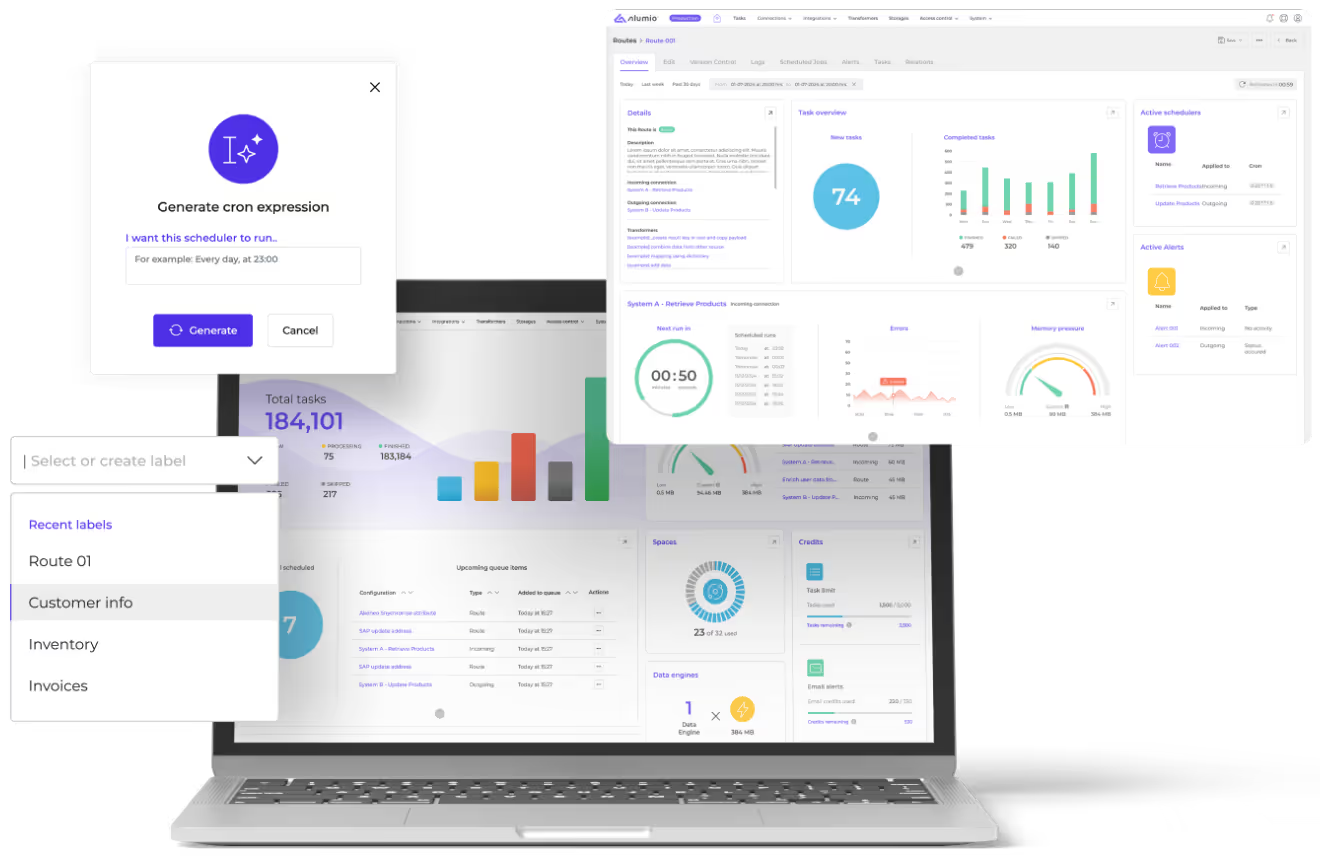
By centralizing all connected systems and data from various relevant sources on one scalable platform, the Alumio iPaaS presents a clear visual overview of a business’s entire IT ecosystem. This provides the operational agility needed to easily add or replace software integrations as a business grows, and to meet evolving market demands. In this regard, the Alumio iPaaS helps businesses avoid having to invest heavily in developing their internal integration solutions, in their quest to achieve digital transformation.
Read more about how an integration platform helps optimize the Value Chain for businesses.
The benefits of using the Alumio iPaaS for digital transformation:
- Rapidly connect new systems
Swiftly integrate multiple new cloud apps or SaaS, without custom code and with real-time data sharing. Use pre-built connectors to implement faster integrations with popular software.
- Automate business processes
The Alumio iPaaS provides integration tools to build and schedule complex workflows to automate a series of repetitive, manual processes across integrations.
- Upgrade legacy systems
Simplify the integration of legacy systems and old-school ERPs with modern, cloud-based, customer-facing applications.
- Enable data synchronization
Use powerful data mapping and transformation features, prevent data siloes, and ensure data is consistent, up-to-date and shared in real-time across all business departments.
- Get real-time error detection
The automated monitoring and logging that the platform provides also help instantly detect data errors, API conflicts, or faulty integrations, saving troubleshooting time and cost.
- Enable data security and compliance
Centralize all integrations and data on one secure cloud space to eliminate data silos and comply with key privacy legislations like GDPR.
- Ensure business continuity
Organize a secure IT ecosystem that can act upon any worst-case scenario. Buffer all data, quickly change connected systems, and receive automated monitoring and logging to ensure data security.
However, before speeding into the future of integrations with the Alumio iPaaS, are you looking to fully explore why businesses really need digital transformation? To explore all the business benefits and the different systems that the Alumio iPaaS helps businesses integrate for digital transformation, download the full white paper: Simplifying digital transformation with the Alumio iPaaS.
Looking to experience first-hand how the Alumio iPaaS helps simplify software integrations for digital transformation? Click here to get a personalized demo from one of our integration specialists.





.svg)
.svg)
.svg)
.svg)
.svg)
.svg)
