

A Alumio vivid purple arrow pointing to the right, a visual representation of how to access more page material when clicking on it.
Go back

Reduce Total Cost of Ownership with the Alumio iPaaS

By
Saad Merchant
Published on
September 19, 2022
Updated on
June 24, 2026
IN CONVERSATION WITH
Email icon
Email icon

Most modernizing businesses seek to digitalize and automate their business processes by integrating software solutions and cloud applications. While the traditional way to develop these integrations involves writing custom code, most companies are starting to use a next-gen integration solution called the iPaaS (integration Platform as a Service). The Alumio iPaaS is a cloud-based integration platform that helps simplify how businesses develop and govern software integrations with minimal IT support. While there are many cost optimization benefits of creating integrations with the Alumio iPaaS instead of with custom code, one of its key business benefits is reduced TCO (Total Cost of Ownership).

3 ways the Alumio iPaaS helps reduce cost of ownership

For businesses that identify departments or processes with high cost of operations, the Alumio iPaaS (integration Platform as Service) offers them the flexibility to integrate any software solution rapidly. These integrations help automate repetitive manual processes, reduce the operational risks of human error, and enable businesses to optimize how they use skilled employees to develop newer solutions.

When it comes to developing and managing integrations themselves, the Alumio iPaaS provides key operational advantages that help businesses significantly lower TCO (Total Cost of Ownership):

1. Making integrations simple for developers and non-coding professionals

Where once only coding experts could develop and monitor integrations, the Alumio iPaaS enables junior developers, project managers, data experts, and even business users with data management skills to create and govern integrations. This helps significantly reduce costs in regard to hiring, outsourcing, and third-party dependency.

More importantly, as a low-code solution, the Alumio iPaaS doesn’t just free Senior Developers to focus on building solutions that still require coding expertise. Rather, it provides advanced integration tools and flexible features that these developers can use to build complex custom integrations, better suited to tackle the specific needs of your business.

2. Reducing troubleshooting costs with automated logging

Eliminating the need to create custom code integrations and centralizing all data and software connections on one platform, the Alumio iPaaS makes it significantly easier to detect and resolve integration errors from one interface.

Additionally, the platform’s automated Monitoring and Logging features help keep track of every process, data transfer, request, and change across all integrations. It also helps instantly detect any integration errors or API conflicts, which users can swiftly troubleshoot and resolve via an intuitive dashboard. This helps save significant time and labor costs.

3. Eliminating black boxes and budget overruns

When governing custom code integrations, the data logic that connects the integrated software solutions is incomprehensible to project managers and business owners, who lack coding expertise. This is called a ‘black box problem’ because all the processes and data of the integration cannot be fully seen or comprehended by everyone involved in the project. It results in hidden and unpredictable costs.

In such a black box scenario, integration specialists or developers may request unrealistic budgets for integration fixes and improvements. Alternatively, they may find themselves hard-pressed to present visual evidence for genuine budget requirements. At the same time, business owners aren’t assured enough to allocate appropriate budgets or IT resources to mitigate integration errors quickly. This makes it difficult to plan fixes, improve current integrations, or add new APIs and software connections.

On the other hand, the Alumio iPaaS is designed to eliminate these black box problems. It makes all integrations and data flows visible on one user-friendly interface, which developers, project managers, and business owners can understand and collaborate upon. By presenting a clear overview of built logic versus agreed-upon logic, the platform helps identify any extra data logic that needs to be created or improved. But, most importantly, the Alumio iPaaS presents predictable pricing models for building these fixes and improvements, or for upscaling integrations.

“For C-level and IT managers: the real-time data integration capabilities and centralized data control of the Alumio iPaaS help prevent costly, manual data entry delays and data siloes, which result in hidden costs.”

For businesses that identify departments or processes with high operational costs, the Alumio iPaaS offers them the flexibility to integrate any software solution rapidly. These integrations help automate repetitive manual processes, reduce the risks of human error, and enable businesses to optimize how they use skilled employees to develop newer solutions.

Apart from helping businesses significantly reduce ownership costs, the Alumio iPaaS also offers two other major cost optimization advantages. To discover, please read:

However, if you’d like to read all the financial benefits that the Alumio iPaaS results in, download the full whitepaper - ‘Cost Optimization Benefits of an iPaaS’.

Want to get a practical demonstration of how the Alumio iPaaS works and reduce cost of ownership? Click here to get a personalized demo by one of our integration specialists.


Turn AI ambition into action

Portrait of Leonie Becher Merli, Business Development Manager at Alumio

Get a free assessment of your integration needs and next steps

Portrait of Leonie Becher Merli, Business Development Manager at Alumio

No items found.
Topics in this blog:
No items found.

FAQ

Integration Platform-ipaas-slider-right
How does the Alumio iPaaS reduce Total Cost of Ownership for system integrations?

Alumio reduces Total Cost of Ownership by turning integration from a recurring, high-variable-cost activity (custom developer time for each build and every maintenance fix) into a predictable infrastructure cost. The mechanisms are: prebuilt connector templates that cut initial build effort, config-based maintenance that replaces code changes with configuration updates, centralized monitoring that shortens incident detection and resolution, and platform-managed connector updates that remove the API version maintenance burden that otherwise falls on custom integration teams. Pricing scales with the number of integrations, not data volume.

Integration Platform-ipaas-slider-right
What are the hidden costs of custom integration that businesses often discover too late?

The hidden costs most commonly discovered too late are: knowledge lock-in (when the developer who built the integration leaves, the cost of understanding and maintaining it rises dramatically), update overhead accumulation (each ERP and e-commerce platform update requires testing custom integrations and often rewriting parts of them), silent failure cost (when custom integrations fail without alerting anyone, the operational damage: overselling, missed orders, reconciliation errors: accumulates before discovery), and opportunity cost (developer time spent maintaining legacy custom integrations cannot be spent on new digital capabilities that generate revenue).

Integration Platform-ipaas-slider-right
How does Alumio's pricing model compare to the cost of custom integration development?

Alumio's subscription pricing converts the highly variable cost of custom integration (developer time at senior rates, per project) into a predictable monthly or annual cost that covers the platform, connector library, monitoring, and connector maintenance. For a business managing five active integrations, the Alumio subscription typically costs less than the equivalent developer time for building and maintaining those five connections with custom code, and provides monitoring and governance capabilities that custom code rarely includes. The more integrations an organization manages, the more favorable the economics become as each additional connection benefits from the existing platform investment.

Integration Platform-ipaas-slider-right
What TCO calculation should businesses perform before investing in an iPaaS?

The TCO calculation should include over a three-year horizon: current integration costs (developer time for all existing integrations, estimated at annual hours multiplied by fully-loaded developer cost), projected integration growth costs (new integrations anticipated over the period, estimated at typical project cost), incident response costs for current integration failures (hours per incident multiplied by incidents per year), and platform subscription cost for the iPaaS. The comparison should also account for the revenue impact of integration quality improvements: fewer oversells, faster time-to-market for new channels, and improved data quality for AI and analytics investments.

Integration Platform-ipaas-slider-right
How does reducing integration maintenance cost free up IT capacity for strategic work?

Reducing integration maintenance cost frees IT capacity because integration maintenance in custom-code landscapes is a significant and growing consumer of developer attention: a team managing ten custom integrations may spend 30 to 50 percent of development capacity on maintenance rather than new capabilities. Migrating to an iPaaS with config-based maintenance typically reduces this to 10 to 15 percent of development capacity, freeing the remaining capacity for the strategic digital initiatives (new channels, AI integration, analytics platforms) that generate competitive differentiation. This capacity shift is often the most compelling part of the iPaaS business case for IT leaders facing growing digital roadmaps with fixed team sizes.

Integration Platform-ipaas-slider-right
What benchmarks should businesses use to evaluate whether their current integration TCO is too high?

Useful benchmarks are: if integration maintenance consumes more than 25 percent of total development capacity, TCO is too high; if the average time to diagnose and resolve an integration failure exceeds four hours, monitoring and governance investment is insufficient; if more than one integration requires a specific developer to understand and maintain it, knowledge concentration risk is creating hidden TCO; and if the time from decision to connected new system exceeds eight weeks for a standard business system integration, the current approach is limiting digital agility in ways that have measurable business cost. Each benchmark translates integration management quality into financial and organizational terms that support the case for platform investment.

Get a free assessment of your integration needs

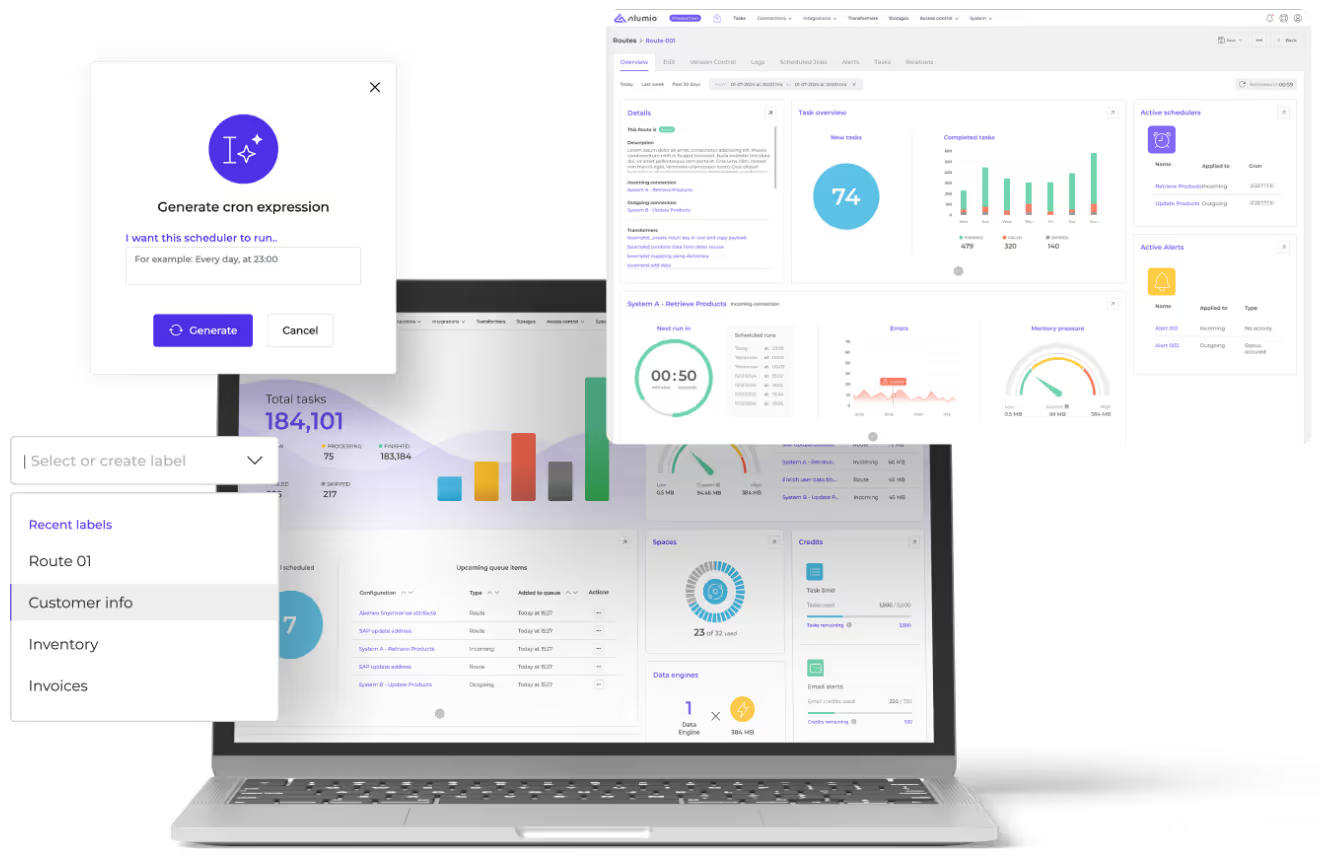
Laptop screen displaying the Alumio iPaaS dashboard, alongside pop-up windows for generating cron expressions, selecting labels and route overview.