

A Alumio vivid purple arrow pointing to the right, a visual representation of how to access more page material when clicking on it.
Go back

Improve time to market with the Alumio iPaaS

By
Saad Merchant
Published on
September 19, 2022
Updated on
June 24, 2026
IN CONVERSATION WITH
Email icon
Email icon

In today's fast-paced digital world, faster “Time to Market” is more than a buzzword! It refers to an organization's ability to bring new products and services to market faster than ever before. To enable this, enterprises implement many new SaaS solutions and cloud apps. However, to unlock the full potential of these apps, businesses need to integrate them to get them to work together and share data and services seamlessly. The traditional (time-consuming) way to build these integrations involves building point-to-point connections with custom code. The Alumio iPaaS (integration Platform as a Service) emerged as a faster way to build multiple integrations with all kinds of systems, apps, and data sources - without any custom code - ensuring cost optimization with improved Time to Market.

How the Alumio iPaaS helps improve TTM (Time to Market)

The Alumio iPaaS (integration Platform as a Service) is a cloud-based, low-code middleware solution that helps simplify how businesses develop and govern software integrations, with minimal IT support. As an API-driven solution, it enables businesses to rapidly deploy integrations with multiple systems, SaaS, cloud apps, and data sources via one user-friendly, web interface, without the need for custom code.

This involves businesses integrating legacy systems and new cloud apps, including ERP systems, e-commerce platforms, PIM, WMS, CRM, and more. In other words, the Alumio iPaaS helps businesses launch, test, and improve products and services for digital commerce, significantly faster. Thus, while there are many cost optimization benefits of creating integrations with the Alumio iPaaS, one of the key business benefits that it provides is that it ensures faster Time to Market (TTM).

How iPaaS integrations result in faster Time to Market

Let’s assume a business is preparing for a Seasonal Sale that is to take place in a month. To optimize the product experience and boost sales, the business decides to integrate its e-commerce platform with a PIM (Product Information Management) system. However, the e-commerce platform is also integrated with the business’s ERP (Enterprise Resource Planning) system, which means that the PIM system will have to be integrated with two connected endpoints (e-commerce to ERP).

Creating these point-to-point integrations (with custom code) and ensuring full data integrity within a month is too much of an operational risk. On the other hand, the Alumio iPaaS can be used to create seamless cross-platform application integrations within a matter of weeks. In this case, it means the Alumio iPaaS can help seamlessly integrate the e-commerce platform, the ERP, and the PIM system altogether, with seamless data exchange and data synchronization capabilities. What’s more - businesses can easily add more systems and software to this integration, without loss of data integrity.


Read a case study on how Verfwinkel.nl, a leading paint and supplies retailer in the Netherlands, used the Alumio iPaaS to seamlessly integrate four systems (ERP, E-commerce, PIM, and WMS), building workflows to automate business processes across all connections.

3 benefits the Alumio iPaaS provides to improve TTM (Time to Market)


Some of the many ways by which the Alumio iPaaS helps businesses achieve faster Time to Market is by enabling them to:

Seamlessly add or interchange integrations: The Alumio integration platform enables businesses to seamlessly add new software connections to existing integrations with support for REST, Custom HTTP, FTP, VPN, database connections, and many more. If a connected application needs to be removed or exchanged with a new application, the Alumio iPaaS provides the integration flexibility needed to seamlessly replace the application with a new one, without any loss of data integrity. This enables businesses to freely experiment with integrating newer applications to improve Time to Market.

Use connector packages as an integration shortcut: To integrate popular software faster, the Alumio iPaaS provides a growing selection of connectors (pre-built integrations). Deploying these connectors helps configure integrations in The platform also offers integration tools to flexibly modify and adjust these ready-to-use integrations to suit specific business needs. Users can also save and reuse the configurations of any new integrations they build with the Alumio iPaaS.

✓ Enable workflow automation: Apart from automating how digitally transforming businesses integrate systems, apps, and data sources, the Alumio iPaaS also helps build process automation workflows between all integrated systems. This helps automate repetitive manual processes, where for instance (in context to the previously stated example), it can enable sending real-time product stock updates from the ERP system to the e-commerce platform and PIM system. This workflow automation is also useful for enabling faster Time to Market by automating data entry work and scheduling daily, weekly, or even monthly tasks.

Apart from helping businesses significantly improve Time to Market, the Alumio iPaaS offers two other major cost optimization advantages. To discover, please read:

However, if you’d like to read all the financial benefits that the Alumio iPaaS provides enterprises, download the white paper - ‘Cost Optimization Benefits of an iPaaS’.

If you’re looking to get a first-hand experience of how the Alumio iPaaS can help you cost-optimize your business with software integrations? Click here to get a personalized demo by one of our integration specialists.


Turn AI ambition into action

Portrait of Leonie Becher Merli, Business Development Manager at Alumio

Get a free assessment of your integration needs and next steps

Portrait of Leonie Becher Merli, Business Development Manager at Alumio

No items found.
Topics in this blog:
No items found.

FAQ

Integration Platform-ipaas-slider-right
What is time to market and why does it matter in digital business?

Time to market is the duration between the decision to launch a new product, channel, or capability and its availability to customers. In digital business, time to market determines competitive positioning: a new channel launched two months before a competitor captures market share that is difficult to recover; a new product line available online before a trade show drives pre-show demand that would otherwise be lost. For e-commerce businesses in particular, the ability to add new capabilities quickly (new payment methods, new marketplaces, new AI features) is a direct competitive differentiator.

Integration Platform-ipaas-slider-right
How does the Alumio iPaaS improve time to market for new digital capabilities?

Alumio improves time to market by providing the integration infrastructure that connects new digital capabilities to the existing system landscape without custom development from scratch for each new connection. When a business decides to launch on a new marketplace, add a new ERP module, or deploy a new AI personalization tool, the integration team uses Alumio's prebuilt connector templates and existing backbone rather than building and testing a new custom integration. The time savings accumulate: each new capability benefits from the connector library and governance patterns already in place, making the marginal integration effort per new capability decrease as the backbone matures.

Integration Platform-ipaas-slider-right
What integration bottlenecks most commonly slow time to market for new systems?

The most common integration bottlenecks are: the absence of a prebuilt connector for the new system (requiring a custom build from scratch), data mapping complexity when the new system's data model is significantly different from existing systems, UAT cycles that run longer than planned because integration failures surface edge cases in data quality, and resource constraints when the integration team is the bottleneck for multiple simultaneous integration projects. A mature integration backbone addresses the first three directly; organizational planning and platform tooling (like Alumio's config-first approach) address the fourth by reducing the specialist expertise required per integration project.

Integration Platform-ipaas-slider-right
How does a config-first integration platform reduce the time required to connect new systems?

A config-first integration platform reduces connection time because the API communication layer (authentication, request formatting, response parsing) is provided by the prebuilt connector template, and the integration logic (field mapping, transformation rules, flow triggers) is expressed through platform configuration rather than custom code. For a common integration combination (a new e-commerce platform to an existing SAP ERP), the connector templates establish both connections as a starting point, and the project focus shifts to the data mapping phase, which is typically more business knowledge than technical, and therefore faster to execute with business and IT working together.

Integration Platform-ipaas-slider-right
What is the relationship between integration maturity and digital agility?

Integration maturity and digital agility are directly correlated: organizations with a governed integration backbone can adopt new digital capabilities faster than those still managing each system connection as a custom project, because each new capability connects to an existing infrastructure rather than requiring bespoke development. The more mature the integration backbone (more connectors in the library, more transformation patterns established, more reusable Route components), the faster the organization can respond to new market opportunities. This is the compounding return of integration infrastructure investment: the backbone becomes more valuable with every new system added to it.

Integration Platform-ipaas-slider-right
How does Alumio's connector library specifically accelerate time to market for common platform combinations?

Alumio's connector library accelerates time to market for common platform combinations (Shopify-to-SAP, Akeneo-to-Adobe Commerce, Dynamics 365-to-Shopware) by providing pretested, maintained starting points for both ends of each connection. For these combinations, the integration project begins from a working connection rather than a blank page, and the effort concentrates on the data mapping and business logic phase. Alumio's Solutions Engineering team provides scoping support to sequence the data mapping phase efficiently, further reducing the time from project kick-off to first data flowing in production.

Get a free assessment of your integration needs

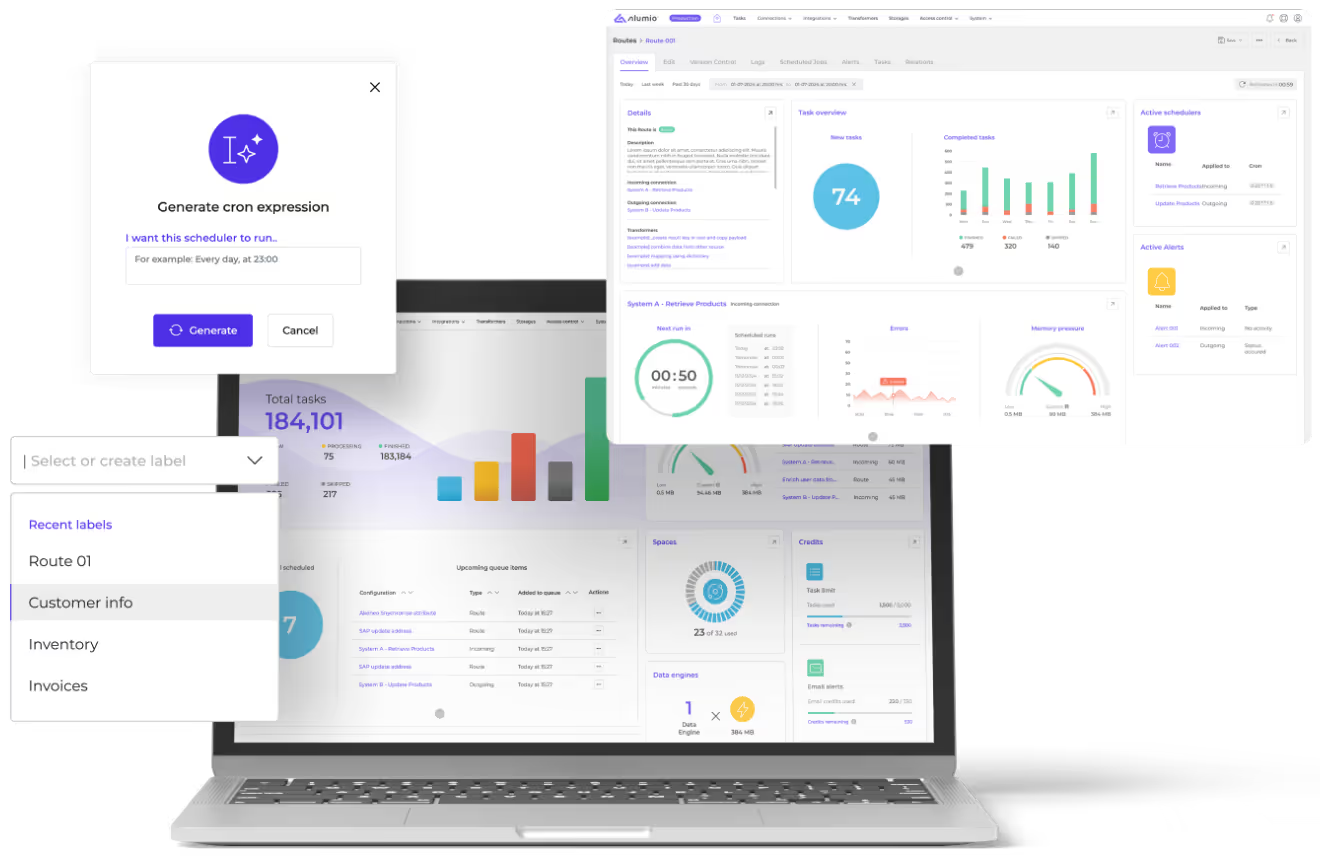
Laptop screen displaying the Alumio iPaaS dashboard, alongside pop-up windows for generating cron expressions, selecting labels and route overview.