

See where the return sits in your own system landscape

Book an assessment
A Alumio vivid purple arrow pointing to the right, a visual representation of how to access more page material when clicking on it.
Go back

How integrations improve ROI across industries

By
Saad Merchant
Published on
October 9, 2026
Updated on
October 9, 2026
IN CONVERSATION WITH
Email icon
Email icon

Businesses select each system for what it does on its own. The ERP (enterprise resource planning) system runs the operation, the webshop takes orders, and the warehouse system tracks stock. Getting data from one to another means writing custom code or having someone retype it. Both limit what you get back. Every vendor API (application programming interface) change becomes a rebuild, every new channel a fresh build, and maintenance costs grow until they cancel the saving. An iPaaS (integration Platform as a Service) removes that limit. Each system connects once, every connection is reusable, and the return grows as you add systems. A manufacturer recovers production time. A wholesaler gets a price change into every channel the same afternoon. A retailer can sell stock from any location. That is the ROI you get from connecting your systems, and the second integration costs less than the first.

Why custom code and manual work cap your ROI

Traditionally, businesses exchange data between systems in two ways without a platform. Someone retypes it, or a developer writes custom code for it. Both work, and both stop working at a predictable point.

A script connecting the webshop to the ERP works until a vendor changes an API, then needs a developer. A person retyping orders works until volume doubles. Neither problem appears in the business case, because both arrive after it is approved.

An integration pays back in two ways. Work stops. Nobody retypes orders, chases missing data, or maintains the spreadsheet that translates one system's article numbers into another's. Work also becomes possible. A marketplace opens because the product data already flows. A customer orders at midnight because the price on screen matches the price in the ERP.

In the projects we see, the return flattens after the third or fourth custom connection, because maintenance grows faster than the connections do. Workflow automation tools hit the same ceiling from the other side. They handle one step between two apps and offer nowhere to see every flow at once.

What that integration ceiling costs depends on your industry. A manufacturer loses production hours. A wholesaler loses days selling at the old price. A retailer loses stock sitting in a store the webshop cannot see.

Manufacturing systems integration: the production time you recover

A manufacturer runs an ERP surrounded by production, quality, and supplier systems. The largest return is time the plant would otherwise spend waiting.

Production orders released continuously rather than overnight keep equipment working through the shift instead of in bursts. Equipment that has the item data it needs runs the task. Without that data, the task goes back to an operator. Both convert capacity the business has already paid for into output.

Accurate stock against production is the second. Morssinkhof connects Microsoft Dynamics 365 F&O, Shopware, and its PIM (product information management) system through one integration layer, replacing 25 scattered applications with a single point of connection. Delivered with partner Sinsou, it keeps stock for around 5,000 products checked every 15 minutes. Planning against current figures means less buffer stock and fewer unplanned stops.

The third is traceability. Where production, quality, and dispatch records share data, assembling a batch history for an auditor is a query rather than a quality manager's week. Wholesale and distribution lose their time somewhere else entirely.

Wholesale and distribution integration: speed to every channel

Wholesale sells to businesses, which means customer-specific pricing, customer-specific catalogues, and ordering through portals or EDI (Electronic Data Interchange). Distribution adds the warehouse, the carriers, and returns. Both gain most from speed.

A price revision has to reach the webshop, the sales team, the marketplaces, and the customer's procurement system. Doing that the same day protects the margin on everything sold after it. B&S International automates over 4 million price updates and data changes daily across multiple channels, and has brought data tasks that used to run for weeks down to days. Its business analysts adjust the flows themselves, which is what holds the gain in place after the project ends.

Catalogue size makes the same problem bigger. AGU connects its Centric ERP to Adobe Commerce for stock, prices, and shipment data, and to Akeneo for products, categories, and attributes, across more than 25,000 products.

For distribution, warehouse management integration means the WMS (warehouse management system) and the ERP hold the same stock figure. That means fewer pick errors, less overselling, and a service level the sales team can commit to.

For both, the gain grows with the next channel or the next location. Connections already built get reused, so opening a new market costs a mapping rather than a project.


Turn AI ambition into action

Portrait of Leonie Becher Merli, Business Development Manager at Alumio

Get a free assessment of your integration needs and next steps

Portrait of Leonie Becher Merli, Business Development Manager at Alumio

Connect orders, prices, stock, and product data on one integration platform

Connect orders, prices, stock, and product data on one integration platform

Retail and e-commerce ERP integration: stock you can sell anywhere

Retail gains most from knowing where stock is and being able to sell it from any location. An item visible in a store but invisible to the webshop is stock the business paid for and cannot move. Once both read the same figure, the same item is sellable from either.

How quickly data moves is the return retailers underestimate. Selfmade replaced nightly synchronisations with hourly ones, cutting data lag from roughly 24 hours to between 30 and 60 minutes across its e-commerce and retail channels. It also brought integration management in-house, so its own IT team can see and change what runs.

Returns are the second. Where the webshop receives the return the moment a store colleague processes it, the item goes back on sale that day instead of at the end of the week.

The third is what the webshop enables rather than what it sells. A customer checks availability online, then buys in store. A colleague on the shop floor places an order through the webshop. Connected data created both sales, and another channel records them.

Professional services firms gain somewhere different again, which is covered in why agencies and system integrators use an iPaaS. What all of them share is that the gain either grows or stalls depending on how the connections were built.

How an iPaaS raises integration ROI over time

An iPaaS works as a shared layer between business systems: each one plugs in once, and the platform carries data to wherever it is needed. Businesses use it for everyday work: orders from the webshop into the ERP, stock and prices back out, product data to every channel.

Because each connection is configured rather than written from scratch, it can be reused, extended, and changed without a rebuild. The Alumio iPaaS provides features that can be configured to keep the return climbing:

  • The next channel starts from the last one: connections built for one channel can be reused for the next, so expansion starts from data that already flows
  • Your own analysts can change a flow: connections are config-first, with the Code Transformer there when an edge case genuinely needs code
  • Problems surface before customers do: monitoring and logging show which messages moved and which failed, so a missed order is picked up early rather than at month end
  • You can see what runs and who changed it: version history means the business is not dependent on one developer remembering how a connection works

A landscape of custom connections gets more expensive with every system added. A platform gets cheaper. Where that return is largest still depends on which business you are running.

Where your integration ROI is largest

Not every industry gains in the same place. A manufacturer gets most from production continuity, a wholesaler from speed to channel, a retailer from stock visibility. Knowing which you are tells you where integration ROI is worth measuring first.

In the projects we see, the businesses that get the most back start with the connection carrying the most volume, then reuse it. The second integration is cheaper than the first, and the fifth cheaper again.

What that leaves is a system landscape that pays back more with every system you connect.

No items found.

FAQ

Integration Platform-ipaas-slider-right
What return should a business expect from connecting its systems?

Two kinds. Work that stops, including retyping between systems, developer time spent repairing connections after a vendor changes an API (application programming interface), and the cost of errors nobody caught in time. And work that becomes possible, such as a marketplace that can open because product data already flows, or B2B orders placed outside office hours because pricing is accurate on screen. The second is usually larger and is the one most business cases omit.

Integration Platform-ipaas-slider-right
Why does custom code limit what an integration returns?

A custom script performs well for one connection between two systems. Each additional connection adds its own maintenance, its own documentation, and its own dependency on whoever built it. Because that overhead grows with every system added, the cost side rises as the landscape grows, which erodes the return the business case promised.

Integration Platform-ipaas-slider-right
What does manufacturing systems integration return?

Mainly recovered production time. Continuous order release keeps equipment working through the shift rather than between batches, and complete item data stops tasks falling back to operators. Accurate stock against production reduces buffer inventory and unplanned stops. Shared production, quality, and dispatch records also turn a batch history for an auditor into a query rather than a manual exercise.

Integration Platform-ipaas-slider-right
What does integration return in wholesale and distribution?

For wholesale, speed. A price revision or new product reaching the webshop, the sales team, the marketplaces, and customer procurement systems the same day protects margin and avoids corrections. For distribution, warehouse management integration that leaves the WMS and the ERP reading one figure, which reduces pick errors and overselling. For both, each new channel or location reuses connections already built.

Integration Platform-ipaas-slider-right
What does e-commerce ERP integration return in retail?

Stock visibility across stores and online, so an item can be sold from wherever it sits. Faster data cycles shorten the gap between a sale and the figure every channel sees. Returns processed in store become sellable again the same day. The webshop also enables revenue that lands in other channels, including orders placed with a colleague on the shop floor.

Integration Platform-ipaas-slider-right
How quickly does an integration platform pay for itself?

It depends on how many systems need connecting and how often they change. A business with two stable connections that rarely change may find a documented custom script cheaper. The balance shifts as systems are added, replaced, or upgraded, because platform connections are reused while custom ones are rebuilt. For a landscape expected to grow, the crossover usually arrives within the first few additional integrations.

Get a free assessment of your integration needs

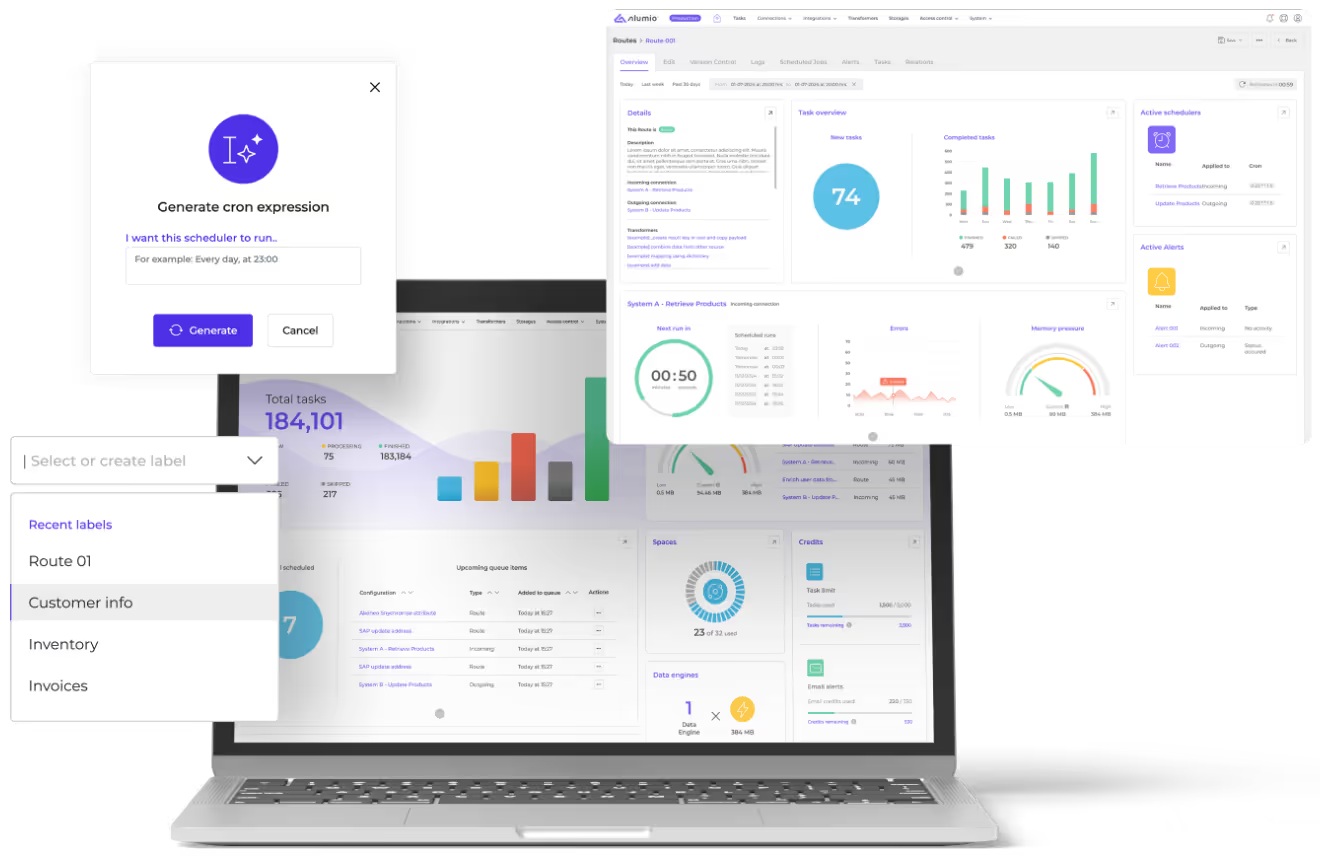
Laptop screen displaying the Alumio iPaaS dashboard, alongside pop-up windows for generating cron expressions, selecting labels and route overview.