


Looking to connect AI to your full operational stack?

Explore the Alumio AI Playbook
A Alumio vivid purple arrow pointing to the right, a visual representation of how to access more page material when clicking on it.
Go back

Why your AI ROI calculation is missing the integration variable

By
Saad Merchant
Published on
May 29, 2026
Updated on
June 1, 2026
IN CONVERSATION WITH
Email icon
Email icon

AI investment decisions are getting harder, not easier. Boards demand hard ROI. Vendors promise dramatic productivity gains. And the gap between projected and realized returns keeps widening across most organizations. The standard AI ROI calculation looks at tool cost versus productivity gain, with implementation work footnoted as a setup expense. That calculation produces the wrong number, because it treats the integration layer as a hidden cost rather than as the variable that determines whether AI delivers returns at all. The real picture is that AI ROI compounds with integration depth. Shallow integration AI delivers cost savings, mid-depth integration AI delivers revenue gains, and deep integration AI delivers business model change. The tools used at each level matter far less than the integration architecture underneath them. Organizations that include integration as a variable in their AI ROI math make better investment decisions and avoid the disappointing returns that come from buying AI tools without the foundation to run them.

Most AI ROI calculations are wrong by design

The standard AI ROI calculation has three variables: tool cost, productivity gain, and time horizon. The math runs as productivity gain minus tool cost over the time horizon, with everything else treated as setup overhead. That calculation is intuitive, defensible to a CFO, and consistently produces optimistic projections that the business then fails to hit.

What's missing is the integration variable. What helps in enabling AI tools deliver productivity gain is delivering current, integrated data to operate on. When the integration layer is shallow, the AI delivers a fraction of its projected productivity gain because it's working on partial data. When the integration layer is mid-depth, AI starts producing the gains the original calculation promised. When the integration layer is deep, AI begins delivering returns that the original calculation never even modeled, because the use cases that emerge at that depth weren't included in the forecast. The integration layer is doing most of the heavy lifting in any actual AI ROI outcome, but it's the variable the calculation pretends doesn't exist.

Why does the integration layer get left out of AI ROI math?

The integration layer gets left out of AI ROI math because integration costs hide in IT budgets while AI costs sit in dedicated AI line items. When the CFO asks, "What did the AI investment return?", the answer compares the AI line item to measurable productivity outcomes, with the integration work footnoted as implementation expense that already got approved separately.

That accounting structure feels reasonable. AI is the new investment, integration is part of existing IT operations, and the two budgets shouldn't get muddled. But it produces a misleading picture of what's actually driving the return. The integration work done to make the AI tool useful is functionally part of the AI investment. Treating it as separate creates two problems: AI ROI looks better than it is on paper because the integration cost isn't allocated against it, and the integration team's contribution to AI outcomes goes unrecognized.

The result is predictable. Boards see disappointing AI returns, conclude the AI tools are weak, and pressure for either replacement or pullback. The integration layer that was actually doing most of the work doesn't get credited or resourced. Next year's AI investment cycle starts with the same flawed math, and the same disappointing outcome follows.

Where does AI ROI actually come from?

AI ROI actually comes from three tiers, each correlated with integration depth. The tier the AI investment lands in determines what kind of return is possible, not the AI tool selected.

Tier 1 is cost savings, delivered through shallow-integration AI. A chatbot accessing a single CRM, a content generator integrated to one CMS, an analytics assistant querying one data warehouse. Productivity gains here are real but modest, because each AI use case is constrained by the single system it can see. Typical ROI in this tier is 10-30% productivity improvement on the specific workflow the AI touches.

Tier 2 is revenue gains, delivered through mid-depth integration AI. Predictive scoring that pulls from CRM, ERP, and commerce platform together. Personalization that uses real-time inventory and customer history. Demand forecasting that combines sales, supply chain, and external signals. The integration work to feed these models is significant, but the returns are also categorically larger, because revenue-side AI use cases scale with business volume rather than with labor hours saved.

Tier 3 is business model change, delivered through deep-integration AI. Autonomous workflows that span the whole operational stack. Dynamic pricing that adjusts based on margin, inventory, demand, and competitor signals simultaneously. Predictive maintenance that prevents downtime across asset classes. These returns are hardest to model upfront because they create new business capabilities rather than improving existing ones, but they're also the returns that move the company's enterprise value rather than just its operating margin.

What changes when integration depth is included in the AI ROI calculation?

Including integration depth changes three things in the AI ROI calculation: which tier of returns is realistic, what the actual cost of those returns is, and which sequence of investments produces the best long-term outcome.

The realistic returns tier comes from honest assessment of current integration depth. A business with mostly point-to-point integrations and batched data flows is in Tier 1 territory regardless of which AI tools it buys. Forecasting Tier 2 or Tier 3 returns from that starting point is wishful thinking. Honest tier assessment prevents the over-promising that makes AI investments look like failures.

The actual cost picture changes when integration work is allocated against the AI investment. AI tool cost plus integration cost is a meaningfully different number than AI tool cost alone, and it forces the business to evaluate whether the integration foundation is worth building for one AI use case or several. Most businesses find that the integration foundation is hugely worth building if multiple AI use cases are coming, and significantly less worth building for one isolated use case.

The investment sequence question is the most consequential. If integration depth determines which tier of returns is possible, the investment sequence that maximizes ROI is integration foundation first, AI tools second. Most businesses run the opposite sequence, buying AI tools first and discovering the integration gap when productivity gains don't show up. The corrected sequence produces faster time-to-value for every AI investment that follows.

How an integration platform changes the AI ROI calculation

The Alumio integration platform-as-a-service (iPaaS) is a cloud-native solution that handles the integration work AI ROI depends on. Rather than building one-off integrations between each AI tool and each underlying system, an iPaaS centralizes connectivity, transformation, validation, and observability across the stack.

The Alumio integration platform provides this foundation for businesses building toward Tier 2 or Tier 3 AI returns. In practice, it does three things that change the ROI calculation. It moves data between ERP, CRM, commerce, and operational systems in real time, replacing the batched flows that limit AI to Tier 1. It transforms and normalizes that data into structures AI tools can consume, eliminating the per-tool integration work that inflates AI implementation costs. It maintains observability across the data flows, which is what makes the returns measurable rather than hypothetical.

The ROI implication is that the integration foundation is reusable across AI use cases. The first AI use case carries the full integration cost, but the second, third, and fifth use cases run on the same foundation at marginal incremental cost. That changes the math significantly. AI ROI calculated on a single use case looks weak. AI ROI calculated across a portfolio of use cases sharing the integration foundation looks strong.

Many Alumio deployments happen through certified system integrators and digital agencies who bring the ROI modeling experience to design the foundation right at the first AI engagement, so the second and third investments don't require rework.


Turn AI ambition into action

Portrait of Leonie Becher Merli, Business Development Manager at Alumio

Get a free assessment of your integration needs and next steps

Portrait of Leonie Becher Merli, Business Development Manager at Alumio

Ready to fix the variable your AI ROI math is missing?

Ready to fix the variable your AI ROI math is missing?

Where to start when building AI ROI on a stronger integration foundation

The starting point is honest tier assessment. Most businesses don't know which tier their current integration depth supports, which means their AI investments get sized for returns the architecture can't deliver. A quick assessment maps the current state: which systems are connected, how often data flows between them, what AI use cases would require which additional connections, and which tier of return each use case targets.

That assessment produces a realistic AI ROI forecast for the next twelve to eighteen months. The forecast usually surprises both directions. Some AI investments get downgraded because the integration depth required isn't there. Other AI investments get upgraded because the integration foundation already exists and could support more ambitious use cases than were being considered.

The next move is sequencing the investments to compound. Build the integration foundation for the highest-value AI use case first. Use the same foundation to extend into adjacent use cases at lower marginal cost. Track ROI by use case rather than by tool, so the compounding effect of the integration investment becomes visible to the people deciding next year's budget.

This sequencing approach beats the prevailing “buy more AI” approach not by spending less on AI, but by getting more out of every dollar spent on AI through the integration foundation underneath. Boards that see this math work once tend to fund the next integration investment without resistance.

The AI ROI conversation is becoming an integration conversation

The next phase of AI adoption in business is going to be defined by which organizations can honestly measure and predict AI returns. The organizations still calculating AI ROI by tool cost and productivity gain alone are going to keep producing the disappointing outcomes that pull AI budgets back. The organizations that include integration depth as a variable in the math are going to forecast more accurately, invest more confidently, and deliver the compounding returns that move enterprise value over time.

The strategic shift worth absorbing is that AI ROI is a function of integration architecture, not of AI tool selection. The AI tool market is competitive and converging. The integration foundation underneath is durable, differentiating, and the actual source of long-term AI returns. Organizations that recognize this allocate their investment differently, with the integration layer treated as the foundation that AI runs on rather than as a hidden cost line.

The conversation is moving in this direction whether individual organizations move with it or not. Boards are getting more sophisticated about AI investment scrutiny. CFOs are demanding clearer accounting for AI returns. CTOs are recognizing that the integration layer is doing more work than the budget reflects. The organizations that get ahead of this shift will define the next phase of AI maturity, while those that don't will keep funding AI investments that underperform the spreadsheet they were sold on.

No items found.

FAQ

Integration Platform-ipaas-slider-right
What is AI integration ROI?

AI integration ROI is the return on investment generated by combining AI tools with the integration layer that connects them to the data and systems they operate on. Unlike standard AI ROI calculations that only count tool cost against productivity gain, AI integration ROI accounts for the integration work that determines whether AI can deliver the projected returns in practice. Including integration depth as a variable produces more accurate ROI forecasts.

Integration Platform-ipaas-slider-right
Why is AI ROI usually calculated incorrectly?

AI ROI is usually calculated incorrectly because integration costs and contributions get hidden in IT operations budgets rather than allocated against the AI investment they enable. The standard calculation compares AI tool cost to productivity gain, treating integration as setup overhead. This produces optimistic forecasts that the business then fails to hit, because the integration depth required for the projected returns wasn't included in the math.

Integration Platform-ipaas-slider-right
How does integration depth affect AI returns?

Integration depth affects AI returns by determining which tier of value the AI can deliver. Shallow integration supports Tier 1 returns (cost savings on isolated workflows), mid-depth integration supports Tier 2 returns (revenue gains from cross-system AI use cases), and deep integration supports Tier 3 returns (business model change from autonomous workflows). The AI tool selection matters less than the integration depth underneath it.

Integration Platform-ipaas-slider-right
What does an integration platform contribute to AI ROI?

An integration platform contributes to AI ROI by providing the connectivity, data transformation, and observability layer that AI tools depend on, while making that foundation reusable across multiple AI use cases. The first AI use case carries the integration cost, but subsequent use cases run on the same foundation at marginal incremental cost. This compounding effect is what makes the integration investment worth more than the AI tool investment in most multi-use-case scenarios.

Integration Platform-ipaas-slider-right
How do organizations build a more accurate AI ROI forecast?

Organizations build more accurate AI ROI forecasts by assessing current integration depth honestly, mapping which tier of returns is realistic given that depth, allocating integration cost against the AI investment rather than burying it in IT, and forecasting returns across a portfolio of AI use cases rather than a single tool. This approach produces forecasts that match actual outcomes more closely and avoids the disappointing returns that come from over-promising on weak foundations.

Integration Platform-ipaas-slider-right
Is the integration investment worth more than the AI tool investment?

The integration investment is usually worth more than any single AI tool investment because the integration foundation is reusable across multiple AI use cases, while individual AI tools are often replaceable or interchangeable. For businesses running one isolated AI use case, the integration investment may not pay off. For businesses running three or more AI use cases on the same data foundation, the integration investment delivers compounding returns that exceed the per-tool investment.

Get a free assessment of your integration needs

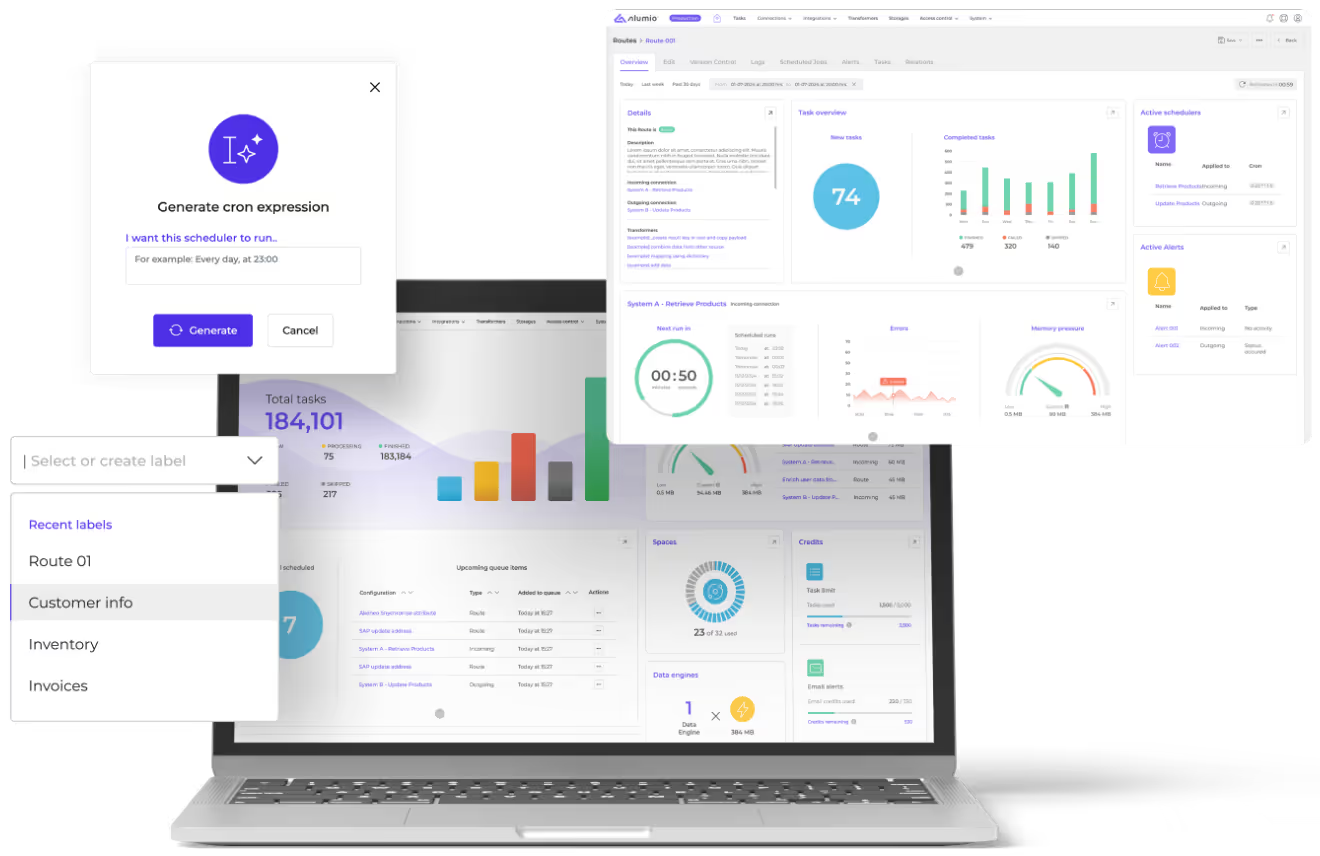
Laptop screen displaying the Alumio iPaaS dashboard, alongside pop-up windows for generating cron expressions, selecting labels and route overview.