What vendor managed inventory requires both sides to share
The commercial agreement sets the targets. The data exchange decides whether they can be hit.
- Current stock on hand: what the buyer's ERP or warehouse system holds now, per location, and the figure the replenishment decision rests on
- Consumption or sales: how quickly stock is being used, which is what turns a level into a forecast
- Agreed minimum and maximum levels: the range the supplier replenishes to, which may vary by item, location, and season
- Inbound and in-transit: what the supplier has already shipped, so the same shortfall is not covered twice
- Exceptions and adjustments: damage, write-offs, and stock transfers that change the position without a sale occurring
The first two are the ones buyers hesitate over, because sharing them means showing a supplier how much they hold and how fast they sell it. That is a commercial disclosure as much as a technical one, and it is worth deciding deliberately rather than by default.
Why does VMI end up running on spreadsheets?
A file is the fastest thing to agree on. Neither side wants the pilot to wait on an integration project, so the first exchange is a weekly stock report by email. The arrangement then proves itself well enough that nobody revisits the mechanism.
The weekly cadence is where it breaks down. A supplier planning replenishment from a seven-day-old stock figure is guessing about the most recent week, which is exactly the period that determines whether the buyer runs out. The supplier compensates by holding buffer stock, which reintroduces the inventory cost vendor managed inventory was meant to remove.
Scale makes it worse rather than routine. A supplier running the arrangement for twenty customers is reconciling twenty spreadsheet formats, twenty definitions of what counts as available, and twenty senders who occasionally forget. Adding the twenty-first is never easier than the first, which is the same arithmetic that makes supplier onboarding expensive.
None of that breaks loudly. It shows up as cost on both sides of the relationship.
What weak data exchange costs a vendor managed inventory program
A stale stock position costs both sides, which is why these relationships often revert quietly to conventional ordering.
- Buffer stock that defeats the purpose: the supplier holds extra to cover data latency, and somebody pays for that inventory
- Stockouts the buyer did not see coming: the buyer stopped planning replenishment and the supplier was working from stale figures
- Double shipments: a shortfall covered twice because in-transit stock was not visible in the position the supplier saw
- Disputes about what was actually held: where consignment terms apply, the stock position determines when ownership and payment transfer
The last one is the sharpest, because it turns a data problem into an invoice problem. Before any of that can be fixed, though, there is a question the buyer has to settle first.
Vendor managed inventory is a trust question with a technical answer
Buyers hesitate to share consumption data for reasons that are commercially rational. A supplier who can see exactly how fast a product moves knows more about the buyer's business than the buyer may want. That knowledge is also useful in the next price negotiation.
The usual resolution is scope. A supplier needs stock and consumption for the items they supply, at the locations they replenish, and nothing beyond that. It is a much narrower disclosure than system access, and it is enough to plan against.
That turns a governance concern into a configuration decision. A buyer able to expose exactly the items, locations, and fields agreed can say yes to the arrangement without exposing anything else. A buyer whose only option is a full stock extract has to choose between the arrangement and the disclosure, and will usually choose the spreadsheet.
There are three ways the exchange usually runs, and none of them is neutral. EDI and APIs support stock and consumption messages properly and suit partners who already run them, which excludes many mid-sized suppliers. Supplier portals let a vendor log in and look, which works until they need the figures inside their own planning system. Scheduled file exchange is the default, and it sets the ceiling on how current any replenishment decision can be.
How does an integration platform support vendor managed inventory?
A current position has to reach the supplier scoped to the items and locations in the agreement, and in a format their planning system can read. Meeting all three at once needs a layer between the two companies rather than a connection into the buyer's own ERP. That layer is an integration platform-as-a-service (iPaaS).
Sharing stock and consumption across a company boundary is a different requirement from sharing them internally. Only some fields may leave. The supplier cannot be asked to accept the buyer's internal data model, and both sides may later need to prove what was sent. Enforcing a scope, reshaping per partner, and recording the exchange are three requirements a file drop does not meet.
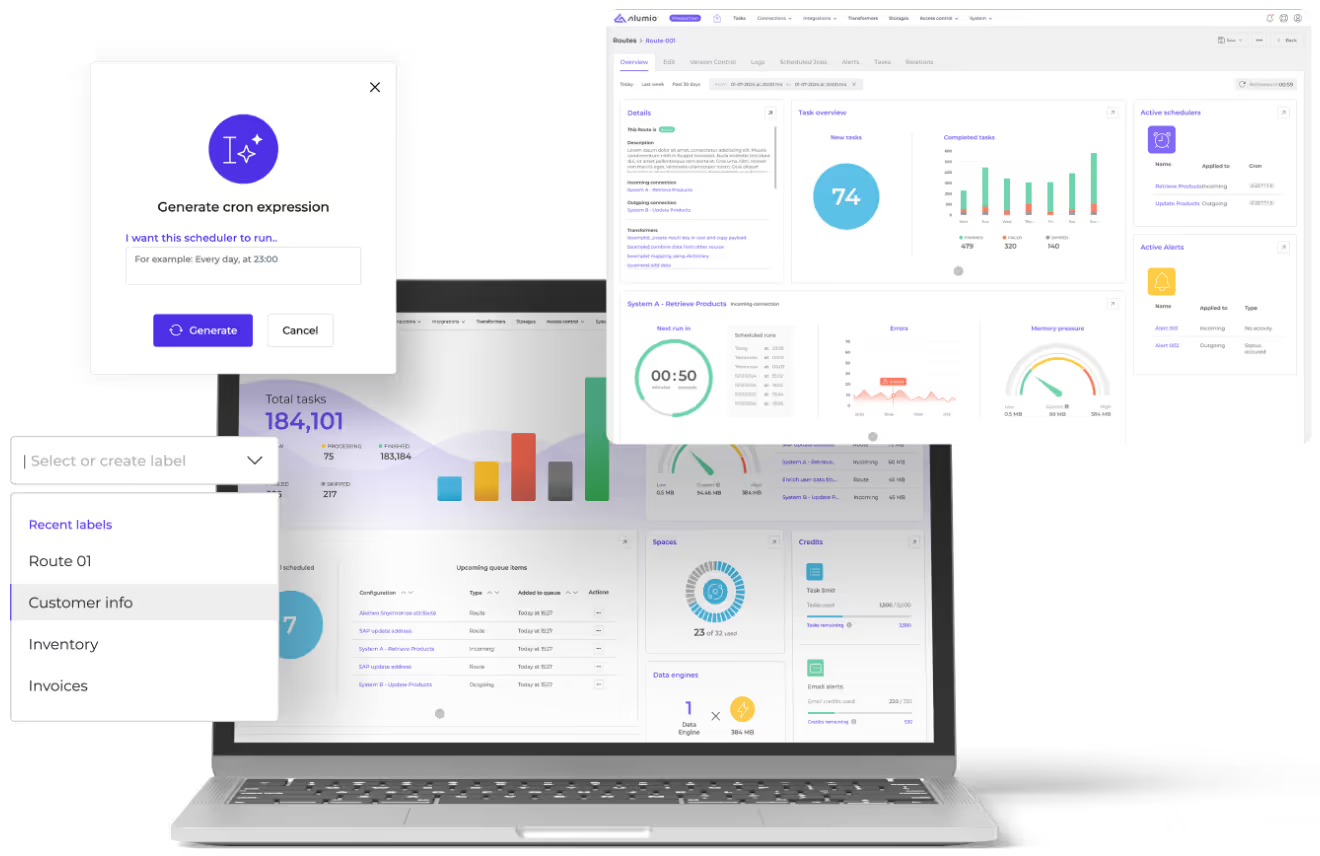
Alumio is an integration platform designed for exchanges that cross a company boundary, where scope matters as much as speed. That work takes four forms.
- Positions shared as they change: an event-driven data Route pushes stock and consumption to the supplier as movements occur, so replenishment is planned against today rather than last Monday
- Scoped to what was agreed: access control and per-partner configuration expose only the items, locations, and fields in the agreement, so the commercial boundary is enforced rather than trusted
- Each partner's format handled: a data Transformer converts one internal stock model into EDI, API, or file formats per supplier, so partner capability does not dictate the internal design
- A record both sides can check: detailed Logs capture what was sent and when, which is what settles a consignment or shortfall dispute without a reconstruction exercise
Configuration handles the scoping and mapping rules, and the Alumio iPaaS provides a Code Transformer for the cases where writing code is more efficient than configuring it. Extending the arrangement to a third and fourth supplier costs a fraction of the first, which is what lets it spread across the supply base.
Vendor managed inventory that both sides can rely on
Vendor managed inventory is usually justified on the buyer's working capital and the supplier's forecast visibility, and both benefits depend entirely on the quality of the shared position.
Three roles carry it, and two of them work for different companies. The buyer's purchasing or supply chain manager gave up the replenishment decision and now depends on somebody else making it well. The supplier's account or planning manager has to hit a service level using data they do not control. Finance on either side owns the consignment position, where the stock figure decides when ownership and payment transfer.
A weekly file lets all three work, badly. A current position lets the supplier hold less buffer while still avoiding stockouts, which is the outcome the contract described and the spreadsheet version rarely delivers. Running the exchange on an integration platform is what makes that position affordable to keep current. It is also the difference between an arrangement that spreads across the supply base and one that quietly reverts to purchase orders.





.svg)









.svg)
.svg)
.svg)
.svg)
.svg)
.svg)
