

Integrate legacy systems with the latest cloud apps

Connect now
A Alumio vivid purple arrow pointing to the right, a visual representation of how to access more page material when clicking on it.
Go back

Connecting legacy ERP with cloud apps with hybrid integration

By
Saad Merchant
Published on
May 15, 2026
Updated on
May 18, 2026
IN CONVERSATION WITH
Email icon
Email icon

Manufacturing IT leaders rarely get a clean slate. Most operations run on legacy ERPs like SAP ECC, IBM AS/400, Oracle, Infor, or older bespoke systems that still process orders, manage stock, run finance, and coordinate production. These systems are too business-critical to rip out, while the cloud applications around them, including e-commerce platforms, CRM systems, analytics tools, and supplier portals, need continuous access to ERP data to function. A hybrid integration platform connects the two without forcing replacement, keeping legacy ERPs in place while modernizing the integration layer around them. That is how most manufacturing modernization actually works in practice. Rip-and-replace migrations make for clean roadmaps but create production-stopping risk. Integration-first modernization moves faster, costs less, and keeps the business running while it happens.

Why manufacturing modernization is rarely a rip-and-replace project

The temptation in manufacturing IT is to plan modernization as a single ERP migration project. Pick the new system, set the cutover date, move the data, train the teams, decommission the old. That model works in slide decks but fails in plants. Modern manufacturing operations rarely tolerate the kind of downtime risk full ERP replacement creates. The surrounding ecosystem of cloud applications, customer portals, and analytics tools also needs reliable ERP data long before any migration is complete.

This is why most manufacturers ultimately take a different path. They keep their legacy ERP running while connecting cloud applications around it through an integration layer. The modernization happens incrementally, with the integration layer absorbing complexity that would otherwise sit inside risky migration projects.

Legacy ERPs hold the business logic manufacturers can't afford to break

The reason legacy ERPs persist is not nostalgia or budget constraints alone. It's the accumulated business logic that lives inside them. A typical manufacturing ERP holds decades of customer-specific pricing rules, production sequences, supplier terms, EDI flows, and operational dependencies built around the system over time. Most of that logic was never properly documented in the first place.

That makes replacement risky in a way that is difficult to quantify upfront. A clean cutover plan can list every module, every interface, every report. It cannot list every undocumented workaround that a production planner created six years ago to handle a specific supplier issue. Those workarounds matter, because they have become operational dependencies the business does not know it has.

The result is that ERP replacement projects tend to discover their real scope mid-migration, by which point the project is already running and the cost of pausing it climbs by the week.

What is a hybrid integration platform?

A hybrid integration platform is a category of software that connects on-premise systems with cloud applications through one managed integration layer. The word "hybrid" describes the architecture it supports, where legacy systems running in private data centers or on dedicated hardware coexist with cloud applications running in shared environments.

For manufacturing, this matters because the operational stack rarely sits in one place. The ERP often runs on-premise on AS/400, IBM i, or older Windows or Unix infrastructure. By contrast, the commerce platform, CRM, and analytics environment are typically cloud-native, each with its own connection method, security model, and data format.

A hybrid integration platform handles the connection mechanics across all of these, including API calls, file transfers, EDI messages, database queries, and event-driven flows. It also manages the transformation, validation, and monitoring of data as it moves between systems, so cloud applications receive ERP data in formats they can actually use.

Connecting AS/400, IBM i, and SAP ECC to cloud apps through one integration layer

The technical challenge in legacy ERP integration is rarely about a single protocol. Mainframe connectivity, AS/400 integration, and SAP ECC integration each have their own conventions. AS/400 environments typically expose data through DB2 queries, file transfers, or older message-based interfaces. SAP ECC typically supports BAPIs, IDocs, and RFC calls. Other systems still rely on MQ Series, FTP-based exchanges, or proprietary protocols.

An integration platform-as-a-service (iPaaS) handles all of these through a single configuration layer rather than requiring custom code for each. The Alumio iPaaS supports direct database connectivity (MySQL, PostgreSQL, MSSQL), file-based exchanges across FTP and SFTP, EDI standards (X12, EDIFACT), REST and SOAP APIs, and SAP-specific API plugins that surface ECC and R/3 endpoints. That breadth matters because most manufacturers have several legacy systems to integrate, each with different connection needs.

Pelican Products, a US manufacturer of protective travel gear with 1,400 employees across 27 countries, integrated its on-premise SAP ECC R/3 ERP with Adobe Commerce through the Alumio iPaaS. The SAP system continues to run as the operational record for finance, inventory, and order processing, while Adobe Commerce handles the customer-facing storefront. The two systems exchange real-time data through the integration layer, which resolved the finance and inventory errors the previous standalone setup was creating. That model, where the legacy ERP stays in place and the cloud layer connects through integration, applies across most manufacturing modernization scenarios.


Turn AI ambition into action

Portrait of Leonie Becher Merli, Business Development Manager at Alumio

Get a free assessment of your integration needs and next steps

Portrait of Leonie Becher Merli, Business Development Manager at Alumio

Looking to modernize your legacy ERP without replacing it?

Looking to modernize your legacy ERP without replacing it?

Where to start with hybrid ERP integration

Hybrid ERP integration projects fail most often when they start with the wrong unit of work. Trying to connect everything at once produces a multi-year integration program. Trying to connect one cloud application to the ERP without thinking about reuse produces a brittle point-to-point fix that becomes the next system to replace.

The starting point worth picking is a single high-value flow that exposes the integration challenge clearly. Order processing between e-commerce and ERP is the usual candidate, because it forces decisions about real-time versus batched updates, data ownership between systems, and error handling when one side is down. Inventory synchronization is the second most common, for similar reasons.

Once that first flow runs reliably through the integration layer, the cost of adding the next one drops significantly. Each additional cloud application connects through the same layer, using the same governance, monitoring, and data transformation patterns. That compounding effect is what separates a hybrid integration platform from a stack of custom connectors.

Most Alumio deployments in manufacturing happen through certified system integrators and digital agencies with industry expertise, which matters because the integration design has to reflect real production workflows rather than generic templates.

Hybrid integration is how legacy ERP modernization actually scales

ERP modernization is one of the longest IT initiatives most manufacturers will run. Three to five years is not unusual for a full ERP migration, and that assumes the project does not stall on scope discoveries or business priority shifts mid-program. Hybrid integration changes the math, because it lets the business gain most of the modernization benefits long before the migration completes, sometimes without requiring an ERP migration at all.

The strategic shift worth absorbing is that integration has become the modernization itself, not just the means to a future migration. A legacy ERP connected to current cloud applications through a governed integration layer is a more functional operational stack than a brand-new ERP that has not been integrated yet. Manufacturing IT leaders making decisions about modernization roadmaps in 2026 are increasingly framing the question as “integrate now and migrate later,” rather than “migrate first and integrate after.”

That framing changes how budgets get allocated, how risk gets managed, and how IT teams plan multi-year roadmaps. The manufacturers gaining the most ground are the ones treating the integration layer as the modernization architecture rather than the migration plumbing. They are connecting AS/400, SAP ECC, and other legacy systems to cloud commerce, CRM, analytics, and supplier portals through a single integration platform, and they are using that connectivity to deliver business outcomes before any ERP replacement project completes.

No items found.
Topics in this blog:

FAQ

Integration Platform-ipaas-slider-right
What is a hybrid integration platform?

A hybrid integration platform is software that connects on-premise systems with cloud applications through one managed integration layer. It supports both legacy environments (such as AS/400, mainframe, or older ERPs) and modern cloud apps (such as e-commerce platforms, CRM systems, and analytics tools), handling connectivity, transformation, validation, and monitoring across both worlds.

Integration Platform-ipaas-slider-right
What is AS/400 integration?

AS/400 integration connects applications running on AS/400, IBM i, or related IBM environments with other systems such as cloud platforms, ERPs, CRMs, and analytics tools. Connection methods vary depending on the AS/400 setup and can include DB2 database queries, file transfers, message-based interfaces, EDI flows, or REST-based wrappers exposed through an integration platform.

Integration Platform-ipaas-slider-right
Why do manufacturers still use legacy ERP systems?

Manufacturers often keep legacy ERP systems because they run business-critical processes that are difficult and risky to replace quickly. These systems typically hold decades of customer-specific pricing rules, production logic, supplier agreements, and operational workflows that were built around the ERP over time, much of which was never formally documented.

Integration Platform-ipaas-slider-right
How does a hybrid integration platform connect legacy ERPs to cloud apps?

A hybrid integration platform connects legacy ERPs to cloud apps by translating data between systems, routing it to the right destination, and monitoring whether each flow runs correctly. It handles multiple protocols (APIs, files, EDI, databases, message queues) through one configuration layer, so cloud applications receive ERP data in the format they expect without each connection requiring custom code.

Integration Platform-ipaas-slider-right
Is hybrid integration better than ERP replacement?

Hybrid integration is not always better than ERP replacement, but it is usually safer as a first step. It allows manufacturers to connect and modernize around the legacy ERP before deciding which systems should be migrated, replaced, or kept long-term. Replacement may still happen later, but it happens with better data visibility, less pressure, and clearer scope.

Integration Platform-ipaas-slider-right
What should manufacturers check before integrating legacy ERPs with cloud apps?

Manufacturers should map which systems own which data records, audit the technical connection methods each legacy system supports, define security and access requirements for cloud-to-on-premise traffic, and identify which data flows need real-time updates versus scheduled batches. They should also document the undocumented business logic inside the legacy ERP before exposing it through integration.

Get a free assessment of your integration needs

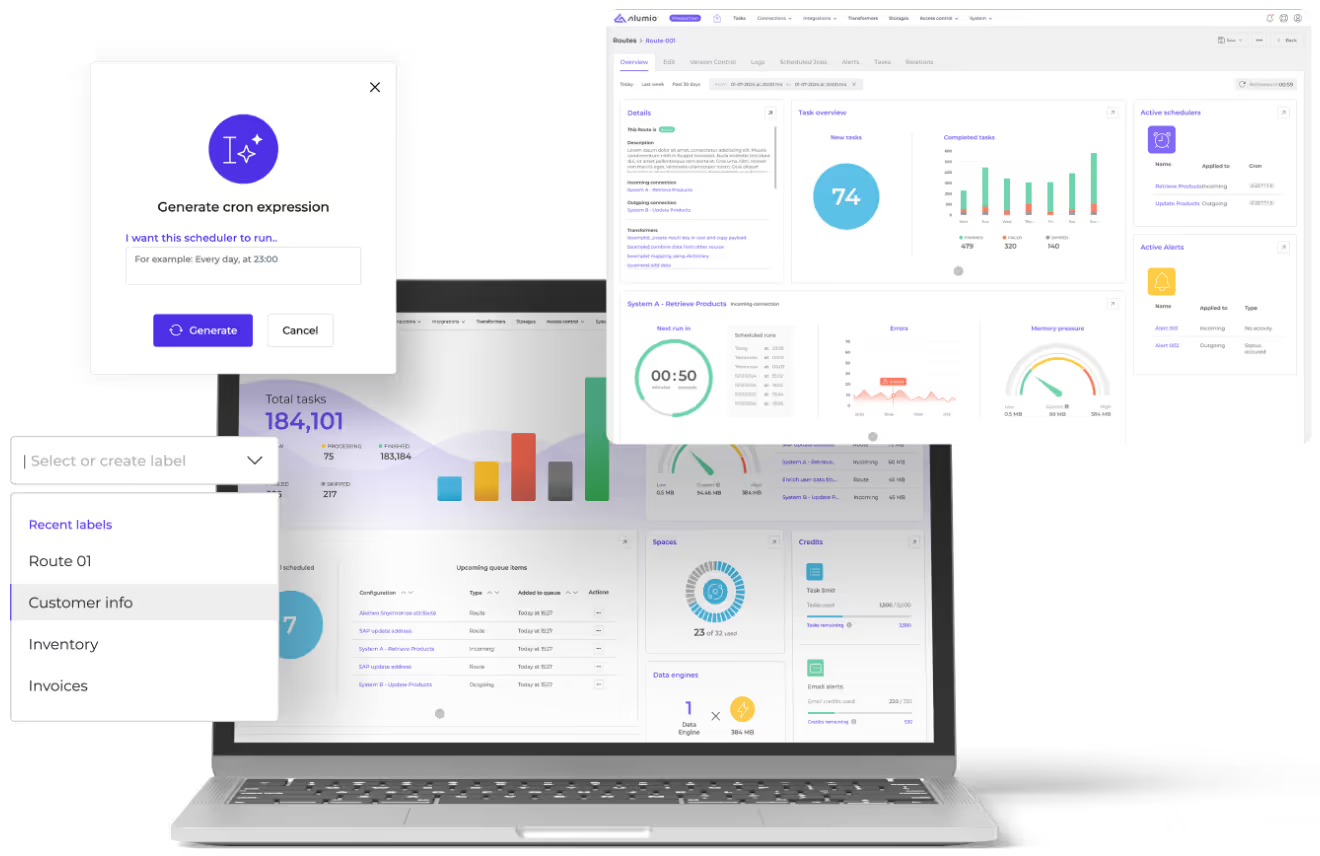
Laptop screen displaying the Alumio iPaaS dashboard, alongside pop-up windows for generating cron expressions, selecting labels and route overview.