Which systems loyalty program integration has to connect
A loyalty program is specified as a customer experience and delivered as exchanges between systems. Naming those exchanges turns a loyalty program into an integration requirement.
- The loyalty platform or engine: holds the balance, the tier rules, and the expiry logic other systems defer to
- The point of sale (POS): reads the balance before approving a redemption, and sends back what was earned and spent
- The e-commerce platform: does the same at checkout, and reads tier status where it drives pricing or free shipping
- The customer app or account page: reads the balance and tier, so a customer sees the figure the register will honor
- The CRM or customer data platform: holds the identity the balance attaches to, across account logins, cards, and phone numbers that can each look like a different person
- The enterprise resource planning (ERP) and finance systems: receive outstanding points and gift card value as a liability
Two kinds of exchange sit in that list. A redemption needs an answer within the seconds a customer is standing at a register, while liability reporting and tier recalculation can move on a schedule. Most programs are built to avoid the first kind entirely.
What happens when each channel keeps its own copy
Most programs give every channel its own copy of the balance and refresh it overnight, rather than connecting the loyalty platform to each channel directly. That is cheaper to build, and for a business selling through one channel it works.
The cost arrives in a predictable order, starting with the customer standing in front of a colleague who cannot override anything.
- Refusal at the counter: a customer is told their balance is lower than their app displays, with other customers waiting
- Gift card value spent twice: direct leakage, usually written off because tracing it costs more than the card was worth
- A liability nobody can size: under the revenue recognition standards ASC 606 and IFRS 15, unredeemed points sit on the balance sheet until redeemed or written off, and sizing them means adding up systems that disagree
The usual response is a tighter reconciliation job. It is worth being precise about what reconciliation can and cannot do.
Why nightly reconciliation is not loyalty program integration
Reconciliation runs after the fact. It reports that two channels approved the same value without preventing either approval, because the failure happens inside the window the job exists to close.
Both channels are also correct by their own reading. The register checks its copy and sees value, the webshop checks its copy and sees the same value, and each approves a redemption it had every reason to approve. That is why tighter process at the counter does not fix it, and neither does a better loyalty platform on its own.
Closing the window means every channel asking the system that holds the balance at the moment it matters. Built by hand, that is a live link per register, per storefront, and per app. Each carries its own authentication and data format, and each has to survive upgrades on both sides. One webshop and one register is two links. A store network, several storefronts, and an app is where multi-channel e-commerce integration stops being a set of connections and becomes an architecture.
How an integration platform connects a loyalty program
An integration platform-as-a-service (iPaaS) changes what each system connects to. Every system connects once to the platform, and the platform carries data between them, in real time where a decision is waiting and on a schedule where nothing is.
Workflow automation tools are the nearest adjacent option, and they move a record between applications when something happens. A redemption needs an answer back before the transaction completes, from the system that holds the balance.
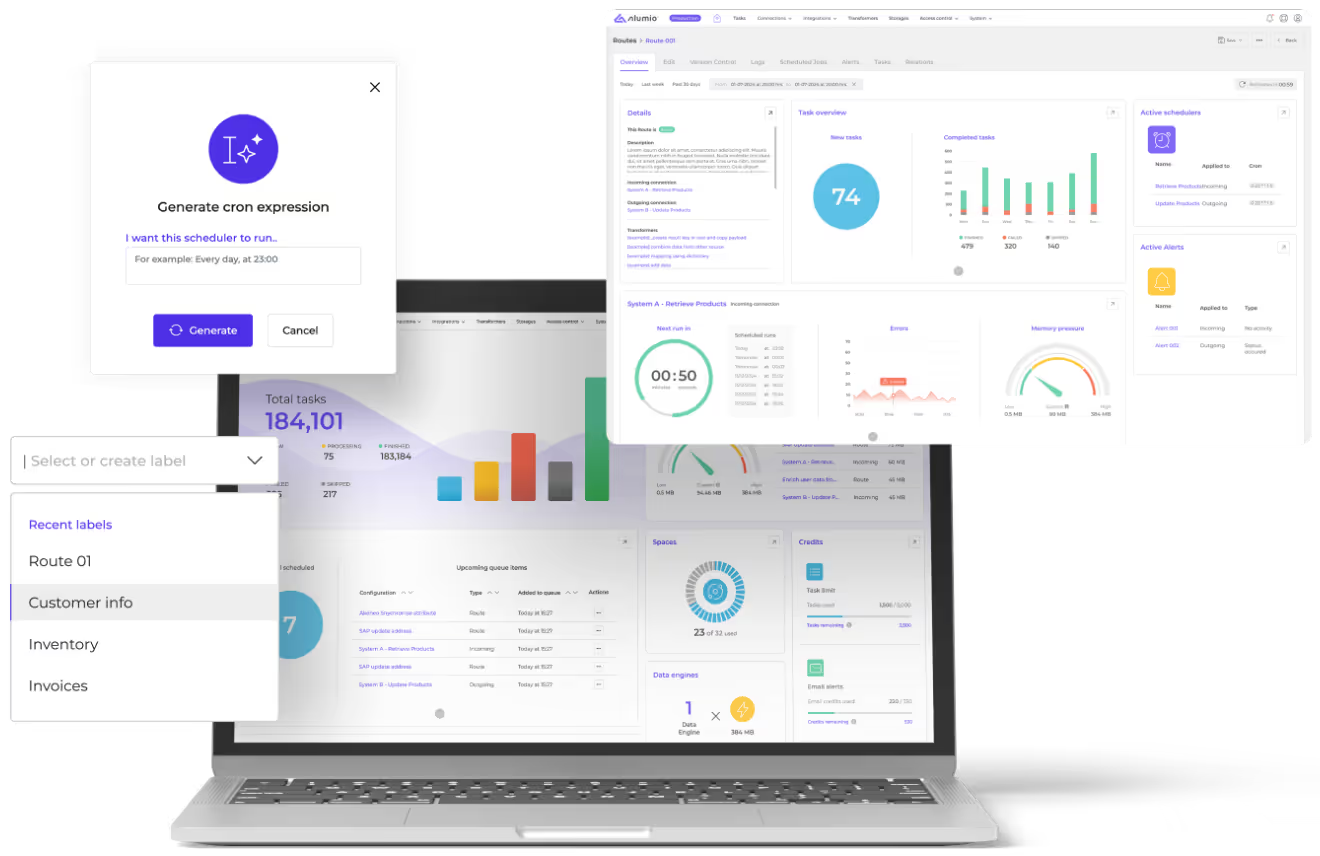
On the Alumio iPaaS that work takes four forms:
- A live check at redemption: a real-time Proxy carries the balance check from the register to the system holding it and returns the answer before the sale completes, so two channels cannot both approve the same value
- Earning sent as it happens: an event-driven data Route carries the transaction to the loyalty platform the moment it closes, so the balance checked an hour later already reflects it
- Identifiers reshaped to match: a data Transformer converts the account, card, and contact references each system uses into the form the loyalty platform expects, so one person stops arriving as two records
- Reporting moved on a schedule: a batch flow carries outstanding points and gift card value into the ERP for finance to size, while detailed Logs record which channel approved which redemption
These flows are configured rather than built again per channel, with the Code Transformer available where configuration cannot express a rule. None of it requires the loyalty program to move into one system, which is the claim worth testing.
Loyalty program integration across seven webshops and a store network
Camping and outdoor retail is a useful place to check whether a loyalty program can really stay where it is. The category runs a large store operation and a spread of country storefronts at once.
Obelink is a Dutch family business trading since 1959 and one of Europe's largest camping and outdoor retailers, running seven webshops across European countries alongside its stores. Adobe Commerce sits on the storefront side, with RetailVista providing cloud ERP and point of sale, and RealtimeWMS in the warehouse.
The Alumio iPaaS sits between those systems rather than inside any of them. Gift card value is synchronized across the ERP, warehouse, POS, and webshop, so the same card is readable wherever a customer presents it. Customer account creation and login data moves through the same layer, which matters here because a balance is only as dependable as the customer record it attaches to.
The loyalty program itself did not move. Because each system connects to the platform rather than to the others, a component that stops meeting requirements can be replaced without rebuilding what surrounds it. The seventh storefront reuses flows already running.
What loyalty program integration returns to a multi-channel retailer
A loyalty program is scoped as a marketing initiative and inherited as an integration problem, because the balance underneath it is a spendable value rather than a record.
In multi-channel retail that problem is split across three desks. The e-commerce or omnichannel director hears about it as a complaint from a store. The retail IT manager maintains the connections and absorbs every new storefront. The finance controller carries the outstanding value as a liability. None of them can fix it alone, which makes this an integration decision rather than a program redesign.
Connecting those systems on a governed integration platform lets all three work from the same balance. What changes commercially is what the business can then do with it. A balance every channel can read is one a retailer can promote. The outstanding value becomes a number finance can state.





.svg)







.svg)
.svg)
.svg)
.svg)
.svg)
.svg)
