What omnichannel fulfillment actually decides
Retailers rarely run out of stock in total. They run out of stock in the wrong place. A business with 400 units spread across a distribution center, six stores, and a third-party warehouse has plenty of inventory and still cancels orders. The unit and the order were never matched sensibly.
Omnichannel fulfillment covers two linked decisions. Allocation sets how much of a shared pool each channel can promise, and what happens when two channels claim the same unit in the same minute. Sourcing decides which location fulfills an order once it exists. Neither is visible in a stock number, and both determine whether the order ships, when, and at what cost.
The promise side of omnichannel is well understood by now. Customers expect to buy, collect, and return anywhere, and delivering that omnichannel customer experience depends on channels sharing data. The execution side gets less attention, and that is where the money goes.
Why does real-time inventory sync not fix omnichannel fulfillment?
Synchronization reports a number. Allocation decides who may use it. Only the first is solved by pushing stock levels faster.
A shared pool of one unit is published to a webshop, a marketplace, and a store app. All three are accurate at that moment. Two orders arrive four seconds apart. Both were placed against valid data, and one cannot be filled. Faster syncing narrows that window without closing it, because the conflict comes from concurrent demand rather than stale data.
The usual workaround is buffering: hold back stock per channel so nothing oversells. It works, and it costs money. Every buffered unit is inventory the business owns and refuses to sell, and the buffer has to be widest on the fast-moving lines where margin is best.
What resolves the conflict is a rule applied at the moment of the claim: reserve the unit, decide which claim wins on defined priority, and release it if payment does not clear. That is a decision with state attached, and it needs to live somewhere that sees every channel at once.
The inventory allocation rules every retailer needs to define
Every business already has allocation rules. In most, they are undocumented, spread across a warehouse system's defaults, a marketplace connector's settings, and the judgment of whoever is working the phones.
The questions needing explicit answers are ordinary and specific:
- Channel priority: when a marketplace order and a store customer want the last unit, which one wins, and whether that changes during a promotion
- Reservation windows: how long stock is held for an unpaid order, a click-and-collect pickup, or a B2B quote
- Sourcing preference: whether an order ships from the nearest location, the cheapest, or the one holding the most stock
- Split behavior: whether a two-line order is split across locations or held until one place can fill it whole
Left implicit, these rules drift. Channels behave differently for the same product, nobody can explain why a particular order was cancelled, and finance cannot reconcile fulfillment cost against the revenue it produced.
What makes omnichannel fulfillment expensive?
Fulfillment decisions are financial decisions that rarely reach the finance team. A split shipment doubles packing and shipping cost on a single order. Shipping from a store consumes retail labor priced for selling rather than picking. A cancelled order carries the full acquisition cost of the sale with none of the revenue, plus a customer who now doubts the stock numbers.
None of this appears as a line item. It surfaces as fulfillment cost creeping up faster than order volume, and as channels whose profitability nobody can state with confidence.
Recovering it requires the cost data to travel with the fulfillment decision, so the rule choosing a location knows what shipping from there actually costs. That is an integration question before it is an analytics one.
How does an integration platform manage inventory allocation?
An integration platform-as-a-service (iPaaS) sits between the channels and the systems holding stock, which is the only vantage point that sees every claim as it arrives. Rules written there apply to every channel at once instead of being configured separately in each connector. The platform also holds the reservation state that makes a rule enforceable rather than advisory.
Dutch cycling wholesaler AGU chose the Alumio iPaaS to connect its Centric ERP with Adobe Commerce and its Akeneo product data across a combined B2B and B2C landscape. With 25,000 products distributed between warehouses in Alkmaar and the wider Benelux, stock, prices, and order shipment data move through one layer rather than through separate links per channel. AGU normalized its data entities in the process, which is what lets it add another channel or tool later without renegotiating how stock is represented.
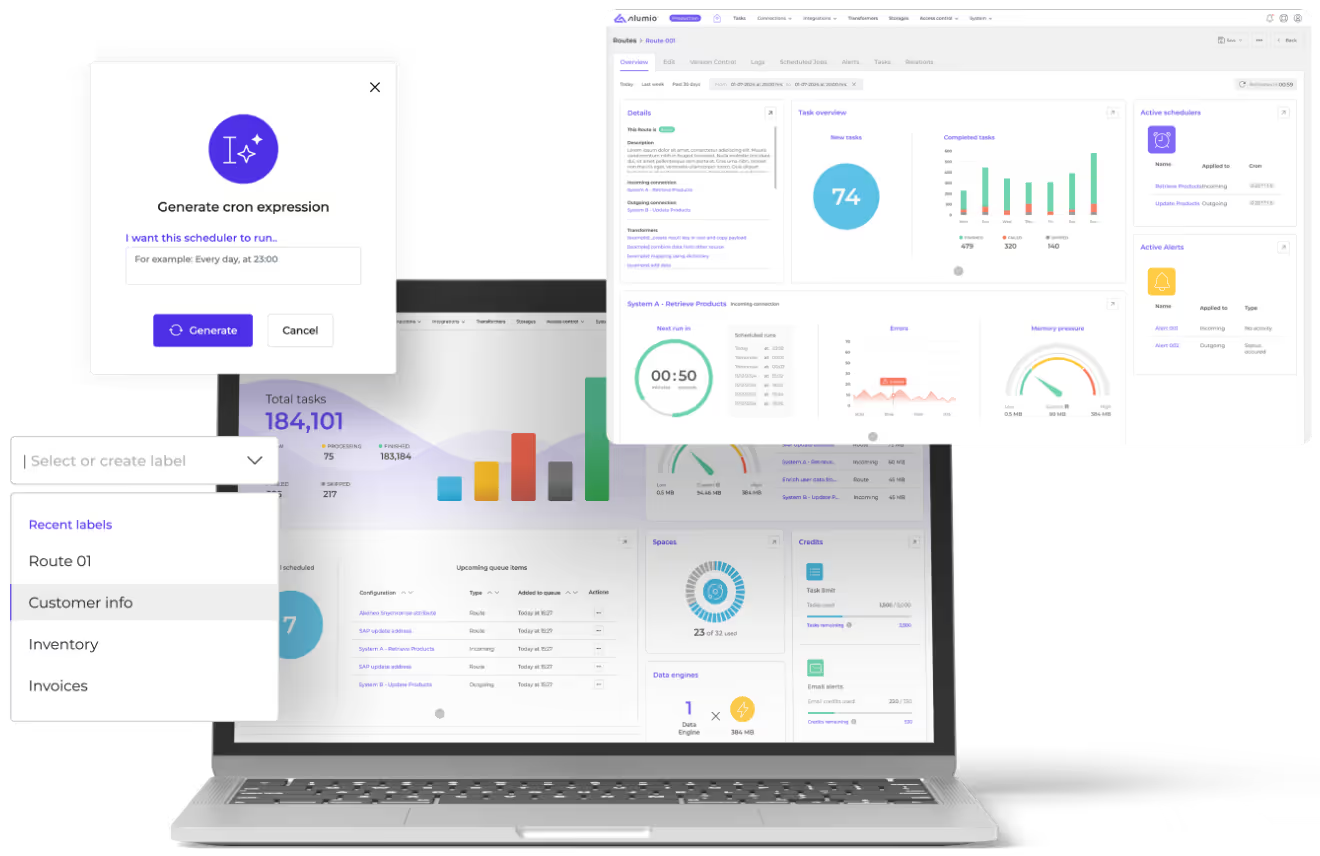
On the Alumio iPaaS, that logic is configured rather than hand-built per channel. Proxies answer live stock checks at the moment of the claim instead of serving a cached figure, and Routes apply the priority and sourcing rules when an order arrives. Transformers reconcile the stock definitions each system uses, while Storage holds reservations so a claim can expire cleanly instead of stranding a unit. Every decision carries an audit trail, so a cancelled order has an explanation rather than a theory.
How an iPaaS turns omnichannel fulfillment into margin
The retailers making omnichannel pay are not the ones with the most channels. They are the ones who decided explicitly how stock is promised and where orders are sourced, then put those decisions somewhere they can be inspected and changed.
In practice, that somewhere is the iPaaS, because it is the only layer that sees every channel and every stock position at the moment a claim arrives. That reframes the work of adding a channel. It stops being a question of whether the storefront can display stock and becomes a question of what claim that channel has on inventory, and what it costs to serve.
Enforced in one place, those rules turn omnichannel from a set of channels competing for the same stock into an operation that allocates it deliberately. The measure worth watching is not how many channels are live, but what each one costs to fulfill and what it returns.




.svg)








.svg)
.svg)
.svg)
.svg)
.svg)
.svg)
