Where reverse logistics costs actually sit
The obvious costs of a return are shipping and labor, and both are real. They are also the ones businesses already measure, which is why they get most of the attention and offer the least room for improvement.
The larger cost is time. An item that takes nine days to reappear in stock is an item the business owns, has paid for, and cannot sell. In seasonal or fashion categories, the delay costs more than the shipping. The window in which the item sells at full price is closing while it waits in a queue.
Refund timing carries its own cost on the customer side. A slow refund generates service contacts, chargeback risk, and a measurable drop in repeat purchase rates. Both costs come from the same source, which is that no system knows the item is back until a person tells it.
Why does a return touch so many systems?
A return runs the original transaction backwards, and the original transaction touched everything. The commerce platform holds the order. The payment provider holds the transaction to be refunded. The warehouse system holds the stock position. The ERP holds the financial record. The customer service desk holds the conversation.
Forward orders are usually well integrated because they generate revenue and get attention. Returns are treated as an exception path, so the same journey backwards is often held together by a spreadsheet, an email to finance, and a person who knows the process.
The asymmetry shows up in the numbers. Businesses that can process an order end to end in seconds routinely take days to process its reversal. The gap is almost entirely down to which path was designed and which one accumulated.
The four events a connected returns process needs
Reverse logistics is easier to fix when it is broken into the moments where a system needs to be told something.
- Return authorized: the commerce platform and service desk agree a return is coming, and the warehouse is told to expect it
- Item received: the warehouse records arrival, which is the event that should start everything else rather than end it
- Condition assessed: the item is graded resellable, refurbishable, or scrap, and that grade determines both the stock update and the refund
- Refund and restock: the payment is reversed, the financial record is adjusted, and the item rejoins sellable inventory in the same sequence
Most delays come from treating these as one manual task rather than four events. When a receipt automatically triggers assessment, and assessment automatically triggers both refund and restock, the nine days become the time the physical checks actually take.
How reverse logistics works at scale with integration
The problem compounds as volume rises and as the operation spreads across more locations and more clients. A business handling returns for its own single warehouse can hold the process in someone's head. One handling returns across several clients and channels cannot.
Drake & Farrell is a Dutch reverse logistics and refurbishment provider working in the circular economy. It runs operations in the Netherlands and the Czech Republic on behalf of other businesses. Its situation is the multiplied version of the problem, because every client arrives with a different commerce platform and expects returns data back in its own systems.
Working with partners Fresh Dynamics and Inteqrate, Drake & Farrell connected Microsoft Dynamics 365 Finance and Operations to customer webshops across Shopify, Adobe Commerce, and WooCommerce through the Alumio iPaaS. Orders arriving as XML and CSV over FTP pass through the same layer. What that buys operationally is a return received in one warehouse updating the right client's stock position and storefront, without a separate build sitting behind each client relationship.
How an integration platform shortens the reverse logistics cycle
Before reaching for a platform, it is worth naming the alternatives. A dedicated returns application handles the customer-facing portal well and still has to be connected to the ERP and warehouse to be useful. Point-to-point integrations between the commerce platform and the warehouse cover the common case and break on the exceptions, which in returns is most of the volume. Manual processing works and is exactly what produces the nine days.
An integration platform covers the gaps between whatever tools are already in place. On the Alumio iPaaS that work takes four forms:
- Triggered on receipt, not on a schedule: an event-driven Route turns the warehouse scan into the trigger for refund and restock, so nothing waits for an overnight run
- Translated between systems: a Transformer converts a return reason from the service desk into a stock disposition in the warehouse and a credit reason in the ERP, with no mapping maintained by hand
- Held safely when something is unavailable: built-in Storage queues the instruction when a payment provider or ERP is briefly unreachable, then replays it rather than dropping it
- Traceable per item: logging records what happened to a specific unit and when, which is what makes disputed refunds and warranty claims answerable
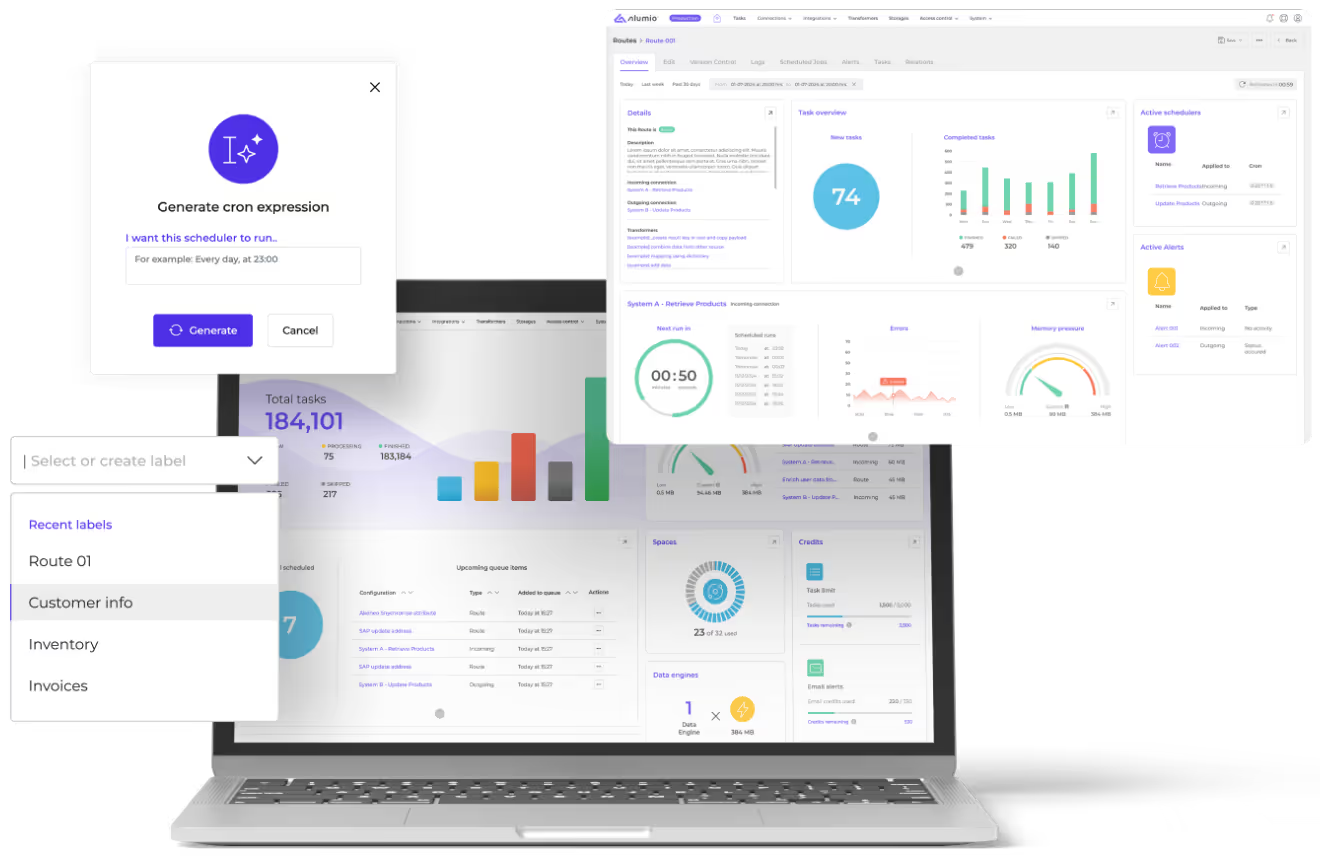
Those flows are configured rather than hand-built per channel, with the Code Transformer available where configuration cannot express a rule. Adding a marketplace or a new client reuses the existing process instead of restarting it.
Turning reverse logistics from a cost into recovered margin
Returns will not stop growing. Free returns are a competitive expectation in most categories. Businesses that treat them purely as a cost to be minimized tend to reach for policy changes that damage conversion.
The more durable move is to shorten the cycle rather than discourage the customer. Every day removed between an item arriving and rejoining sellable stock is a day of recovered margin on inventory the business already owns. A faster refund is also one of the cheapest trust signals available.
An integration platform is what makes that possible, because the delay is not in the warehouse or the finance team but in the space between them. What the business gets back is inventory that returns to sale in days rather than weeks, and refunds fast enough to stop generating service contacts. The returns operation can then absorb another channel or client without adding headcount to carry it.





.svg)








.svg)
.svg)
.svg)
.svg)
.svg)
.svg)
