
Connect your plant systems to every new sales channel

Learn more
A Alumio vivid purple arrow pointing to the right, a visual representation of how to access more page material when clicking on it.
Go back

Manufacturing e-commerce: new channels without rebuilding the ERP

By
Saad Merchant
Published on
October 23, 2026
Updated on
October 23, 2026
IN CONVERSATION WITH
Email icon
Email icon

A manufacturer's digital transformation lead wants to sell direct to consumers, open a B2B portal, or list on a marketplace abroad. The CIO sees an ERP project, because the SAP or Microsoft Dynamics ERP running the plant was never built to serve a webshop. Plans for e-commerce for manufacturers tend to stall there, on lead time rather than budget. Extending the ERP or building custom connections to each channel works, but ties every launch to the ERP's roadmap. An iPaaS (integration Platform as a Service) offers another route: a cloud-based, central hub connecting the ERP to each sales route. It transforms product, price, and order data into the format each one expects, and automates the exchange in real time or on a schedule. Web orders arrive in the ERP ready to process, and each channel shows its own prices and stock. The ERP keeps running the factory, and each new channel opens on its own timetable.

Why do new channels stall in manufacturing?

A manufacturer's ERP is built around the plant. It holds production orders, bills of materials, stock, and the trade price lists used to invoice distributors. The MES (manufacturing execution system) runs the shop floor against it, and the PLM (product lifecycle management) system feeds it product definitions.

Selling direct, or into a new country, asks for things that ERP was never configured to handle. Consumers expect their own prices, single-unit orders, card payments, and delivery in days. New markets add their own currency, VAT rules, language, and often a local carrier or 3PL (third-party logistics provider).

So a request for e-commerce for manufacturers arrives at IT as a request to change the ERP. It joins a queue behind everything the ERP already does for the plant, and nobody wants to risk the system that keeps production running.

Does selling direct mean changing the ERP that runs production?

A direct to consumer (D2C) channel needs data the ERP already holds: products, stock, and prices, plus somewhere to send orders. Only the shape of that data changes, and that difference can be handled between the ERP and the channel rather than inside it.

Many manufacturers take one of two familiar routes. They extend the ERP with consumer customer types, web order types, and extra fields, or they have a developer build a direct connection from the ERP to the webshop. Both work for the first channel, and the people building them usually know the ERP well. But each customisation sits in the ERP's upgrade path, and each direct connection has to be built again for the next channel.

Some manufacturers plan to sort it out in the ERP project instead. Integrations are often what slips in an ERP project, because they get scoped last. Keeping them in their own layer means the new channel does not wait for the ERP project, and the ERP project does not have to carry the channel.

The challenges of adding a marketplace or new country without an integration layer

The first channel takes the most work, and the next one should not mean starting again. But each marketplace or new country brings its own rules. Marketplaces score sellers on accurate stock and on-time dispatch confirmation. Cross-border selling adds currencies, tax rules, translated product content, and local delivery partners.

When every channel has its own direct connection to the ERP, each of those rules ends up in another piece of custom code, maintained by whoever built it. International expansion then becomes a series of projects, each with its own developer time and its own risk to the ERP. The same pattern slows international e-commerce expansion in any business.

E-commerce for manufacturers adds one more problem, which is the plant. Orders arrive from every channel in a different format, so production planning works from several order feeds instead of a single order book. An omnichannel sales operation then turns into a planning problem, unless the channels share one integration layer.


Turn AI ambition into action

Portrait of Leonie Becher Merli, Business Development Manager at Alumio

Get a free assessment of your integration needs and next steps

Portrait of Leonie Becher Merli, Business Development Manager at Alumio

Want to connect a new sales channel to your ERP through one integration platform?

Want to connect a new sales channel to your ERP through one integration platform?

What does an integration layer change for the plant?

With an iPaaS in place, the ERP, the MES, and the sales channels each connect to one hub. The hub transforms data so each system receives it in the format it understands, and automates the exchange in real time or on a schedule.

For the plant, the ERP and the MES carry on as they are. New channels connect to the hub rather than to the ERP. Opening a webshop, a B2B portal, a marketplace, or a new country no longer has to wait for an ERP change. Each channel's rules sit in the hub, where they can be adjusted without touching the ERP.

The Alumio integration platform provides features that can be configured around what each channel needs from the ERP:

  • Consumer orders reach the ERP ready to process: a Route between the webshop and the ERP can turn each web order into the order type the ERP expects.
  • Each channel shows the right price and stock: a Transformer between the ERP and each channel can apply consumer, trade, or country price lists. Stock updates run in real time or on a schedule.
  • A new marketplace or country reuses what is already running: a second channel reuses the existing ERP connection and adds only its own mapping.
  • Every change is traceable and the data secured: version control, approval workflows, and audit trails show who changed which flow, and when. The platform is ISO 27001 certified, so the customer and order data each new channel brings in is handled to a recognised security standard.

The Dutch company in-lite, which designs low-voltage outdoor lighting systems for landscaping professionals and end customers, works this way. Its SAP Business One price lists sync to Magento customer groups, so each customer sees their own price at login. Orders, customer data, and stock move between Magento, SAP Business One, and ShipHero, its 3PL in North America, as it expands into that market.

Where to start with e-commerce for manufacturers

For most manufacturers, the ERP is the most important system in the business, which is why new channels wait for it. Every quarter a channel waits is a quarter of direct sales, marketplace reach, or new markets that does not happen.

Starting with e-commerce for manufacturers rarely means starting with the ERP. Pick the channel with the clearest demand and list what it needs from the ERP, usually products, prices, stock, and a place for orders. Then connect it through one layer. On an integration platform like Alumio, integrations typically go live in weeks, not months. The plant keeps running, and the commercial team gets a launch date that does not depend on the ERP roadmap.

The next channel then costs less than the first, because a marketplace, a B2B portal, or a second country connects to the same hub. When the ERP is eventually upgraded or replaced, only its own connection to the layer needs rebuilding, and the channels stay connected.

No items found.

FAQ

Integration Platform-ipaas-slider-right
What is e-commerce for manufacturers?

E-commerce for manufacturers, also called manufacturing e-commerce, is selling online directly from the manufacturer, through a webshop, a B2B portal for trade customers, or a marketplace. It differs from retail e-commerce because the products, prices, and stock live in an ERP built around production rather than around online orders. Connecting that ERP to each channel is usually the main piece of work.

Integration Platform-ipaas-slider-right
What does direct to consumer (D2C) mean for a manufacturer?

Direct to consumer, or D2C, means a manufacturer sells to end customers itself instead of only through distributors and retailers. It adds consumer prices, single-unit orders, online payments, and parcel delivery to a business set up for trade orders. Many manufacturers run D2C alongside their existing B2B channels rather than replacing them.

Integration Platform-ipaas-slider-right
How do manufacturers connect a webshop to SAP or Microsoft Dynamics?

Through a direct custom connection, an ERP extension, or an iPaaS that connects both to one hub. The iPaaS then maps products, prices, stock, and orders between the webshop and the ERP. That keeps consumer-specific logic out of the ERP itself.

Integration Platform-ipaas-slider-right
How long does it take to add a new sales channel with an integration platform?

Integrations on the Alumio integration platform typically go live in weeks, not months. The first channel takes longest, because the ERP connection is built then. Later channels reuse that connection and add only their own mapping and rules.

Integration Platform-ipaas-slider-right
Should a manufacturer change its ERP before selling direct?

Not necessarily. Most of what a D2C channel needs is data the ERP already holds, and the differences can be handled in an integration layer. Changing the ERP first ties the channel to the ERP's timeline and adds risk to the system that runs production for the sake of a sales project.

Integration Platform-ipaas-slider-right
Is an integration platform the same as a tool like Zapier or Make?

No. Workflow automation tools such as Zapier and Make link apps for simple tasks. Alumio is a config-first integration platform for business-critical flows across several systems. It adds version control, approval workflows, and audit trails, and orchestrates flows across the ERP, the MES, and every sales channel.

Get a free assessment of your integration needs

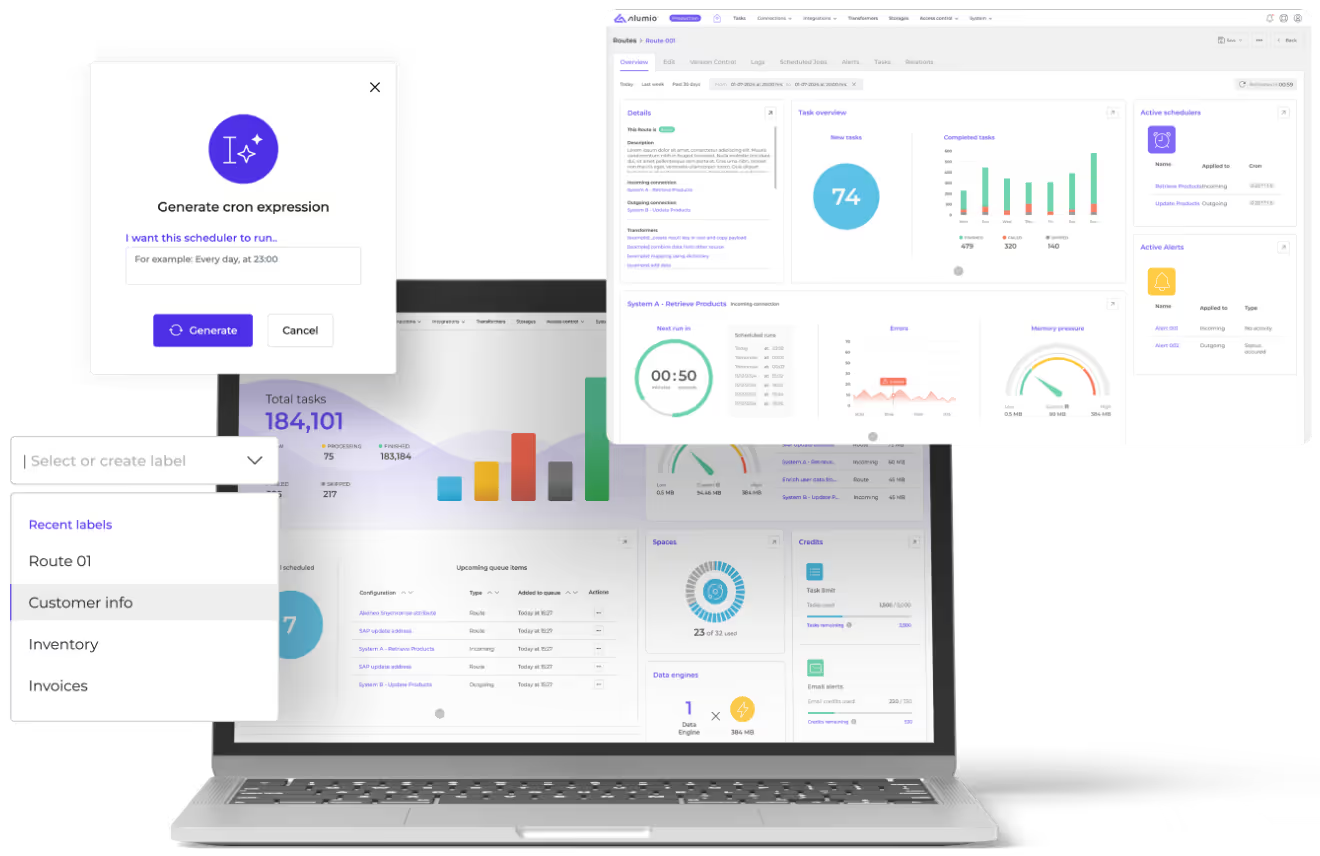
Laptop screen displaying the Alumio iPaaS dashboard, alongside pop-up windows for generating cron expressions, selecting labels and route overview.