What is PHP2Shell, and why does it matter to businesses?
PHP2Shell is the name given to two flaws in the core of PHP, tracked as CVE-2026-109618 and CVE-2026-109619. In plain terms, they allow an attacker to send a specially crafted upload request to a web server running PHP. In the worst case, the attacker can then run their own commands on that server. Both were rated critical, and proof-of-concept exploit code appeared publicly within days.
PHP released fixed versions on the day of disclosure, and national security bodies such as NCSC-NL began tracking which software was affected. Older PHP branches, such as PHP 7.4, no longer receive fixes, so systems still running them need an upgrade rather than a patch.
For a business, the risk sits in what those servers hold. A webshop server handles customer and order data. An integration server usually holds the credentials that connect it to the ERP, the webshop, and the warehouse system, which makes it a valuable target in its own right.
Why a connected stack is harder to patch
Most mid-market companies do not run one PHP system. They run several, owned by different teams and looked after by different partners. The webshop may sit with an agency and the PIM with a vendor. The integration scripts may belong to a developer who built them years ago, on a server nobody has touched since.
When a critical flaw lands, each of those owners has to be found, asked, and chased. Some systems are hosted by the vendor and patched for you. Others are self-hosted, and the update is your job. The hardest ones to spot are the quiet ones, such as a custom integration script on an old PHP version that still moves orders every night.
Patching is only half the work. The other half is knowing whether anything happened before the patch, which means reviewing logs that are spread across as many systems as there are owners. That spread is one reason integration security has become a board-level concern.
What a managed integration platform takes off your list
There are two familiar ways to run integrations. Self-hosted middleware or custom scripts give full control over the environment, and some teams prefer that. The cost is that every security update, firewall rule, and log review for that layer is theirs to handle, often at short notice.
A managed integration platform moves that work to the provider. The business still owns its integrations and can see what runs, but the runtime underneath is kept up to date by a team whose job it is. On the Alumio integration platform, that comes down to four things:
- Security updates applied by the platform team: operating system and runtime updates are rolled out across Alumio-managed environments, so customers do not patch the integration layer themselves.
- Malicious requests filtered at the edge: Cloudflare firewall rules block malicious requests before they reach the platform.
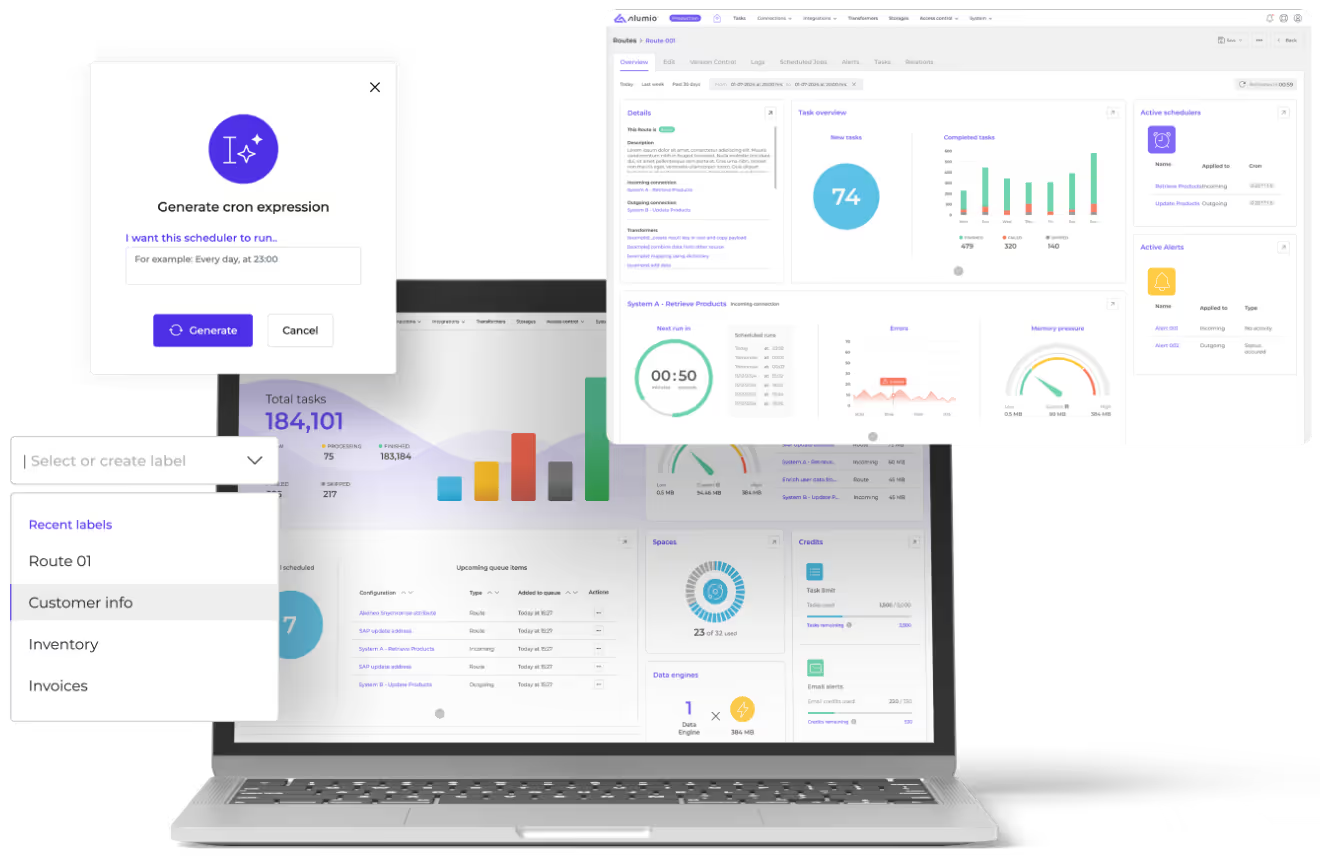
- One place to check what moved: logs and an audit trail show which flows ran and who changed what. A review then covers the whole integration layer at once.
- Access kept tight: role-based access controls who can view or change each flow, and the platform is ISO 27001:2022 certified.
A managed platform does not remove risk from the rest of the stack. It does take one of the hardest systems to patch off the list, and it gives one place to look when the next advisory arrives.
How Alumio handled PHP2Shell
The Alumio platform uses PHP, so the PHP2Shell advisory was relevant to it from the day of disclosure. Cloudflare firewall rules that block malicious requests were already active across the Alumio platform before 21 October 2026, and Cloudflare protection was enabled for customer environments where needed.
As soon as PHP and Ubuntu published their security updates, the Alumio team applied them to all Alumio-managed environments during planned maintenance windows. All affected environments were back online the same day.
The team then reviewed its monitoring data from 15 October 2026 onwards, including Cloudflare firewall events and application error tracking. That review found no evidence that the vulnerabilities had been exploited in Alumio-managed environments, and no indication that customer data had been accessed as a result. No action was required from Alumio customers.
What to ask before the next PHP vulnerability
PHP2Shell will not be the last critical flaw in a technology that much of the commerce stack depends on. The businesses that handled it calmly were the ones that already knew which systems run PHP, who patches each one, and where to look for signs of misuse.
That inventory is worth building now. For each system, ask whether it is hosted by the vendor or by you, how quickly security updates reach it, and who can check its logs. Integration scripts on forgotten servers usually come out of that exercise as the weakest point.
Moving integrations onto a managed platform shortens the list. The integration layer is patched and monitored by the platform team, and the business keeps full visibility of its flows. When the next advisory lands, there is one fewer server to chase and one clear place to confirm what moved.