Why integration security outgrew the IT department
Integration used to be a background task. A developer linked two systems; the data flowed, and as long as nothing broke, no one asked about it. That model made sense when a business ran a handful of systems inside its own walls.
The picture has changed. A modern business connects dozens of partners, SaaS platforms, payment providers, and now AI tools. Each connection is a path into its data. Many of those paths run through systems the business does not own or control. This is where integration security risk now concentrates, and it is larger and less visible than the risk a firewall was built to handle. The standards that certify a platform, such as ISO 27001 certification, exist precisely because this exposure has become a board-level assurance question.
The result is a mismatch. The exposure has grown into a business-level risk, but ownership often sits several layers below the board. That gap is the real problem, and closing it starts with naming integration security as something the board is accountable for.
What a single weak connection actually costs
The danger of an ungoverned integration is not abstract. When a connection to a supplier, a marketing tool, or an AI service is poorly secured, an attacker who reaches that partner can often reach the data flowing through it. The business may not even know the connection exists, because it was set up years ago by someone who has since left.
The consequences land at the top. A breach through a third-party connection still counts as the business's breach in the eyes of regulators and customers. It brings fines, mandatory disclosures, and the slow erosion of trust that follows a headline. Operations can stall while the source is traced, which turns a security event into a revenue event. None of these outcomes stay inside the IT department, which is exactly why the board has a stake in them.
Why are regulators now holding boards accountable?
Because the law has caught up with where the risk sits. New rules across the EU, such as NIS2 and DORA, place responsibility for managing cyber and third-party risk with senior leadership, not only with technical teams.
The direction is consistent. As businesses grow more connected, regulators increasingly treat the security of those connections as a governance duty. Integration security sits squarely in that shift, because most third-party and data-flow risk now travels through integrations. A board that treats it as a technical detail is, in a growing number of jurisdictions, accepting a liability it has not examined. This is the same accountability that already applies to securing AI integrations, where governance has to come before experimentation.
How an integration platform turns scattered risk into one governed layer
The fix is not more point security on each connection. It is structural. When every connection runs through one managed layer instead of dozens of separate, hand-built links, security becomes something a business applies once and oversees centrally.
That structural move is what an iPaaS (integration Platform as a Service) provides. Rather than each team securing its own connections in isolation, the business routes them through a single governed platform. Authentication, encryption, access control, and logging live in that layer, so every flow is handled to the same standard, and every exchange leaves a record. For the board, the value is not the technology. It is that integration risk becomes visible, measurable, and owned, rather than scattered across connections no one is watching.
What does board-level integration security look like in practice?
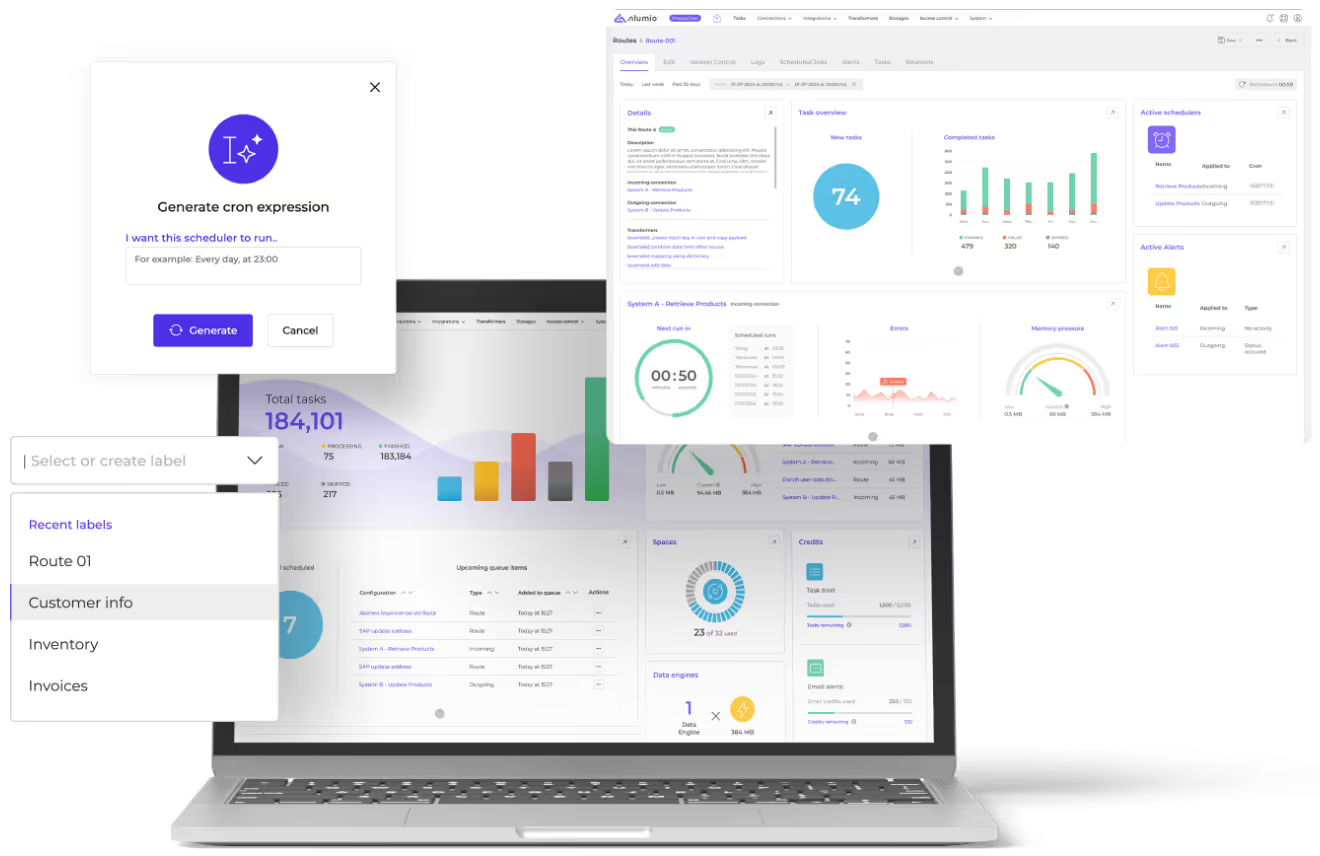
It looks like one platform where every connection is governed and every data flow can be accounted for. The Alumio iPaaS is built for this: a cloud-native platform that routes a business's integrations through one layer, so security and oversight are properties of the platform rather than the habits of whoever built each connection.
In practice, credentials sit under central access control instead of inside scattered scripts, every integration runs as a logged, inspectable flow, and alerts fire when something behaves abnormally. For assurance, the platform is built and hosted in the European Union, ISO 27001 certified, and GDPR-aligned, and most businesses run it with a certified integration partner who governs the connections to policy. That combination gives a board something it has rarely had for integration: a single, auditable view of where data goes and who can reach it.
There is a trade-off worth naming. Concentrating integrations in one layer makes that layer critical, so its own security and uptime matter more than any single connection did. But a governed platform that is watched and certified is a far smaller risk than dozens of connections no one is accountable for.
Making integration security a board-level discipline
Integration security will not go back to being a quiet IT task. The number of connections behind a business keeps growing, and so does the share of its risk that travels through them. The boards that recognize this early will treat integration as something to govern deliberately, with clear ownership and a platform that makes the risk visible.
That is the shift worth making now. Not another security tool bolted onto each connection, but a governed layer that turns scattered, invisible integration risk into something a business can see, measure, and answer for. The businesses that get there will spend less time explaining breaches after the fact, and more time growing with confidence that their connections are under control.





.svg)










.svg)
.svg)
.svg)
.svg)
.svg)
.svg)
