Why isn't production data from the MES ready for reporting?
An MES is built to run the factory floor. It records start and stop events, machine states, quantities, and scrap against each production order, often by the second. Its job is execution, and it does that job well.
The data it produces is shaped for the people on the floor. Machines carry local IDs, scrap reasons are codes an operator picks from a list, and each plant has usually configured its MES in its own way. Business intelligence needs the opposite: the same order, product, and reason codes across all plants and systems.
So before a single dashboard goes live, someone has to rebuild the context. Which order was this, which product, which revision, and which line? That work happens at the handoffs between the MES and the systems around it, and MES integration either holds or breaks there.
Where does data quality break between the MES and planning?
Production orders come down from planning in the ERP, and confirmations go back up. Each crossing is a chance for the two sides to stop agreeing, and the breaks tend to fall in the same four places:
- Order references: an order number reformatted in transit no longer matches the order planning released.
- Units of measure: the MES counts pieces while planning books kilograms, or the reverse.
- Timing: confirmations sent once per shift mean planning works from yesterday's output.
- Scrap and rework: recorded in the MES but booked differently, or not at all, in the ERP.
Each break is small. Together they mean the MES and the ERP report different output for the same week, the kind of drift that undermines data consistency across plant systems. Any report built on either one gets argued with rather than used, and a model trained on either learns the disagreement. Most of these breaks trace back to codes that mean different things in different systems.
Why does master data have to mean the same thing in every system?
Master data is the shared vocabulary of the plant: item numbers, routings, work centres, units, and reason codes. PLM defines the product, the ERP plans it, and the MES executes it. If a work centre is "L3" in the MES and "LINE-03" in SAP or Microsoft Dynamics, each report needs a mapping table to join them.
AI raises the stakes. A person can guess that two codes mean the same machine. A machine learning model cannot, so it learns the inconsistency as if it were a pattern. That is why master data management comes before any serious analytics.
Many manufacturers handle this in the data warehouse, with transformations that clean and map MES data on the way in. That approach is proven and good at reporting on history. But the fix lives only in the warehouse, so planning and the MES still disagree, and each new model or dashboard depends on someone maintaining the mappings.
How an iPaaS gives every system the same production data
Production data has several owners. PLM holds the product definition, the ERP holds orders and stock, and the MES records what happened on the floor. Reporting and AI need one consistent version of all three, assembled before the data reaches planning, a dashboard, or a model. An iPaaS can carry that role without taking ownership away from any of them. It applies the agreed definitions as data moves, so planning, the data warehouse, and the business intelligence tools built on it receive the same version. Records can also pass data validation there before any system accepts them.
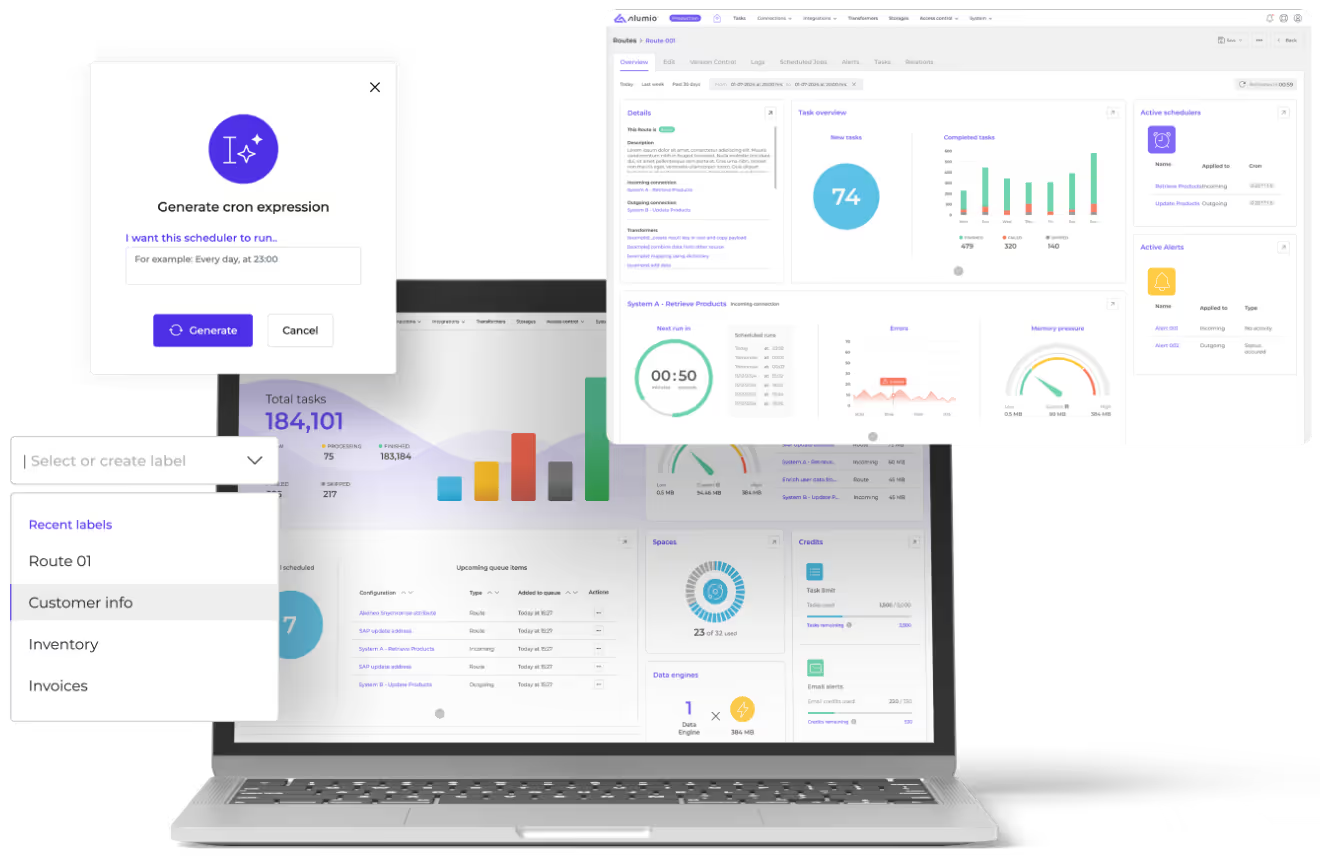
In practice, a manufacturer connects its plant and business systems to the platform once. The platform transforms data into the format each system understands and automates the exchange in real time or on a schedule.
The Alumio integration platform provides features that can be configured around the MES and the systems that depend on it:
- Confirmations reach planning in the right shape: a Route between the MES and the ERP can turn each confirmation into the quantities, units, and order references planning expects.
- One set of codes across every plant: a Transformer between the MES and the data warehouse can map local machine, work-centre, and scrap codes to one common set.
- The floor works from the current product definition: a Route between PLM and the MES can pass each released revision, so production and reporting use the same version.
- Every change is traceable and the data secured: version control, approval workflows, and audit trails show who changed a mapping, and when. The platform is ISO 27001 certified, so production data moves under a recognised security standard.
Where to start: from MES integration to analytics and AI
Many manufacturers spend their Industry 4.0 budget on dashboards and AI tools before the data underneath means the same thing in each system. The production data is usually already there, but nobody has agreed what it means once it leaves the MES. Until that changes, manufacturing data analytics produces dashboards that operations and finance read differently.
The practical start is one flow that feeds one decision, such as output and scrap per line. Agree the definitions for that flow, covering order, item, work centre, and reason code, and apply them in the integration layer. On an integration platform like Alumio, that first flow typically goes live in weeks, not months. The MES, planning, and the data warehouse then work from the same numbers, and the data team stops rebuilding context for each request.
Each further step costs less than the first. A second plant, a new dashboard, or a machine learning use case connects to definitions that already hold. When the MES itself is replaced or a new factory comes online, the definitions stay in the layer rather than leaving with the old system.