What is master data management (MDM)?
Master data management is the practice of creating and maintaining one agreed version of a business's core records and distributing that version to every system that needs it. Master data is the slow-changing, definitional data: what a product is, who a customer is, which supplier delivers what. It differs from transactional data, the fast-moving records of what happened, like orders, shipments, and stock movements.
The distinction matters because master data is referenced everywhere. Every order line points at a product record and a customer record. When those records differ between systems, every transaction built on them inherits the conflict. A wrong stock count corrupts one decision. A wrong product record corrupts every decision that touches the product.
That reach is why MDM has outgrown its enterprise-only reputation. Any business running an ERP, a webshop, a PIM, and a CRM already has a master data problem in practice. The only question is whether it is managed.
Why does master data break as businesses grow?
Master data breaks because every system creates its own version of the records it needs. The webshop team adds a product before the ERP entry exists. Sales creates a customer in the CRM that finance already has under a slightly different name. An acquisition brings a second ERP with its own item numbering. None of these are errors at the moment they happen. They become errors when the versions meet.
Unmanaged, the forks compound quietly. Duplicate customer records split order history and break reporting. Conflicting product data shows customers different specifications on different channels. This is a different failure mode from data consistency problems in transactional flows, where the same fact drifts between systems in real time. Master data breaks at the definition level, and no amount of syncing fixes records that were never reconciled in the first place.
MDM strategy: golden records and data ownership
The core of any MDM strategy is the golden record: the single, authoritative version of each master data entity, assembled from the best available sources and cleaned of duplicates. Every system either contributes to the golden record or consumes it. What no system gets to do is quietly maintain its own competing version.
Making that work requires deciding where each golden record lives, following the same logic as a single source of truth: authority assigned per data domain, not one system ruling everything. The ERP typically owns customers and financial records. Product content often lives best in a PIM. Alongside ownership sit the quality rules, formats, required fields, and deduplication checks, and a named owner for each domain. An MDM strategy that exists only as a document changes nothing; it has to be enforced where the data actually moves.
MDM vs PIM: where each one fits
MDM and PIM (Product Information Management) overlap on products, which causes regular confusion, but they solve different problems. A PIM manages the depth of product content: descriptions, specifications, images, and translations, prepared for every sales channel. MDM manages the breadth of core records across all domains: products, but also customers, suppliers, and assets.
In practice they are complementary. A PIM frequently serves as the golden source for product content within a broader MDM approach, while the ERP remains the golden source for commercial and logistical product data. That split is exactly why PIM ERP integration is where product master data most often forks: two systems, each legitimately authoritative for part of the record, exchanging updates in both directions. Businesses that define which fields each system owns, and enforce it in the exchange, get the benefits of both without the conflicts.
How to integrate master data management with ERP, PIM, and CRM
Integrating master data management means connecting every system that uses master data through one governed layer, so the golden record is the only version that travels between them. An MDM strategy that lives in a policy document changes nothing, because records fork wherever systems exchange data without rules. Enforcement means the ownership map and quality rules are built into the actual connections: the flows that carry a product from the PIM to the webshop, or a customer from the CRM to the ERP.
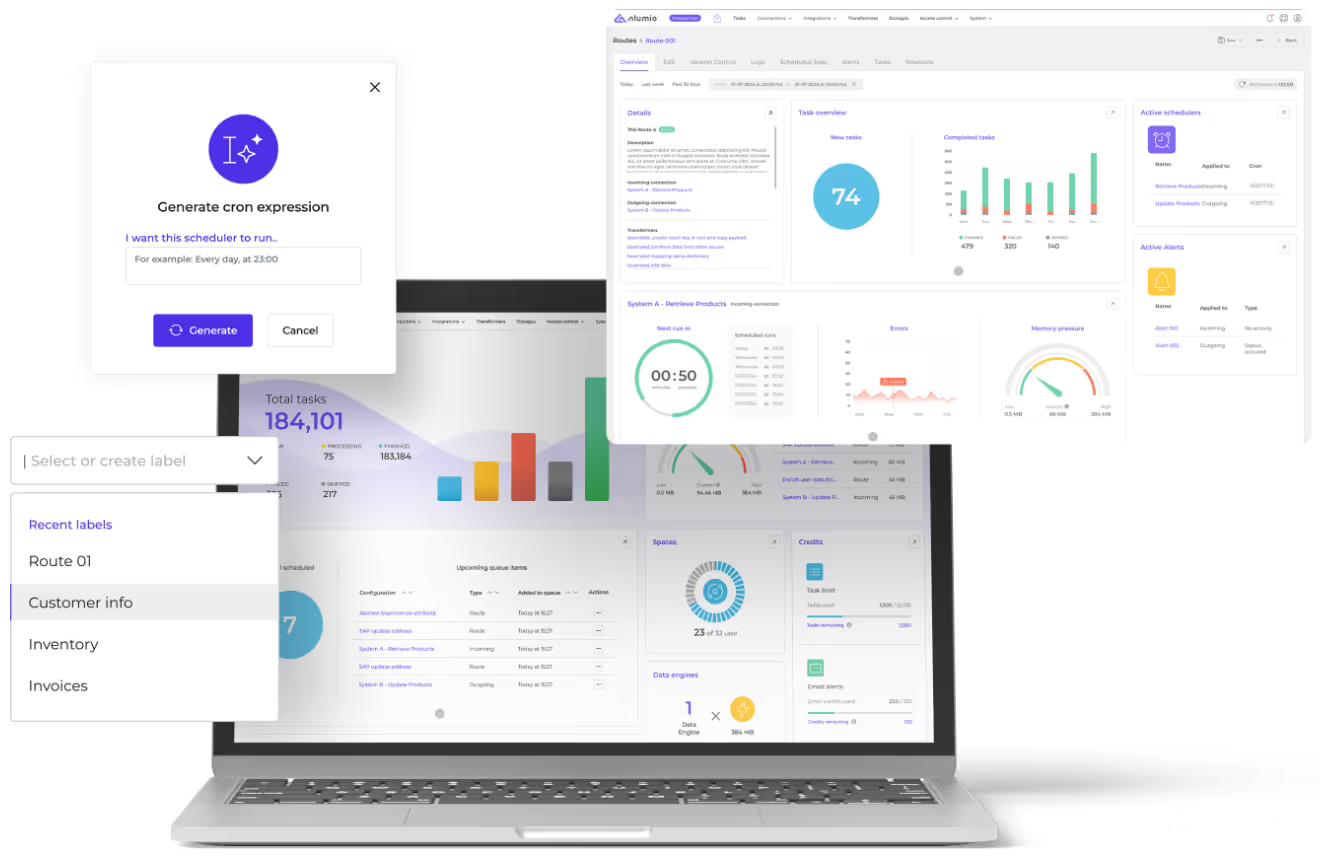
This is where an integration layer earns its place in MDM. An iPaaS (integration Platform as a Service) connects every system to one managed hub that controls which system may update which fields, validates records in transit, and propagates golden record changes to every consumer. It is also why the overlap between the two categories runs one way: an integration platform can carry the core of master data work, while an MDM tool cannot take over integration, since it governs records but cannot move data between live systems.
Dutch cycling wholesaler AGU, which distributes more than 25,000 products across B2B and B2C channels, shows what this looks like in practice. AGU connected its Centric ERP, Adobe Commerce webshop, and Akeneo PIM through the Alumio iPaaS, normalizing its data entities so every channel sells from the same records and future systems plug into the same clean structure. The enforcement is configuration rather than custom code: transformations normalize formats, validation rejects records that break the rules, and audit trails show which version of a record went where.
Master data management as a foundation for growth
Bad master data taxes a business in ways that rarely get itemized: duplicate records to merge, channel conflicts to explain, reports to reconcile before anyone acts on them. Clean master data removes that tax, and it compounds. Every new channel, system, or market launched on governed records starts consistent instead of starting a new fork.
There is a forward-looking reason to care as well. Automation and AI initiatives are only as good as the records they run on, and master data is where those records are defined. Businesses that treat MDM as infrastructure, golden records enforced where the data actually flows rather than policed by hand, are building the foundation that everything else, from the next storefront to the first AI use case, quietly depends on.





.svg)









.svg)
.svg)
.svg)
.svg)
.svg)
.svg)
