

Integrate the best PLM, ERP, and MES systems

Connect now
A Alumio vivid purple arrow pointing to the right, a visual representation of how to access more page material when clicking on it.
Go back

Connecting the digital thread for manufacturers: PLM to ERP to MES

By
Saad Merchant
Published on
May 1, 2026
Updated on
May 1, 2026
IN CONVERSATION WITH
Email icon
Email icon

In manufacturing, a product goes through many hands before it reaches the shop floor. Engineers define it in a PLM system. Procurement and finance plan around it in the ERP. The production team executes against it in the MES. When those three systems share data accurately and automatically, manufacturers have what is increasingly called a digital thread: a continuous, connected flow of product information from design through production. When they do not, the gaps between those systems become the most common source of engineering errors, production delays, and costly rework. Building that thread is not primarily a software problem. It is an integration problem.

Why PLM, ERP, and MES integration is the foundation of digital manufacturing

Most manufacturers run PLM, ERP, and MES as separate systems, each doing its job well in isolation. The problem is the handoffs between them. A design team updates a component dimension in the PLM. Production continues with the old drawing. Procurement orders the wrong part. Quality flags a deviation. By the time anyone traces the source, the cost in rework, scrap, and delays has already accumulated. The failure did not happen in one place. It happened in the gaps between systems.

The commercial consequences of those gaps are significant. Engineering changes that do not reach the ERP in time trigger incorrect procurement orders. Production runs started against superseded BOMs generate scrap and rework costs. Quality deviations that cannot be traced back to a design revision create compliance exposure. Each of these is a direct financial cost, and each one is preventable when the integration between systems is governed rather than manual.

The eBOM to mBOM handoff: where most breaks occur

The engineering Bill of Materials (eBOM) lives in the PLM. It represents design intent: what the product is, how it is structured, and what it is made of. The manufacturing Bill of Materials (mBOM) lives in the ERP. It represents production intent: what gets built, in what sequence, at what cost.

These two BOMs are related but not identical. The transformation from eBOM to mBOM involves structuring design data for procurement, costing, and production routing, and it is one of the most error-prone steps in the product lifecycle when handled manually. When it is not governed by an automated integration, discrepancies accumulate every time an engineering change is made.

What a connected digital thread actually looks like

A digital thread connects PLM, ERP, and MES so that product data flows automatically between them throughout the product lifecycle, not just at project handover. When an engineer releases a new BOM revision in the PLM, the integration layer picks up the change, transforms the eBOM into the mBOM structure the ERP expects, and updates the relevant procurement records, cost structures, and production orders. When the ERP releases a work order, the MES receives the routing instructions it needs to execute. When production data comes back from the shop floor, quality and yield figures flow upstream to close the loop.

The integration layer that holds it together

Each of these systems has its own data model, API behavior, and timing requirements. PLM changes can be event-driven: a released engineering change order should propagate immediately. ERP-to-MES work order flows may be synchronous or scheduled depending on production cadence. None of these systems was designed to talk directly to the others out of the box.

An integration platform-as-a-service (iPaaS) sits between PLM, ERP, and MES and manages how data moves between them. It handles the data model transformation between eBOM and mBOM, routes engineering change orders to downstream systems, synchronizes work orders to the MES, and provides centralized monitoring and error handling that manual handoffs cannot offer.

PLM to ERP: engineering change order synchronization

When a design change is approved in the PLM, it needs to reach the ERP before affected components are ordered or a production run is scheduled. An automated integration routes the engineering change order from PLM to ERP, updates the mBOM, and flags any open purchase orders or production orders referencing affected components. Without this, procurement teams work from outdated BOMs, and production starts running against superseded designs.

ERP to MES: work order and routing synchronization

When the ERP creates a production order, the MES needs the work order, routing sequence, and component requirements to execute it. An integration between ERP and MES ensures this data arrives in the format and at the time production planning requires, whether event-driven on order release or batch-synchronized at shift start. This eliminates the manual re-entry of production data that is one of the most consistent sources of shop floor errors.

MES to PLM: closed-loop feedback

Production data including actual cycle times, yield rates, and quality outcomes can flow back upstream through the integration layer to inform engineering and process improvement decisions. This closed-loop feedback is what turns a one-directional data push into a genuine digital thread, where production reality informs future design decisions rather than existing only in the MES.


Turn AI ambition into action

Portrait of Leonie Becher Merli, Business Development Manager at Alumio

Get a free assessment of your integration needs and next steps

Portrait of Leonie Becher Merli, Business Development Manager at Alumio

Ready to build your digital thread with a scalable integration backbone?

Ready to build your digital thread with a scalable integration backbone?

How Alumio connects PLM, ERP, and MES for manufacturers

Alumio is a cloud-native, low-code integration platform-as-a-service that connects manufacturing systems through a central governed layer. It supports connectors for PLM platforms, including SAP PLM, PTC Windchill, and Siemens Teamcenter, alongside ERP and MES systems, enabling manufacturers to build the data flows that constitute a digital thread without bespoke custom code for each connection.

Data transformations between eBOM and mBOM structures are managed within Alumio's transformation layer, which handles the field mapping, data model differences, and conditional logic that the conversion between engineering and manufacturing structures requires. Engineering change events trigger automated downstream updates rather than relying on a developer to initiate them manually. Centralized monitoring across all flows gives manufacturing IT teams the visibility to know when a handoff between PLM, ERP, or MES has failed. This allows them to act on it before the error reaches the production floor as a mismatch, a shortage, or a quality deviation.


The digital thread only works if the integration behind it does

Choosing the right PLM, ERP, and MES is a necessary condition for digital manufacturing. It is not a sufficient one. The value of those systems depends on how reliably they share data across the full product lifecycle.

The digital thread is not a single system. It is the result of well-governed integrations between systems, built to handle the data model differences, timing requirements, and error conditions that manual handoffs cannot. Every gap in that thread is a point where an engineering change can be missed, a production order can be wrong, or a quality issue can go untraced until it is expensive.

For manufacturers working toward that architecture, a central integration layer is what makes the thread continuous rather than fragmented at every system boundary.

No items found.

FAQ

Integration Platform-ipaas-slider-right
What is a digital thread in manufacturing?

A digital thread is a continuous, connected flow of product data across the full product lifecycle, from engineering design in the PLM through procurement and costing in the ERP to shop floor execution in the MES. It ensures that product information is consistent, current, and traceable across every system and every stage of production.

Integration Platform-ipaas-slider-right
What is the difference between an eBOM and an mBOM?

An engineering BOM (eBOM) is created in the PLM and represents the design intent of a product: its components, structure, and specifications as defined by engineering. A manufacturing BOM (mBOM) is used in the ERP and represents how the product will actually be built: the production sequence, procurement requirements, and cost structure. Transforming the eBOM into the mBOM accurately is one of the most critical integration steps in building a digital thread.

Integration Platform-ipaas-slider-right
Why is PLM to ERP integration so difficult in manufacturing?

PLM and ERP systems use different data models, terminology, and structures for representing product information. The transformation from eBOM to mBOM requires mapping logic that accounts for those differences. When handled manually or through fragile custom scripts, engineering changes fail to propagate correctly, leading to production errors and procurement mistakes.

Integration Platform-ipaas-slider-right
How does MES fit into the digital thread?

The MES receives work orders, routing instructions, and component requirements from the ERP and uses them to execute production on the shop floor. In a connected digital thread, the MES also sends production data back upstream, including yield rates, cycle times, and quality outcomes, that can inform engineering and process improvement decisions in the PLM.

Integration Platform-ipaas-slider-right
What role does an integration platform play in building a digital thread?

An integration platform manages the data flows between PLM, ERP, and MES, handling data model transformations, routing logic, and timing requirements at each handoff. It provides centralized monitoring and error handling across all flows, so that a failed data transfer is detected and addressed before it causes a downstream production problem.

Integration Platform-ipaas-slider-right
How does Alumio support PLM, ERP, and MES integration for manufacturers?

Alumio provides a central integration layer connecting PLM platforms, including SAP PLM, PTC Windchill, and Siemens Teamcenter, with ERP and MES systems. It manages eBOM-to-mBOM transformations, routes engineering change orders to downstream systems, synchronizes work order data to the MES, and provides centralized monitoring that manufacturing IT teams need to govern data flows across the full digital thread.

Get a free assessment of your integration needs

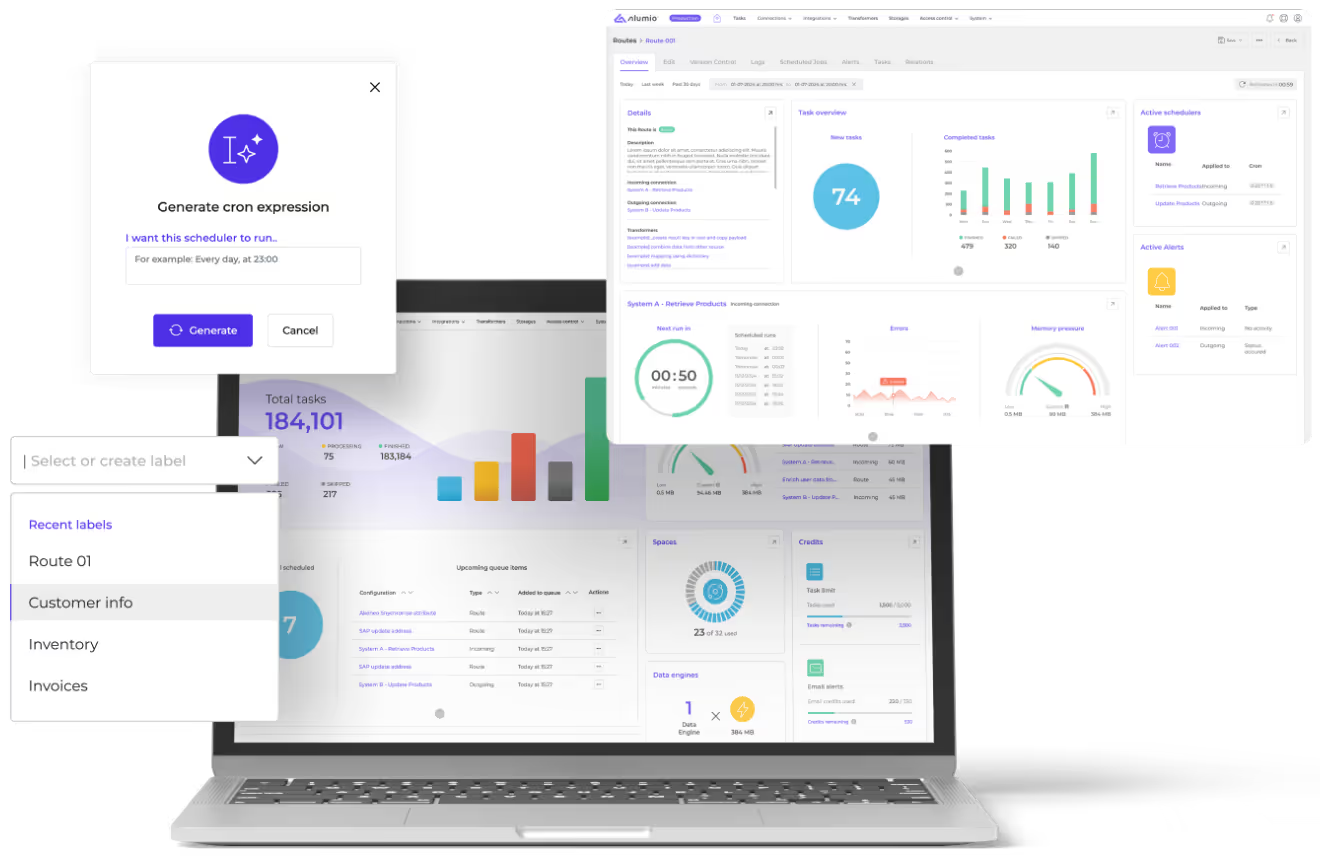
Laptop screen displaying the Alumio iPaaS dashboard, alongside pop-up windows for generating cron expressions, selecting labels and route overview.