


A Alumio vivid purple arrow pointing to the right, a visual representation of how to access more page material when clicking on it.
Go back

Integrating third-party systems from one central system

By
Published on
August 3, 2021
Updated on
June 24, 2026
IN CONVERSATION WITH
Email icon
Email icon

For businesses to be successful, we genuinely believe it's vital to have a connected IT ecosystem. Everything and everyone in your digital ecosystem should connect across channels, devices, and platforms. Companies with a connected infrastructure are far outpacing their competitors. This blog is for companies with digital ambition. We'll look at one of the reasons why you should be thinking of an integration strategy: machine learning and artificial intelligence.

McKinsey followed a selection of major retailers already using and experimenting with artificial intelligence in the following areas:

  • Products and prices - product prices (B2C and B2B), trends, upsell related products, personalized promotions and pricing
  • Warehouse and stock - optimized stock levels, purchases, and purchase prices
  • Planning - demand forecasting
  • Returns - how returns are handled
  • R&D - automatized test processes, speed-up R&D, and predicted outcomes
  • Customers - automatized customer segments and profiling interests

"Companies who are using Ml and AI to run their business are 35% more successful." - McKinsey

AI requires a significant amount of data to be effective, especially from different parts of the customer journey.

  • Pricing
  • Delivery satisfaction
  • RMA & Returns
  • Support tickets
  • Financial data
  • Weather
  • Customer Satisfaction
  • Speed of service / delivery
  • Contact sales / physical store

This blog, 'Machine Learning and Artificial Intelligence,' only showed one of the eight advantages of why it is interesting to include an integration platform in your IT infrastructure. Learn more about the benefits of an iPaaS in our other blogs or download the white paper: '8 Reasons to have an iPaaS solution in your IT eco-system.'


Turn AI ambition into action

Portrait of Leonie Becher Merli, Business Development Manager at Alumio

Get a free assessment of your integration needs and next steps

Portrait of Leonie Becher Merli, Business Development Manager at Alumio

No items found.
Topics in this blog:
No items found.

FAQ

Integration Platform-ipaas-slider-right
What does it mean to integrate third-party systems from one central system?

Integrating third-party systems from one central system means connecting all external applications, SaaS tools, and data sources through a single integration backbone rather than building separate point-to-point connections between every pair of systems. The central platform (an iPaaS like Alumio) acts as the hub: each system connects once to the backbone, and all data flows, transformations, and monitoring are managed in one place. This architectural approach is what allows a growing system landscape to remain manageable rather than becoming an uncontrollable web of custom connectors.

Integration Platform-ipaas-slider-right
Why do companies with connected IT infrastructure outpace competitors?

Companies with connected IT infrastructure outpace competitors because connectivity enables speed: new digital capabilities connect to the existing backbone rather than requiring bespoke integration projects, data flows in real time enabling faster decisions, and operational automation removes the manual steps that slow every business process. Disconnected organizations are limited by their slowest system: the one that requires manual data export to share information with others. Connected organizations are limited only by the speed of the market, because their technology landscape responds as fast as events occur.

Integration Platform-ipaas-slider-right
What is the hub-and-spoke integration model and how does Alumio implement it?

The hub-and-spoke integration model places a central integration platform (the hub) between all connected systems (the spokes). Each system connects once to the hub rather than directly to every other system, reducing the total number of connections from N×(N-1)/2 point-to-point links to N hub connections as the system count grows. Alumio implements this through its governed integration backbone: each connected system has its own connector, and Routes between systems are configured in the platform rather than coded between each system pair. Adding a new system requires one new connector and new Routes, not N new custom integrations to existing systems.

Integration Platform-ipaas-slider-right
What are the most important third-party systems to integrate for digital ambition?

For businesses with digital ambitions, the most important third-party systems to integrate are: ERP (the financial and operational backbone), e-commerce platform (the revenue-generating storefront), PIM (the product data master), WMS or 3PL (the fulfillment backbone), CRM (the customer relationship master), and marketing automation tools (the revenue activation layer). These six systems form the core digital commerce ecosystem; connecting them through a central backbone is the foundation on which AI, analytics, and new channel capabilities are built as the business grows.

Integration Platform-ipaas-slider-right
How does Alumio help businesses with digital ambition build connected ecosystems?

Alumio helps ambitious businesses build connected ecosystems through its prebuilt connector library (covering the most common third-party systems), config-first Route architecture (reducing the time and expertise needed to configure new data flows), and governed monitoring infrastructure (making the connected ecosystem visible and manageable as it grows). The platform is designed to scale with the business: each new system connected to Alumio benefits from the existing backbone infrastructure rather than requiring a new custom integration approach, which is what makes digital ambition operationally achievable rather than architecturally aspirational.

Integration Platform-ipaas-slider-right
What are the risks of not centralizing third-party system integrations?

The risks of not centralizing integrations are: undocumented custom connections that break silently and are difficult to diagnose, knowledge concentration in the developers who built each connection, no monitoring layer so failures are discovered by customers rather than by the team, exponentially growing maintenance complexity as new systems are added, and the inability to provide a consistent audit trail of data flows for compliance or debugging purposes. These risks are individually manageable for one or two integrations but become strategically limiting once the system landscape reaches five or more connected applications.

Get a free assessment of your integration needs

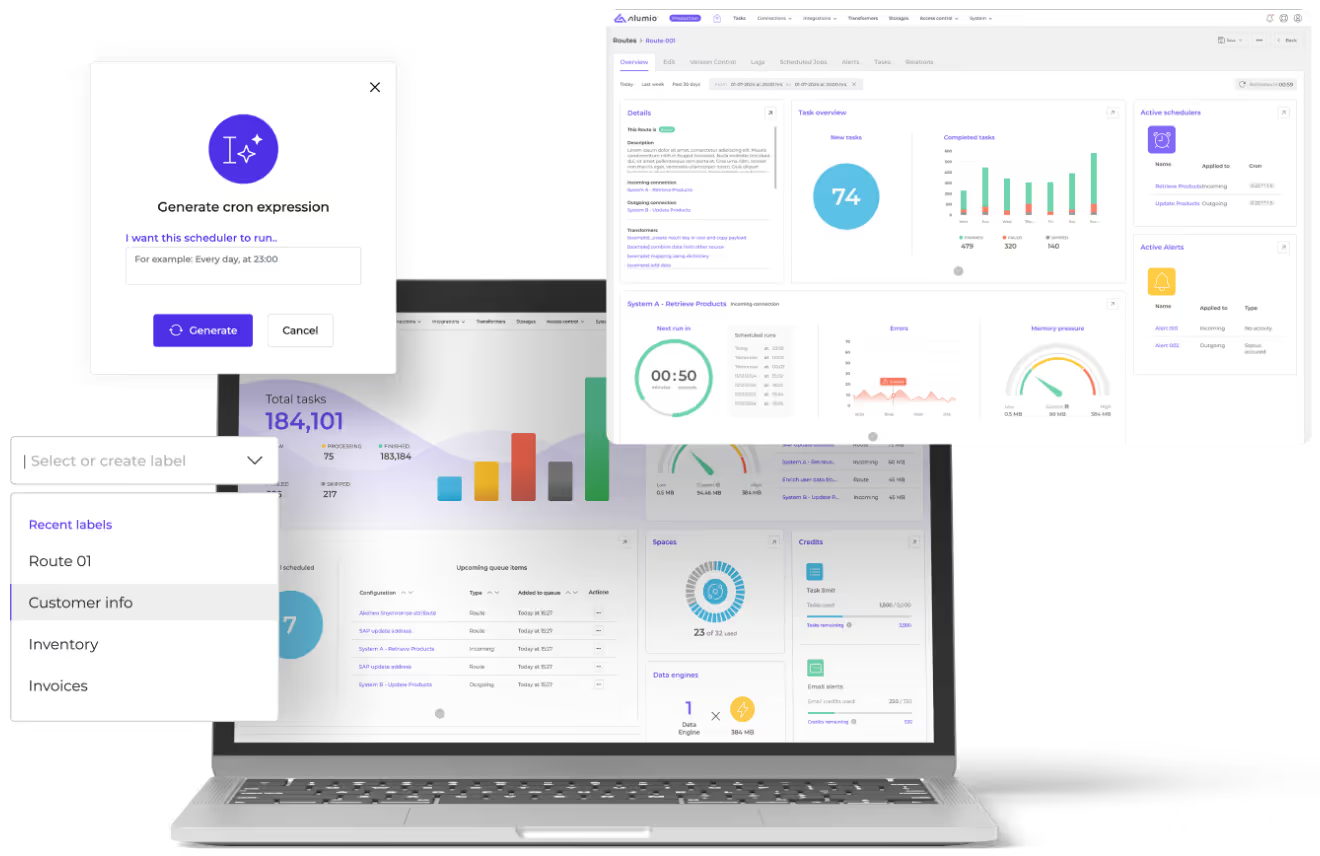
Laptop screen displaying the Alumio iPaaS dashboard, alongside pop-up windows for generating cron expressions, selecting labels and route overview.