


A Alumio vivid purple arrow pointing to the right, a visual representation of how to access more page material when clicking on it.
Go back

Get a 360 customer view with the Alumio iPaaS

By
Published on
December 7, 2020
Updated on
June 24, 2026
IN CONVERSATION WITH
Email icon
Email icon

E-commerce has transformed how we shop, giving customers the convenience of browsing and purchasing products online. With this digital shift, the customer journey has become more complex, spanning various touchpoints from discovery to checkout. To truly excel in this landscape, businesses need a comprehensive understanding of their customer's behavior and preferences. Enter Alumio, the integration platform that empowers e-commerce businesses with a 360-degree customer view, revolutionizing how you engage with your audience.

The power of a 360-degree customer view

Alumio’s integration prowess enables you to seamlessly connect and consolidate customer data from diverse sources and get 360-degree insights into all the connected systems across your entire IT landscape. By uniting information from CRM systems, social media interactions, email campaigns, and more, you gain a holistic view of each customer. This 360-degree perspective unlocks valuable insights into shopping patterns, preferences, and pain points.

Why is it crucial to create a seamless customer journey?

In the realm of e-commerce, the customer journey is a series of interconnected touchpoints that guide shoppers from consideration to conversion. A disjointed experience can lead to frustration and abandonment, while a seamless journey can turn casual visitors into brand advocates.

Learn how to ensure a seamless journey for your customers.

What role do integrations play in e-commerce success?

Integrations lie at the heart of a frictionless customer journey. Alumio’s iPaaS (Integration Platform as a Service) capabilities allow you to effortlessly connect various systems and applications. Whether it’s synchronizing inventory between your e-commerce platform and backend systems or seamlessly updating customer data across different touchpoints, Alumio’s integrations ensure your entire IT landscape is connected and information is never lost.

Creating cohesion across channels

Picture this: a customer discovers your brand through a captivating social media ad, explores your e-commerce site, and then receives a personalized email with product recommendations. Alumio’s integration platform orchestrates this symphony of touchpoints, ensuring that each step complements the previous one. The result? A consistent, memorable, and delightful journey that encourages conversions.

Read our blog on omnichannel customer experiences.

Uniting e-commerce and customer data

Central to Alumio’s prowess is its ability to consolidate customer data in real-time. No more manual data entry or siloed information. Alumio seamlessly synchronizes customer data across your e-commerce platform, CRM, marketing tools, and more. This ensures that every interaction is informed by the latest insights, creating a unified and relevant customer journey.

Real-time Insights for Informed Decisions

Imagine having the ability to track a customer’s journey from their initial visit to the final purchase, all in real-time. Alumio’s integration platform equips you with actionable insights that help you fine-tune your strategies on the fly. Adjust marketing campaigns, optimize product recommendations, and address pain points promptly, all while delivering a superior customer experience.

Conclusion

In the ever-evolving e-commerce landscape, delivering an exceptional customer journey is paramount. Alumio’s integration platform empowers businesses to seamlessly connect customer data, insights, and touchpoints, enabling a 360-degree view that transforms interactions into lasting relationships. By providing a 360-degree customer view and seamlessly connecting touchpoints, Alumio empowers you to create a customer journey that captivates, converts, and cultivates loyalty. Elevate your e-commerce game with Alumio and craft a journey that leaves a lasting imprint on your customers’ hearts and minds.


Turn AI ambition into action

Portrait of Leonie Becher Merli, Business Development Manager at Alumio

Get a free assessment of your integration needs and next steps

Portrait of Leonie Becher Merli, Business Development Manager at Alumio

No items found.
Topics in this blog:
No items found.

FAQ

Integration Platform-ipaas-slider-right
What is a 360-degree customer view and why is it valuable for e-commerce?

A 360-degree customer view is a unified profile that aggregates all data about a customer from every touchpoint and system: e-commerce browse and purchase history, CRM interaction records, marketing engagement data, customer service contacts, loyalty status, and in-store or offline transactions. It is valuable for e-commerce because it enables truly personalized customer experiences (recommendations, communications, and service that reflect the customer's full relationship with the brand), reduces customer service resolution time (agents see the complete context), and improves marketing segmentation accuracy (segments based on total customer value, not just one channel's data).

Integration Platform-ipaas-slider-right
How does Alumio iPaaS help businesses achieve a 360-degree customer view?

Alumio achieves a 360-degree customer view by connecting all the systems that generate customer data (e-commerce, CRM, marketing automation, ERP, loyalty platform, customer service tool) through a governed integration backbone. Customer data from each system flows to a designated master (typically the CRM or CDP) while each system also receives the customer context it needs from others. Rather than each system maintaining its own isolated customer record, Alumio's data flows keep all systems synchronized from the authoritative source, creating the unified profile that makes personalized service operationally possible.

Integration Platform-ipaas-slider-right
What data sources contribute to a complete 360-degree customer profile?

A complete 360-degree customer profile draws from: the e-commerce platform (browse behavior, purchase history, cart data, wishlist items), the CRM (contact details, sales interactions, account tier, relationship history), marketing automation (email engagement, campaign responses, content interests), customer service tools (support ticket history, issue types, satisfaction scores), the ERP (order history, payment behavior, credit status), and the loyalty platform (points balance, reward redemptions, tier status). Each of these data sources requires an integration connection to the central profile store, which is why 360-degree customer views are an integration project as much as a data project.

Integration Platform-ipaas-slider-right
How does a 360-degree customer view improve personalization in e-commerce?

A 360-degree view improves personalization by enabling recommendations, communications, and pricing that reflect what the brand actually knows about the customer rather than what is visible in a single channel. A customer who has been a loyal B2B account for three years receives different treatment than a new visitor; a customer who browsed a category but did not purchase receives a targeted email; a high-value customer with a service issue is prioritized in the support queue. Each of these personalization actions requires data from multiple systems unified in a single profile, which is what the integration backbone enables.

Integration Platform-ipaas-slider-right
What are the main technical challenges of building a 360-degree customer view?

The main challenges are: identity resolution (the same customer may exist in multiple systems with different email addresses, account IDs, or names), data latency (real-time personalization requires near-real-time data synchronization, not nightly batch exports), data model reconciliation (each system represents customer attributes differently), GDPR compliance (the unified profile contains personal data that must be governed, auditable, and deletable on request), and master data governance (which system is authoritative for each customer attribute when systems conflict). Each of these is an integration architecture problem that must be solved at the data flow design stage, not after the profile store is built.

Integration Platform-ipaas-slider-right
How does Alumio support GDPR compliance in customer data integration?

Alumio supports GDPR compliance in customer data integration through: full audit logging of every customer data exchange (providing the traceability required for data subject access requests), role-based access controls on Routes involving personal data (limiting who can configure or modify customer data flows), data minimization enforcement via Transformer components (ensuring only necessary personal data fields flow to each destination system), and propagation of deletion or anonymization events across all connected systems when a customer exercises their right to erasure. The ISO 27001:2022 certification covering Alumio's platform provides independent verification that these controls meet internationally recognized security standards.

Get a free assessment of your integration needs

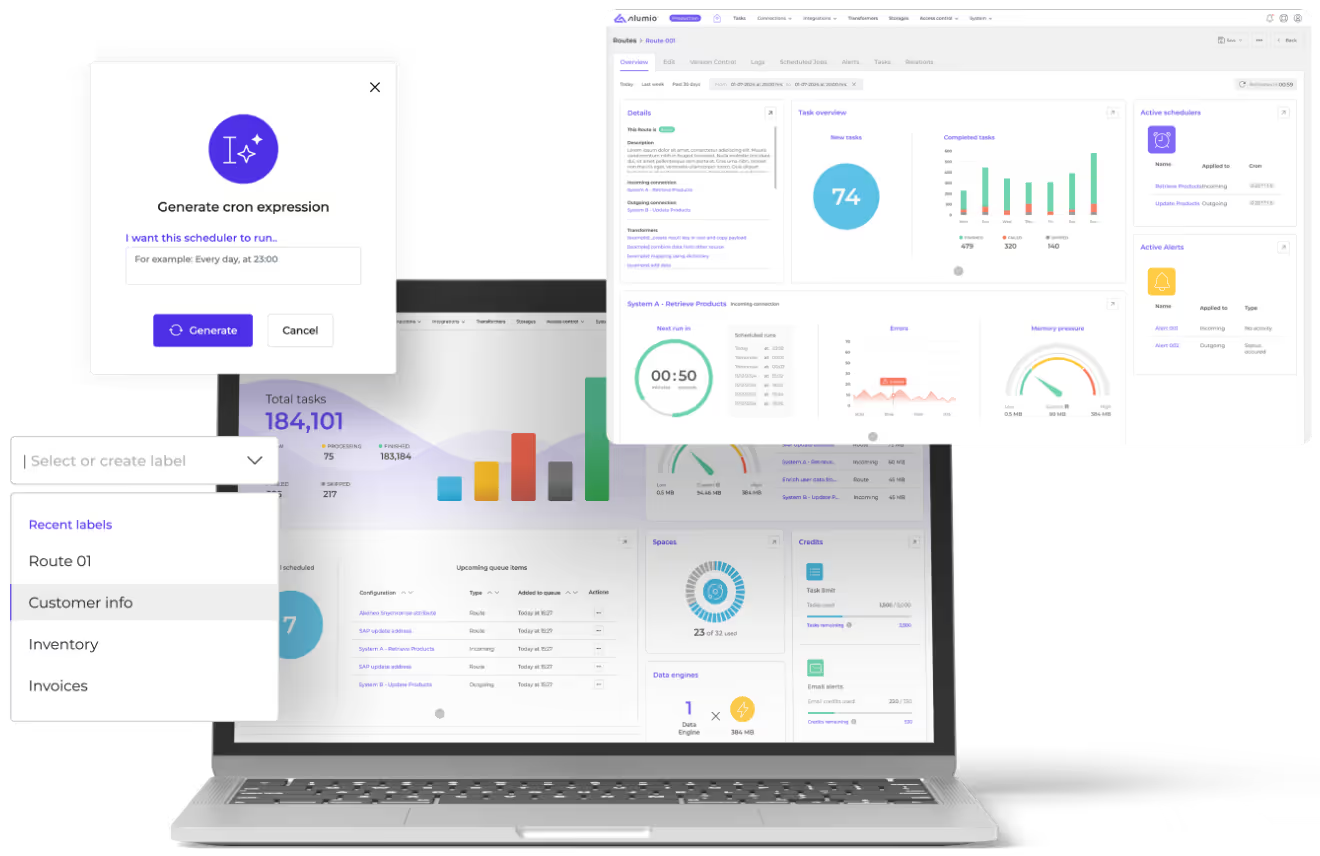
Laptop screen displaying the Alumio iPaaS dashboard, alongside pop-up windows for generating cron expressions, selecting labels and route overview.