




.svg)



Let's consider the following scenario:
You are a business owner looking to upgrade your business to increase revenue, so you decide to complement your physical store with a webshop to sell your products online. This way, you can expand your market reach and access new customer segments, improve operational efficiency and reduce manual efforts, enable scalability and adaptability to changing business needs, and as a result, increase your sales and revenue.
Setting up a webshop seems like a smart move for your business, so you look at the following steps:
What systems do you need to integrate to run an online business?
These will likely include but are not limited to an e-commerce platform such as Adobe Commerce, BigCommerce, Shopify, or Commercetools, a CRM system like Salesforce, an ERP system like SAP, Microsoft Dynamics 365, or Sage, a PIM system like Akeneo or Pimcore, and a marketplace software solution, like ChannelEngine that will connect your e-commerce store with marketplaces like Amazon or Bol.com.
These are just a few examples of the basic systems you need to ensure the optimal functioning of an online business. Yet, there are many more: according to Statista, “Since 2021, companies worldwide have been using an average of 110 SaaS (Software as a Service) applications.” However, without integration, these systems will function independently and form silos, risking the loss of valuable data and forming what we call an entangled IT ecosystem consisting of data silos and a jungle of crisscrossing data flows. This brings us to our next question:
How can you integrate different systems for e-commerce?
In short: with an iPaaS (integration Platform as a Service) that acts as middleware, bridging the gap between systems and ensuring full data synchronization. Once you have an iPaaS set up, the different systems are no longer separate elements and become a unified group, also known as an integrated IT landscape.
However, with all the different iPaaS vendors on the market, it can be difficult to find one solution that perfectly fits your needs. A popular solution that is making waves in the e-commerce sector is the Alumio iPaaS.
What is an iPaaS?
An iPaaS (integration Platform as a Service) is a cloud-based middleware that allows businesses to connect two or more systems, SaaS solutions, cloud applications, or data sources from one central hub. As such, it provides a range of tools and services for connecting, mapping, and transforming data between various applications and systems.
The Alumio iPaaS
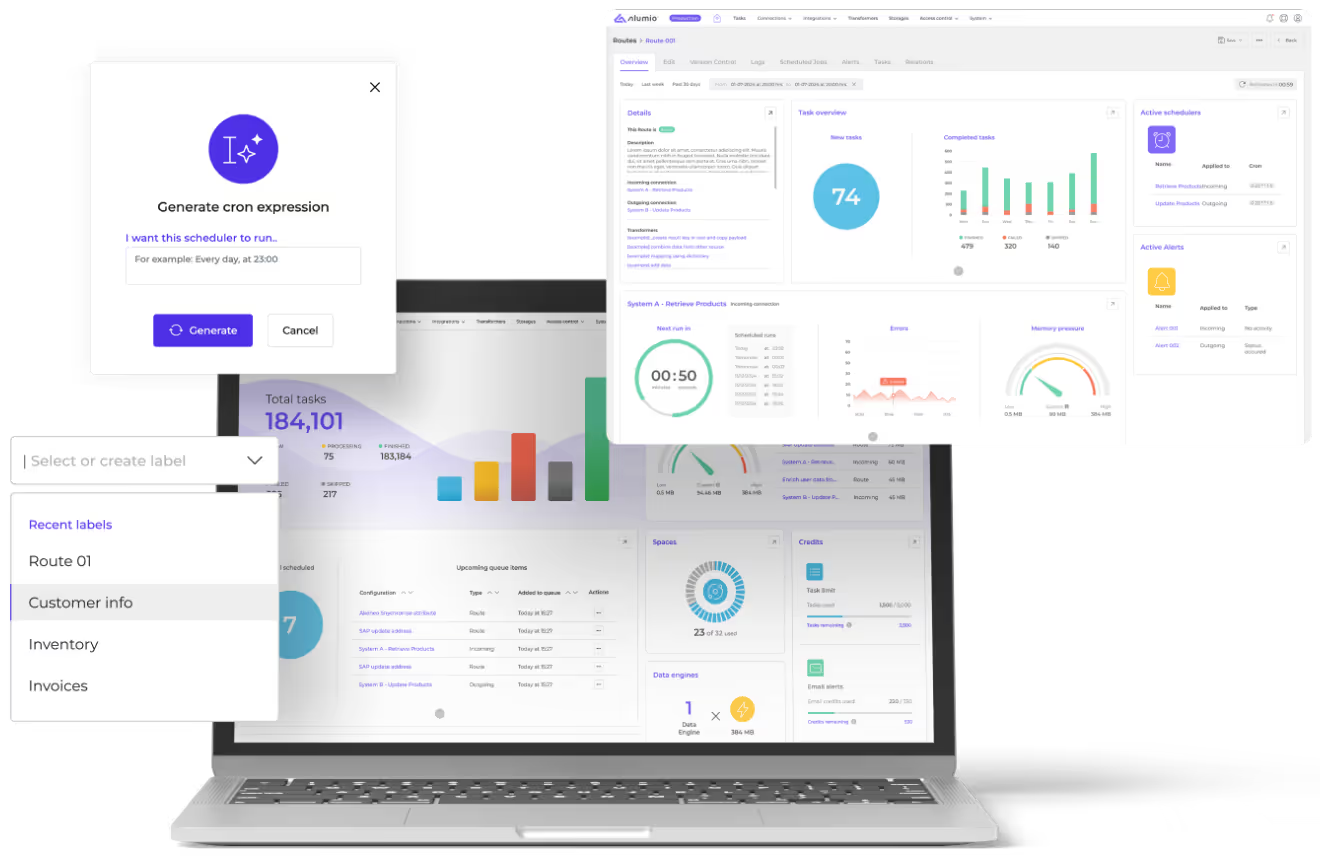
Designed to bypass the problems of complex integrations, the Alumio iPaaS has emerged as a leading solution to help significantly reduce the technical threshold for creating integrations. As a low-code integration platform, it enables businesses to integrate two or several software solutions from one user-friendly interface, without any custom coding, and across on-premises or cloud environments.
Get a comprehensive overview of how the Alumio iPaaS works.
Why should you choose Alumio if you have an e-commerce business?
Alumio is ideal for e-commerce businesses of all sizes as we have extensive experience in the sector and a high success rate. Among other things, Alumio enables e-commerce businesses to:
Benefit from a faster time-to-market:
Thanks to Alumio’s connector packages, users have integration shortcuts to quickly connect popular software or systems within a matter of weeks. The platform also offers tools to flexibly modify and adjust these ready-made integrations to suit specific business needs. Finally, Alumio enables workflow automation, speeding up data entry and repetitive manual processes, such as simultaneously sending real-time product stock updates from the ERP system to the e-commerce platform and the PIM system.
Benefit from Composable Commerce:
By enabling Composable Commerce, Alumio allows businesses to select the systems and apps that suit their specific purposes, preventing vendor lock-in, creating more meaningful product experiences for their customers, and accelerating their time-to-market. This approach fosters unparalleled flexibility to customize e-commerce stacks, replacing old applications with new ones without losing data integrity, and provides the freedom to experiment with integrating newer applications. Download our Composable Commerce white paper.
Reduce operational costs:
By making integrations easy for developers and non-coding professionals, Alumio significantly helps reduce operational costs related to hiring, outsourcing, and third-party dependencies. Alumio also reduces troubleshooting costs with automated logging that helps save significant time and labor costs and eliminates black box problems by making all integrations and data flows visible on one user-friendly interface.
Increase revenue:
Alumio enables e-commerce businesses to create seamless omnichannel experiences for customers, maximizing customer engagement, satisfaction, and loyalty, resulting in higher revenues. Don’t just take our word for it; check out these case studies to discover how Alumio has enabled these e-commerce businesses to expand and improve their operations:
Activating omnichannel customer experiences with ShoeStories
Coherent product and brand display for Jollein
Future-proofing Obelink’s IT ecosystem
Conclusion
Running an e-commerce business is not without challenges, but adopting new systems in an attempt to improve innovation and gain a competitive edge shouldn’t be one of them. Yet, this is a common issue: “Market Study Reveals 89% of Companies Struggle with Data and System Integration.”
With Alumio, e-commerce businesses can focus on their core activities and be assured that their systems will be integrated accordingly, forming a synchronized IT landscape that is ready for rapid changes and growth.
Ready to plan your e-commerce strategy and take your business to the next level? Contact one of our specialists and prepare for growth!





.svg)
.svg)
.svg)
.svg)
.svg)
.svg)
