Where production lead time actually accumulates
Manufacturers measure lead time end-to-end, then look for savings inside the parts that involve machines. Cycle times get optimized, changeovers get shortened, layouts get reworked. Those efforts are real, and they address the visible half of the problem.
Much of the elapsed time is queue time, where work sits waiting for a decision, a document, or a data entry. A part waits for a revised drawing. A work order waits for a bill of materials that matches the current revision. A buyer waits to learn that a component changed before placing the next order.
Waiting between systems is the least examined category of all. It rarely shows up in a lead-time analysis, because no department owns it and because it looks like administration rather than production.
Why do engineering change orders take so long to reach production?
An engineering change order is a controlled instruction to alter a product, and its delay comes from how many systems must act on it before anything changes physically. The approval itself is rarely the slow part.
A released change has to reach the ERP so the manufacturing bill of materials, standard costs, and open work orders reflect it. It has to reach purchasing so the old component is no longer ordered and the replacement is sourced with its own lead time. It has to reach the floor so operators build to the current revision rather than the one printed last month. Each of those is a separate system with a separate owner.
When the handoffs are manual, a change moves at the speed of whoever remembers to move it. A three-day approval becomes a three-week implementation, and the gap stays invisible until someone builds to a superseded revision.
The handoffs that add days to a change
Every transfer between systems is a place where a change can sit. The pattern is consistent across most operations:
- Revision entry: the engineering bill of materials is re-keyed into the ERP as a manufacturing bill of materials, usually by hand and often days after release
- Cost and sourcing update: standard costs and supplier records are amended separately, so purchasing may order the wrong part in the meantime
- Work order effectivity: open work orders are reviewed one at a time to decide which build to the old revision and which to the new
- Shop floor documentation: drawings and work instructions are reissued to the floor, sometimes on paper, with no confirmation that the previous version was withdrawn
Each step is short on its own. Sequenced, with a queue in front of each, they account for most of the interval between approval and production.
What does automating the change handoff actually remove?
It removes the queue, not the work. The revision still has to be validated, costed, and sourced. What disappears is the waiting between those steps, along with the re-entry that introduces errors while the change waits.
The mechanics of that handoff, converting an engineering bill of materials into the structure the ERP expects and pushing routing to the floor, are what the digital thread between PLM, ERP, and MES describes. The time argument is simpler than the architecture. When a released change moves on its own, the interval between approval and buildable state collapses to the time the checks themselves take.
One trade-off deserves naming. Automating this handoff means the change process itself has to be correct, because a wrong revision now reaches every system immediately instead of being caught by someone re-typing it. The answer is validation at the point of transfer, not slower transfer.
How an integration platform shortens the change cycle
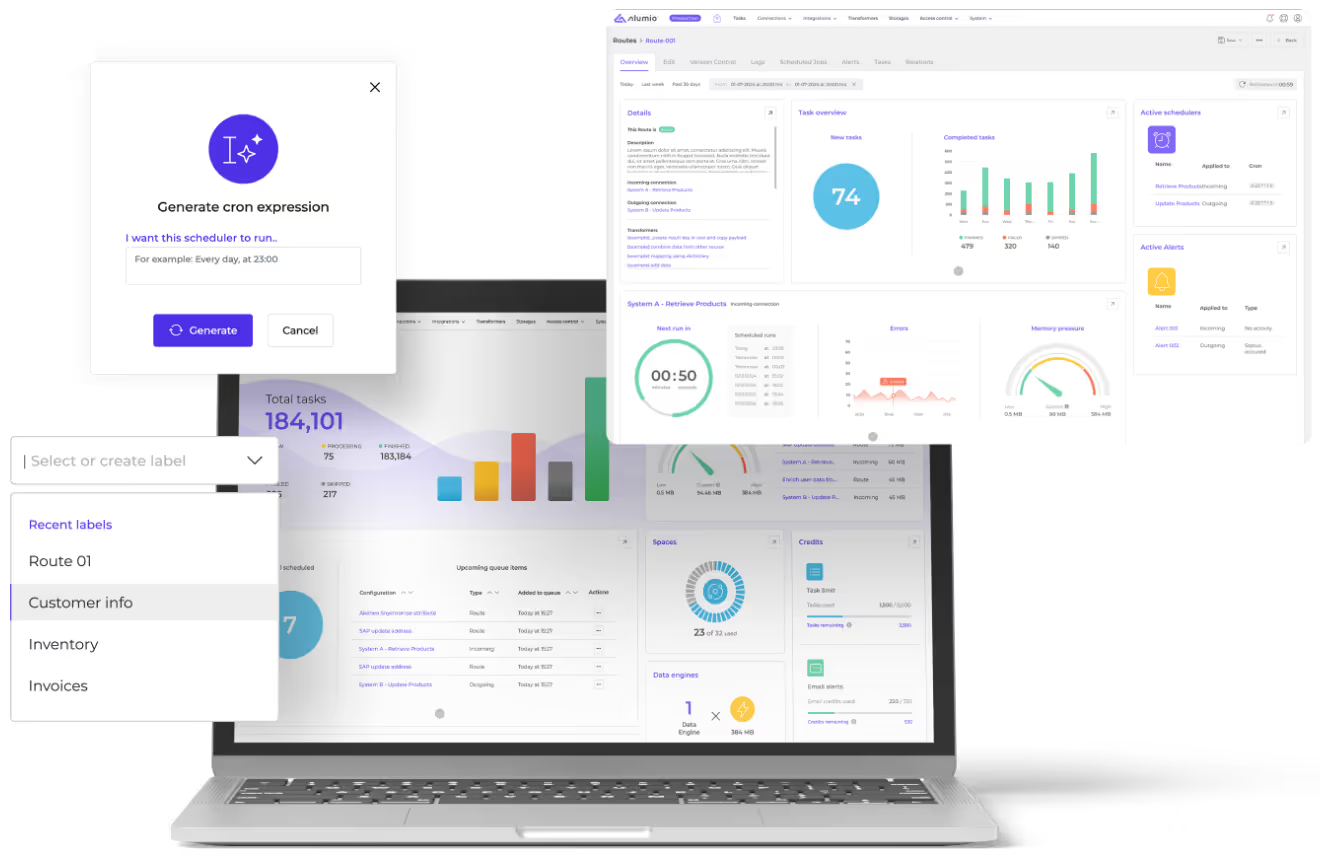
An integration platform sits between PLM, ERP, and the shop floor systems, and treats a released change as an event rather than a document. When PLM publishes a revision, the platform picks it up, reshapes it into what each receiving system expects, and delivers it in the order the process requires.
On the Alumio iPaaS, that logic runs as:
- Routes: carry the released change as an event-driven flow, so propagation starts on release instead of waiting for the next scheduled sync
- Transformers: convert the engineering structure into the format the ERP accepts, so delivery is automatic without becoming automatically wrong
- Storage: holds intermediate state, so a change that fails one step gets replayed instead of re-entered by hand
- Logging and alerting: record where each change reached and when, turning cycle time into a number the business can measure rather than estimate
Because those connections are configured rather than hand-built for each system pair, with the Code Transformer available where configuration cannot express a requirement, adding a second plant or swapping a PLM does not restart the work. That matters for ERP integration in manufacturing generally, where the same flows tend to get rebuilt every time a system changes.
Why lead time reduction starts with the change process
Lead time programs usually start where the work is visible, on the floor. The larger reserve sits in the gaps between systems, where a change waits for a person to carry it forward.
Engineering change orders are the clearest case, because the delay is entirely administrative and entirely measurable. A business that knows how many days pass between release and production has a number it can attack. Most do not have that number, which is itself the finding.
Shortening that interval compounds. Faster change cycles mean fewer builds to the wrong revision, less scrap, and a business that can adjust a product without the adjustment costing three weeks of throughput.




.svg)








.svg)
.svg)
.svg)
.svg)
.svg)
.svg)
