


A Alumio vivid purple arrow pointing to the right, a visual representation of how to access more page material when clicking on it.
Go back

What is manufacturing resource planning (MRP)?

By
Carla Hetherington
Published on
March 28, 2025
Updated on
June 24, 2026
IN CONVERSATION WITH
Email icon
Email icon

If you’re a manufacturing leader trying to keep pace with rising demand, tightening margins, and increasing complexity in your supply chain, you’re not alone. Many manufacturers are facing the same challenges. And the backbone to solving these issues? Smart, integrated manufacturing resource planning (MRP). MRP is no longer just about managing inventory levels or scheduling production runs. It has evolved into a powerful approach to streamline operations, ensure resource availability, and enable data-driven decision-making. And in today’s manufacturing environment, MRP needs to be more than just functional; it needs to be intelligent, connected, and future-proof. Let’s dive into what manufacturing resource planning is, why it’s vital, what systems power it, the common challenges, and how an iPaaS like Alumio can transform your MRP into a competitive advantage.

What is manufacturing resource planning (MRP)?

Manufacturing resource planning, often referred to as MRP or MRP II, is a method used by manufacturers to efficiently plan, schedule, and control the production process. At its core, MRP ensures that the right materials, people, and machines are available at the right time to fulfill production goals. MRP evolved from basic inventory control (MRP I) into a broader, integrated system (MRP II) that also includes areas like workforce scheduling, shop floor control, capacity planning, and even financial planning. An effective MRP strategy aligns your entire production operation, from procurement and inventory to sales forecasts and delivery timelines.

Why manufacturing resource planning is vital

Manufacturing resource planning (MRP) plays a pivotal role in driving that efficiency by reducing waste through smarter inventory management, improving delivery times by synchronizing supply with demand, and optimizing the allocation of labor, equipment, and materials. It also increases visibility across the production process, offering real-time insights into procurement, inventory, and scheduling. Most importantly, MRP lays the foundation for scalable growth, helping manufacturers expand without operational bottlenecks.

Popular applications used in manufacturing resource planning

Modern MRP systems don’t operate in silos. Instead, they rely on seamless data exchange between various business applications. Key systems often integrated within an MRP framework include:

  • ERP (Enterprise Resource Planning): The backbone of manufacturing operations. Common ERPs include SAP, Microsoft Dynamics, Oracle NetSuite, and Infor.
  • MES (Manufacturing Execution Systems): Helps manage production on the shop floor in real-time.
  • WMS (Warehouse Management Systems): Ensures efficient inventory movement and storage.
  • SCM (Supply Chain Management) software: Coordinates sourcing, logistics, and delivery.
  • PLM (Product Lifecycle Management): Manages product data and development processes.
  • CRM (Customer Relationship Management): Feeds demand data into production forecasting.

The challenges manufacturers face with MRP

Even with powerful tools, manufacturers often struggle to implement MRP successfully. Why? These applications must work together. Without integration, data stays trapped in silos, leading to a wide array of problems, including:

  • Disconnected systems: Integrating ERP, MES, WMS, and other tools is complex and time-consuming.
  • Manual processes: Many manufacturers still rely on spreadsheets and email-based approvals.
  • Data silos: When applications don’t communicate, decision-makers lack complete visibility.
  • Scalability issues: As production grows, the complexity of coordinating resources multiplies.
  • Slow adaptation to change: Adjusting plans in response to real-time disruptions is difficult without a dynamic infrastructure.

The result? Inefficient operations, lost revenue, and missed opportunities. Explore other manufacturing challenges →


Turn AI ambition into action

Portrait of Leonie Becher Merli, Business Development Manager at Alumio

Get a free assessment of your integration needs and next steps

Portrait of Leonie Becher Merli, Business Development Manager at Alumio

How an iPaaS transforms manufacturing resource planning

An iPaaS (integration Platform as a Service) like Alumio acts as the connective tissue between all your business-critical systems. Instead of building point-to-point integrations (which are hard to maintain), Alumio provides a centralized, low-code integration layer that:

  • Connects ERP, MES, WMS, CRM, and more
  • Automates data flows between systems
  • Monitors and logs integration performance in real-time
  • Allows for easy adjustments as business needs evolve
  • Supports scalability without disrupting operations

With Alumio, manufacturers gain a unified view of their operations, enabling:

  • Real-time production planning and inventory updates
  • More accurate demand forecasting
  • Faster adaptation to supply chain disruptions
  • Improved decision-making through clean, connected data

It’s the difference between constantly putting out fires and proactively optimizing your production process.

Why manufacturers should invest in an iPaaS for MRP

C-level executives in manufacturing need to think beyond software licenses and IT projects. They need to think about business agility, resilience, and long-term value creation. An iPaaS like Alumio is a strategic investment that enables users to launch integrations faster and get results sooner, eliminate manual work and reduce IT overhead, increase operational resilience in the face of supply chain shocks and market volatility, and lay the groundwork for smart manufacturing.

Manufacturing resource planning is at the heart of efficient, scalable, and future-ready manufacturing. But it only works when all your systems, people, and processes are connected and aligned. An iPaaS like Alumio doesn’t just connect your tools; it connects your vision for growth with the operational agility needed to achieve it.

If you’re ready to eliminate data silos, automate production planning, and make smarter decisions with unified data, it’s time to rethink your MRP strategy. Talk to us today →

No items found.
Topics in this blog:

FAQ

Integration Platform-ipaas-slider-right
What is Manufacturing Resource Planning (MRP) and how has it evolved?

Manufacturing Resource Planning (MRP, also called MRP II) is a planning methodology and software system that coordinates production scheduling, inventory management, and procurement based on demand signals, production capacity, and inventory levels. It evolved from Material Requirements Planning (MRP I, focused on component inventory) through MRP II (adding capacity planning and financial integration) to modern ERP-integrated planning that incorporates real-time demand signals, supply chain visibility, and AI-driven forecasting. Modern MRP is no longer a standalone calculation but a planning engine embedded in ERP systems that depends on integrated data from sales, purchasing, inventory, and production systems to generate accurate plans.

Integration Platform-ipaas-slider-right
Why does MRP depend on integrated data to function accurately?

MRP accuracy depends entirely on the quality and currency of its input data: demand signals (customer orders and forecasts from e-commerce, EDI, and sales systems), inventory levels (actual stock in all locations from WMS), bill of materials (engineering and production master data from ERP or PLM), supplier lead times (from purchasing history and supplier systems), and production capacity (from the factory floor systems). If any of these inputs are stale, incomplete, or inconsistent (because the systems holding them are not integrated with the ERP in real time) MRP generates production plans and purchase orders based on outdated information, producing either overproduction, stockouts, or missed delivery commitments.

Integration Platform-ipaas-slider-right
How does integration with e-commerce improve MRP accuracy for manufacturers?

Integrating e-commerce with ERP-based MRP improves accuracy by feeding real demand signals into planning rather than relying on sales forecasts alone. When Shopify or Adobe Commerce orders flow automatically into the ERP via Alumio, the MRP calculation incorporates actual confirmed orders rather than approximated demand, reducing the planning error that causes either overproduction (when forecast exceeds actual demand) or production shortfalls (when demand exceeds conservative forecasts). For manufacturers with mixed B2C e-commerce and B2B EDI order intake, integrating all order channels into a single ERP ensures MRP sees the complete demand picture rather than only the orders manually entered.

Integration Platform-ipaas-slider-right
What systems does a manufacturer need to integrate for smart MRP to work?

Smart MRP requires integration of: demand-side systems (e-commerce platforms, EDI trading partner connections, CRM opportunity pipeline) feeding confirmed and forecasted demand into ERP, inventory systems (WMS, production floor stock tracking) providing real-time stock levels, supplier systems (supplier portals, EDI ASN receipts) providing incoming goods visibility, production systems (MES, shop floor data collection) providing WIP inventory and production completion signals, and the ERP itself as the planning engine that synthesizes all of this into production schedules and purchase orders. An integration platform like Alumio manages all of these data flows, ensuring the MRP engine always works from current data rather than aging snapshots.

Integration Platform-ipaas-slider-right
How does Alumio support manufacturers implementing integrated MRP?

Alumio supports integrated MRP by connecting all the systems that feed the ERP planning engine: e-commerce order data flows from Shopify or Adobe Commerce to ERP in near real time, EDI purchase orders from B2B customers flow through the EDI connector, WMS inventory levels synchronize to ERP on scheduled Routes, supplier advance ship notices from EDI trading partners update incoming goods expectations, and MES production completion data flows to ERP for inventory updates and order fulfillment. All of these flows are monitored centrally, ensuring that when any data source fails to update the ERP, the team is alerted before stale data affects planning decisions.

Integration Platform-ipaas-slider-right
What operational improvements do manufacturers see when MRP is connected to real-time integrated data?

Manufacturers with real-time integrated MRP see: inventory reduction (more accurate planning means less safety stock required to buffer against planning uncertainty), improved on-time delivery performance (production plans based on real demand rather than estimates are more accurate), reduced expediting costs (fewer emergency material purchases when planning has better visibility into demand and supply), better supplier relationship management (more accurate purchase orders with reliable lead time signals reduce last-minute order changes), and faster response to demand changes (real-time demand signals enable MRP to react within hours rather than waiting for the weekly planning cycle). Each improvement requires the same foundation: data from all relevant systems flowing accurately and currently into the ERP planning engine.

Get a free assessment of your integration needs

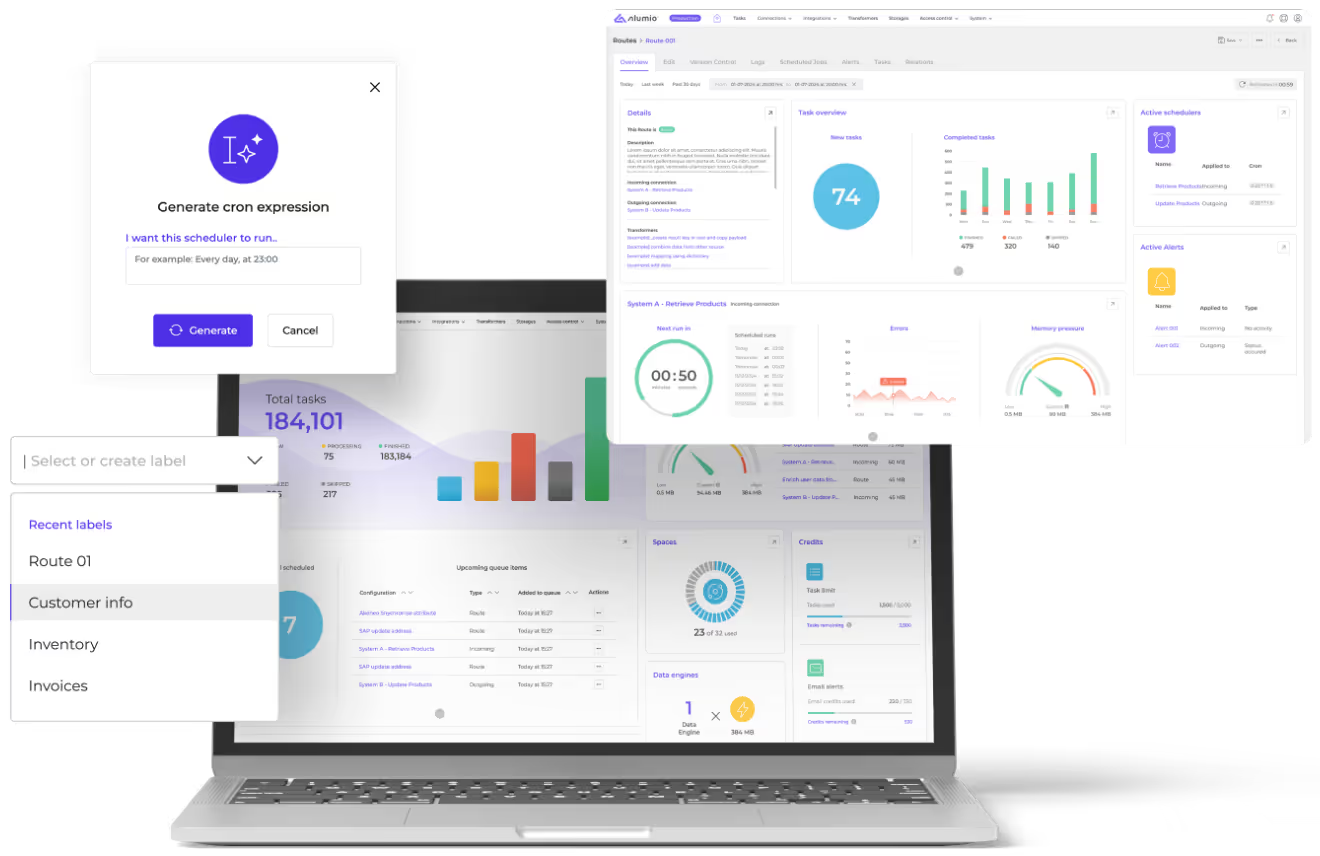
Laptop screen displaying the Alumio iPaaS dashboard, alongside pop-up windows for generating cron expressions, selecting labels and route overview.