


A Alumio vivid purple arrow pointing to the right, a visual representation of how to access more page material when clicking on it.
Go back

6 reasons why businesses are using the iPaaS

By
Published on
August 3, 2021
Updated on
June 24, 2026
IN CONVERSATION WITH
Email icon
Email icon

The iPaaS is a cloud-based integration platform that helps businesses connect multiple applications, data sources, and new SaaS solutions. Enabling real-time data exchange, it acts as a unifying intermediary of communication between all these integrated systems. Discover six essential reasons why modern businesses are using the iPaaS as a central tool to enable digital transformation, automate business processes, and boost cost optimization.

6 reasons why businesses are using the iPaaS

Modern businesses are using the iPaaS (integration Platform as a Service) as a next-gen API-driven middleware solution to integrate existing business systems with multiple new SaaS or cloud apps. This involves integrating ERP systems, e-commerce platforms, PIM, CRM, WMS, POS, Marketing automation software, and many other applications. As such, businesses are using the iPaaS to streamline internal and external workflows, and as a scalable solution to build future-proof integrated data ecosystems as they grow.

Here are 6 essential advantages that the iPaaS provides, due to which businesses are increasingly adopting it as their central hub to accelerate digital transformation and business automation: 

1. Build integrations without custom-code:

An iPaaS solution is either a low-code or no-code cloud-based/native integration platform, which helps business integrate multiple systems, SaaS, and cloud apps, without custom code. It provides a user-friendly interface that both developers and non-coding professionals, such as junior developers, project managers, or C-level, can collaborate on to create, monitor, and manage integrations.


2. Enable real-time error detection: 

The iPaaS provides monitoring and logging features that help automatically detect integration errors or API conflicts. This helps signficantly reduce troubleshooting time and cost. And businesses can build custom monitoring alerts to notify them in case of errors in crucial data transactions.

3. Eliminate black boxes:

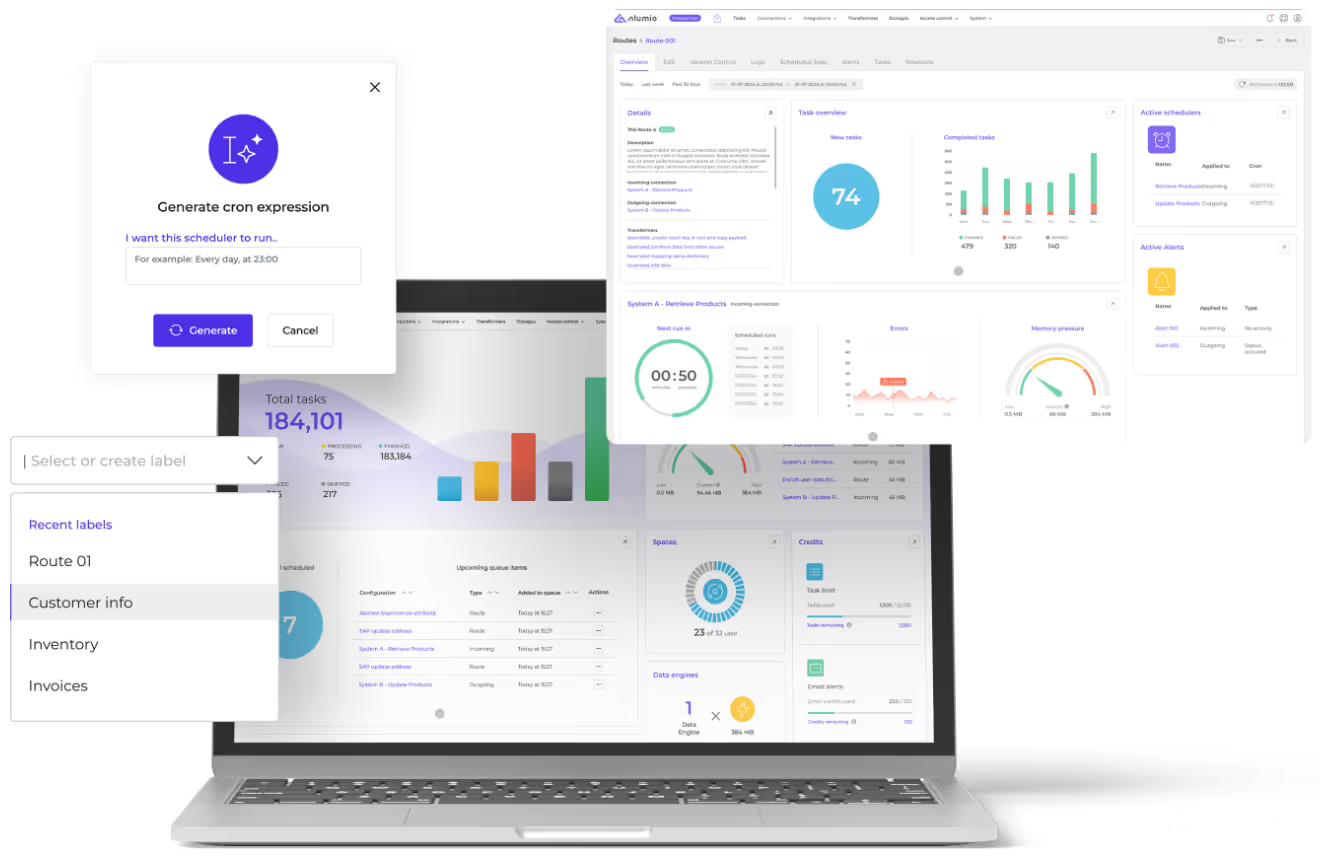
The iPaaS provides a clear visual overview of all connected systems and data sources of a business on one user-friendly interface. It provides extensive logging for all data transactions and it visualizes all data flows exchanged between integrated systems. This allows business users to collaborate effectively with developers or system integrators to plan improvements on their integrations.

4. Prevent data silos:

As an API-driven integration solution, the iPaaS enables data synchronization and real-time data exchange between all integrated systems. This eliminates data silos, inconsistenceis, duplications, and other hindrances that arise from manual data entry. Most importantly, it provides access to real-time access to critical information, improving decision-making processes.

5. Get faster Time to Market (TTM):

iPaaS solutions usually provide connectors (pre-built integrations) that enable businesses to integrate popular software and cloud apps faster. By enabling businesses to be API-first, it provides them with the flexibility to swap out connected applications for new ones, or to add new systems to existing integrations, without loss of data integrity. This provides businesses with agility to implement new strategies, connect new technoloies, and experiment with new ideas significantly faster.

6. Ensure security and privacy compliance

Centralizing all integrations and data on one platform, the iPaaS cultivates better security and makes it easier for businesses to comply with privacy legislislations like GDPR, SOC2, and CCPA. Additionally, iPaaS solutions adhere to the latest security standards and being cloud-based/native solutions, provide better error management, protection from security issues, and reactivation procedures.

"Enable digital transformation, business automation, and cost-optimization from one future-proof integration platform"

In summary, businesses are increasingly using the iPaaS to simplify integration efforts, reduce costs, improve data quality, and adapt to changing technology landscapes. The iPaaS is enabling organizations to harness the full potential of their digital ecosystem by connecting and automating processes across various systems and applications.


Turn AI ambition into action

Portrait of Leonie Becher Merli, Business Development Manager at Alumio

Get a free assessment of your integration needs and next steps

Portrait of Leonie Becher Merli, Business Development Manager at Alumio

No items found.
Topics in this blog:
No items found.

FAQ

Integration Platform-ipaas-slider-right
What is an iPaaS and why are businesses using it?

An iPaaS (Integration Platform as a Service) is a cloud-based platform for connecting business applications, automating data flows, and governing the exchange of information across an organization's software ecosystem. Businesses use iPaaS because modern operations depend on multiple specialized systems (ERP, CRM, e-commerce, PIM, WMS) that need to exchange data reliably and in real time. An iPaaS replaces fragile, custom-coded point-to-point integrations with a governed, scalable integration backbone.

Integration Platform-ipaas-slider-right
How does an iPaaS enable digital transformation?

An iPaaS enables digital transformation by connecting existing systems to new cloud applications and digital tools without requiring full system replacement. Businesses can add a new e-commerce channel, a PIM, or an AI analytics tool and connect it to the existing ERP and CRM through the integration platform, rather than rebuilding all existing connections from scratch. This composability allows organizations to evolve their technology landscape incrementally at the pace of their strategy.

Integration Platform-ipaas-slider-right
What are the main business benefits of using an iPaaS?

The main business benefits are: real-time data availability across all connected systems, elimination of manual data transfer and its associated errors, faster onboarding of new tools and channels, reduced IT dependency for integration changes (config-first platforms let business teams adjust flows without development), and full audit visibility into every data exchange. Together these translate into lower operational costs, faster decision-making, and the agility to adapt the system landscape as the business grows.

Integration Platform-ipaas-slider-right
What is the difference between an iPaaS and custom-coded integrations?

Custom-coded integrations are built specifically for each pair of systems and require developer expertise to build, maintain, and update. They become harder to manage as the system landscape grows, and any change to either connected system risks breaking the integration. An iPaaS provides a reusable framework of connectors, transformation tools, and monitoring that standardizes how all integrations are built and governed. Integrations built on an iPaaS are maintained by configuration rather than code, making them faster to update and easier to own long-term.

Integration Platform-ipaas-slider-right
What kinds of systems can be connected with the Alumio iPaaS?

Alumio connects ERP systems (SAP, Microsoft Dynamics 365, NetSuite, Business Central), e-commerce platforms (Shopify, Adobe Commerce, Shopware, WooCommerce, BigCommerce), PIM systems (Akeneo, Pimcore), WMS and 3PL platforms, CRM tools (Salesforce, HubSpot), marketplaces (Amazon, Bol.com, ChannelEngine), marketing automation tools, and any system with an open API. Alumio's prebuilt connector templates cover the most common combinations, and new systems can be connected via REST, SOAP, or file-based integration.

Integration Platform-ipaas-slider-right
How does an iPaaS differ from point-to-point integrations or an ESB?

Point-to-point integrations connect each pair of systems with a separate custom connector, which becomes unmanageable as the number of systems grows. An ESB (Enterprise Service Bus) is an on-premise hub that centralizes integration but requires significant infrastructure and specialist maintenance. An iPaaS provides the same centralization as an ESB but as a managed cloud service, with lower operational overhead, faster deployment, and native support for modern SaaS and cloud APIs that traditional ESBs were not designed to reach.

Get a free assessment of your integration needs

Laptop screen displaying the Alumio iPaaS dashboard, alongside pop-up windows for generating cron expressions, selecting labels and route overview.