What the ESPR destruction ban actually prohibits
The Ecodesign for Sustainable Products Regulation, usually shortened to ESPR, entered into force on 19 July 2024. Its first concrete prohibition arrived two years later. Since 19 July 2026, a large company in the EU cannot destroy unsold apparel, clothing accessories, or footwear.
A large company here means one that exceeds at least two of three thresholds. Those are more than 250 employees, more than EUR 50 million in turnover, and more than EUR 25 million in total assets. Medium-sized enterprises follow from 19 July 2030, and micro and small enterprises are excluded from the prohibition.
Four things changed on that date for the companies in scope:
- Destruction stopped being a default: writing off unsold stock and disposing of it is no longer an available end-of-line decision
- Damaging a product counts as destroying it: deliberately cutting or marking an item so it cannot be sold is destruction under the regulation, not a workaround
- Exceptions have to be evidenced: destruction remains possible in defined circumstances, provided the company documents why and notifies the waste treatment operator of the justification it is relying on
- Online sales are included: the obligations apply where products are sold through online platforms, so producers must supply the required data to marketplaces and make sure it displays correctly there
Textiles are the first product group subject to the ban, which makes other categories a question of timing rather than exemption. The digital product passport that will eventually travel with those products is a separate obligation on its own timeline, and one that lands mostly on product information management.
Why recycling does not satisfy the ESPR ban
Sending unsold stock to a recycler looks like the obvious response, and under the ESPR it does not work. The regulation treats recycling as a form of destruction. The only route excluded from that definition is discarding an item solely to prepare it for reuse, which covers refurbishment and remanufacturing.
So the compliant outcomes are narrower than they first appear. Reselling through a discount channel, donating, refurbishing, and remanufacturing all keep an item clear of the ban. Shredding it to recover fiber does not, even though it is often described as recycling internally.
That difference is invisible in most stock systems. An ERP records that an item left inventory, along with a reason code somebody picked from a short list. Whether the destination was a recycler or a refurbisher is frequently the difference between compliance and a breach, and both usually get logged the same way.
What the ban costs an unprepared retailer
The exposure is not the penalty. It is that a decision made quickly in a warehouse now has to be defensible months later, several hundred times a season:
- No record of where an item went: the ERP shows it left stock, and nothing shows whether it was donated, resold, or shredded
- Reason codes that do not distinguish: one write-off code covering recycling, damage, and preparation for reuse, so the compliant and non-compliant cases look identical
- Exceptions nobody can evidence: destruction that was genuinely permitted, with no documentation of why and no proof the waste operator was told
- Marketplace data that lags: required product information sent to channels by hand, so what a marketplace displays does not match what the brand holds
- Disclosure assembled by hand: a reporting obligation met by pulling numbers from three systems into a spreadsheet once a year, with nothing underneath it to audit
None of these need a new capability. They need the item-level tracking the warehouse already does, carried through to the point where stock leaves the business.
Where the ESPR disposal record actually comes from
The regulation asks for something no retailer currently produces in one place. Not a total, and not a policy, but a continuous account of each unsold item. That means what it was, what condition it was in, what was decided, on what basis, and who received it.
Every part of that account already exists somewhere. The ERP holds the stock record and the write-off. The warehouse system holds the condition, and the returns process holds why the item came back. The resale or donation channel holds what happened next, and that one often belongs to a different company.
None of them holds the whole account, and none was built to hand its part to the others. So retailers assemble it afterwards, exporting movements from one system and outcomes from another, matching them on SKU and date, and accepting that a share will never reconcile. That produces an annual total. It does not answer a question about one consignment in March.
Recording something as it happens is cheaper than reconstructing it later. Doing that means the system where the decision is made has to write it somewhere the others can read. That is a connection problem rather than a reporting one. The same logic already applies to GDPR and ISO 27001 obligations, where the evidence has to exist before anyone asks for it.
How an integration platform helps build the ESPR record
An integration platform-as-a-service (iPaaS) gives a business one place where all its systems connect. Every system connects to it once instead of connecting directly to each other, and the platform moves and reshapes the data between them. Retailers already use it for everyday work: pushing orders from the storefront into the ERP, returning stock figures to the sales channels, and passing shipments to a carrier.
The disposal record runs on those same connections. When the returns team grades an item and decides what happens to it, that decision becomes a message like any other. The systems that need it receive it, and a copy of what was sent stays on the platform.
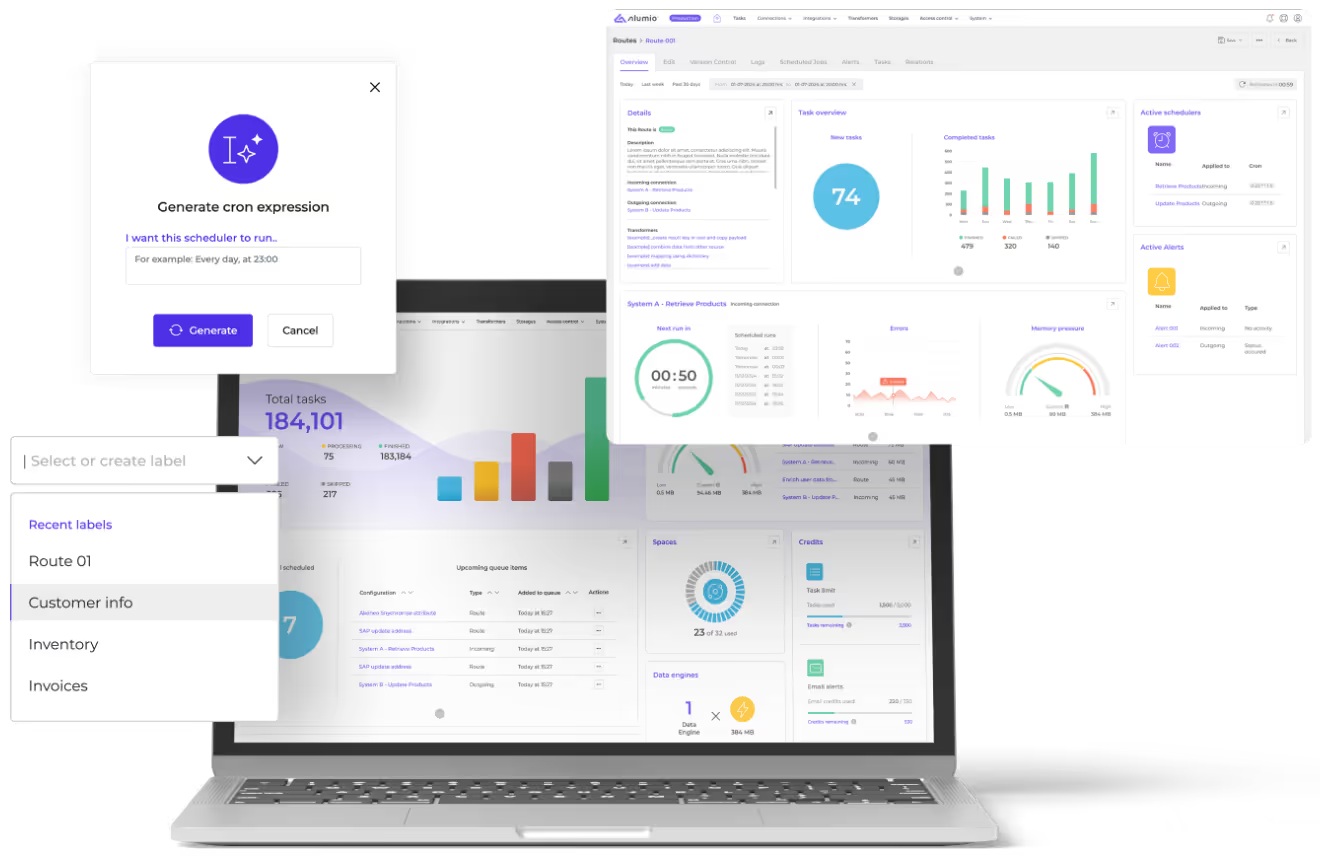
The Alumio integration platform provides features that can be configured to produce that record as stock moves. Four of them do most of the work:
- A Route that captures the outcome where it is decided: a Route can be built between the returns or warehouse system and the ERP, so the disposal decision arrives as it is made rather than in an overnight summary
- A Transformer that enforces one vocabulary: a Transformer can be configured to map each system's reason codes into one set that distinguishes resale, donation, refurbishment, recycling, and permitted destruction
- Flows that reach third parties: the same connections can carry required product information to a marketplace and a destruction justification to a waste operator, with the response recorded
- Storage that keeps the evidence: Storage within Alumio can hold each message, so a specific consignment can be reconstructed and explained months later
Because the record accumulates as stock moves, the annual disclosure becomes an extract rather than a project. Whichever product category the ban reaches next connects to what apparel already established.
What a working ESPR record gives the business
Retailers reading the destruction ban as a sustainability obligation will resource it as one, with a policy, a training session, and a report at year end. The obligation is operational. It asks a warehouse to make a different decision on a Tuesday afternoon, and asks the business to prove six months later that it made it.
An integration platform makes that proof automatic rather than reconstructed, because the evidence is created by the same flow that moves the stock.
The business ends up with a disposal record it can stand behind when a regulator asks about one consignment, rather than a total it hopes nobody examines.




.svg)








.svg)
.svg)
.svg)
.svg)
.svg)
.svg)
