
A Alumio vivid purple arrow pointing to the right, a visual representation of how to access more page material when clicking on it.
Go back

What is SAP Commerce Cloud?

By
Published on
April 9, 2025
Updated on
June 24, 2026
IN CONVERSATION WITH
Email icon
Email icon

SAP is widely recognized for its industry-leading ERP and CRM solutions that have revolutionized how businesses manage operations, financials, and customer relationships. However, for B2B and B2C enterprises that are looking to build e-commerce experiences, especially one that’s integrated within the SAP ecosystem, they offer SAP Commerce Cloud. Enabling seamless integrations with key systems — including ERP, CRM, PIM, and more, SAP Commerce Cloud is designed to deliver robust omnichannel capabilities. Let’s explore what SAP Commerce Cloud is, highlight its unique benefits, and why it is the ideal choice for enterprises seeking to transform their customer-facing operations.

What is SAP Commerce Cloud?

SAP Commerce Cloud is a cloud-based e-commerce platform for B2B, B2C, and B2B2C use cases. It’s designed to enable large enterprises to create personalized omnichannel shopping experiences. Most importantly, for enterprises already leveraging the SAP ecosystem, it offers seamless integration with other key SAP products such as SAP’s latest flagship ERP solution, SAP S/4 Hana.

Formerly known as Hybris, SAP Commerce Cloud enables seamless shopping experiences by helping create and manage large, complex product catalogs. It also helps automate order workflows and unify customer interactions across web, mobile, social, and in-store channels. Ensuring product data consistency across all these touchpoints, it also supports global expansion with multilingual and multicurrency catalogs.

Thus, whether you’re a global retailer or a B2B supplier, SAP Commerce Cloud provides the tools to streamline operations and meet the evolving needs of modern commerce.

Unique benefits of SAP Commerce Cloud

SAP Commerce Cloud stands out from other e-commerce platforms due to its powerful features and capabilities. Here are its key benefits:

1. Personalized customer experiences

SAP Commerce Cloud uses AI-driven tools like product recommendations and targeted promotions to deliver highly personalized shopping experiences. By analyzing customer data, businesses can offer relevant products and services, boosting engagement and sales.

2. Omnichannel capabilities

With its omnichannel approach, SAP Commerce Cloud ensures a consistent shopping experience across all touchpoints. Customers can seamlessly transition between web, mobile apps, and social platforms, with data synchronized across all channels.

3. Scalable infrastructure with customization

Built on a flexible cloud architecture, SAP Commerce Cloud handles high traffic and large-scale operations with ease. Its modular design allows businesses to customize the platform to fit specific needs, ensuring it grows alongside your organization.

4. Seamless integration with SAP solutions

A major advantage of SAP Commerce Cloud is its native integration with other SAP products, such as SAP S/4HANA, CRM, and ERP systems. This helps enterprises create a unified digital ecosystem, streamlining data flow between their e-commerce operations and back-end processes.

5. Advanced B2B and B2C features

The platform delivers both B2B and B2C features, offering tools like complex pricing, bulk ordering, and account management. This ensures it carers to diverse commerce requirements.

6. Intelligent selling services

SAP Commerce Cloud provides intelligent selling features, such as dynamic pricing and real-time inventory management, enabling businesses to optimize sales strategies and engage customers with tailored offers.


Turn AI ambition into action

Portrait of Leonie Becher Merli, Business Development Manager at Alumio

Get a free assessment of your integration needs and next steps

Portrait of Leonie Becher Merli, Business Development Manager at Alumio

Overcoming SAP integration challenges with the Alumio iPaaS

While SAP Commerce Cloud excels at seamless integration within the SAP ecosystem, modern businesses require a more modular approach to connect a wide range of offline and online applications. In today’s omnichannel environment, enterprises are not only unifying their core operations, but also integrating with specialized systems such as generative AI tools, business intelligence (BI) analytical applications, advanced point-of-sale (POS) systems, marketplace listing tools, and marketing automation platforms. These tools enable companies to deliver cohesive experiences across physical stores, mobile apps, in-store kiosks, and digital channels, all while maintaining real-time, actionable insights.

To expand omnichannel operations by addressing the growing need for such diverse connectivity, a versatile integration platform is essential. The Alumio iPaaS is a low-code, cloud-native integration platform that simplifies connecting SAP Commerce Cloud with a broader and specialized tech stack. It is purpose-built to streamline integrations between multiple endpoints, providing a rich library of pre-configured Connectors for popular applications.

Delivering a dedicated SAP Commerce Cloud connector, the Alumio iPaaS empowers businesses to quickly and reliably bridge their SAP-based operations with other critical systems. This results in a more adaptable, comprehensive digital ecosystem that supports seamless omnichannel strategies without compromising on flexibility or performance. With Alumio’s user-friendly interface, even non-technical users can manage integrations, making it a cost-effective and flexible solution for businesses of all sizes.

Want to learn more about how you can seamlessly integrate SAP Commerce Cloud with specialized third-party apps outside the SAP ecosystem? Find out more →

Accelerate digital transformation with SAP Commerce Cloud

In today’s fast-paced digital landscape, enterprises face the constant challenge of bridging traditional systems with new innovative technologies to deliver truly integrated, customer-centric experiences. SAP Commerce Cloud not only extends the proven power of SAP’s ERP and CRM solutions into the e-commerce realm but also paves the way for businesses to create seamless omnichannel ecosystems. By offering advanced capabilities—from personalized customer engagement and efficient catalog management to robust, API-driven integrations—it serves as a comprehensive foundation for enterprises eager to fast-track their digital transformation. Ultimately, SAP Commerce Cloud empowers organizations to streamline operations, adapt quickly to evolving market demands, and drive substantial growth in an increasingly competitive environment.

No items found.

FAQ

Integration Platform-ipaas-slider-right
What is SAP Commerce Cloud and what does it offer for e-commerce?

SAP Commerce Cloud (formerly SAP Hybris) is SAP's enterprise B2B and B2C e-commerce platform, designed for large enterprises that need deep integration with the SAP ecosystem (ERP, CRM, PIM). It offers: sophisticated product catalog management, complex B2B pricing and quoting capabilities, multichannel commerce support, and native integration with SAP ECC and S/4HANA. Its primary strength is in enterprise B2B and B2B2C scenarios where the depth of SAP back-office integration and the complexity of product configuration, pricing, and catalog management requirements justify the platform's significant implementation and licensing investment.

Integration Platform-ipaas-slider-right
How does Alumio integrate SAP Commerce Cloud with other systems?

Alumio integrates SAP Commerce Cloud with non-SAP systems through its Commerce Cloud connector, enabling data flows between SAP Commerce Cloud and external platforms that may not have native SAP integration: third-party PIM systems, external WMS or 3PL providers, marketing automation platforms, CRM systems outside the SAP CX suite, and marketplace connectors. Rather than building custom point-to-point integrations between SAP Commerce Cloud and each external system, Alumio provides the governed backbone that manages all these connections with consistent transformation, monitoring, and governance. This is particularly valuable for enterprises that use SAP Commerce Cloud alongside non-SAP systems in a heterogeneous landscape.

Integration Platform-ipaas-slider-right
What are the main use cases for integrating SAP Commerce Cloud with external systems?

The main use cases are: connecting SAP Commerce Cloud to a third-party PIM (Akeneo, Pimcore) for product content enrichment when SAP's native catalog management does not meet content complexity requirements, integrating with external marketing automation (Klaviyo, HubSpot) for e-commerce lifecycle marketing that goes beyond SAP's native marketing tools, connecting to marketplace platforms for multichannel selling beyond the SAP Commerce Cloud storefront, integrating with third-party WMS or logistics providers when SAP's native warehouse management does not cover the required fulfillment scenarios, and connecting to analytics platforms (Power BI, Tableau) for BI reporting that requires data from both SAP and non-SAP systems.

Integration Platform-ipaas-slider-right
How does SAP Commerce Cloud compare to standalone e-commerce platforms for integration complexity?

SAP Commerce Cloud has a more complex integration architecture than standalone e-commerce platforms (Shopify, Adobe Commerce) because it is designed to be deeply embedded in the SAP ecosystem: its product catalog and order management are tightly coupled to SAP's data models, and the platform's strength comes from native SAP ECC or S/4HANA integration. Integrating with non-SAP systems requires navigating SAP Commerce Cloud's data model, which is more complex than the product and order schemas of standalone e-commerce platforms. An integration platform with dedicated SAP Commerce Cloud connector support reduces this complexity, providing a pretested API connection as a starting point for each external system integration.

Integration Platform-ipaas-slider-right
What types of enterprises benefit most from SAP Commerce Cloud?

SAP Commerce Cloud benefits: large enterprises with complex B2B pricing (customer-specific price books, product configuration, quote management) that require deep SAP ERP integration, businesses already heavily invested in the SAP ecosystem (ECC, CRM, BW) where deep native integration with these systems is a priority, B2B manufacturers and distributors with complex catalog, configurator, and quoting requirements, and enterprises with large global operations requiring SAP's multi-language, multi-currency, and multi-entity e-commerce capabilities. The platform is less suitable for B2C-only businesses, mid-market organizations, or businesses using primarily non-SAP back-office systems where the deep SAP integration advantage does not apply.

Integration Platform-ipaas-slider-right
How should enterprises using SAP Commerce Cloud approach their broader integration architecture?

Enterprises using SAP Commerce Cloud should treat it as one node in a broader integration ecosystem rather than assuming SAP's native integrations will cover all connections. A governed integration backbone (Alumio) should manage: all non-SAP system connections that SAP Commerce Cloud requires (external PIM, WMS, marketing automation, marketplaces), the data flows between SAP Commerce Cloud and non-SAP analytics and BI tools, and the monitoring of all these connections with consistent visibility alongside SAP-native integrations. This hybrid approach allows enterprises to maintain the depth of SAP-native integration where it adds value while using governed iPaaS connectivity for the parts of the landscape that extend beyond the SAP ecosystem.

Get a free assessment of your integration needs

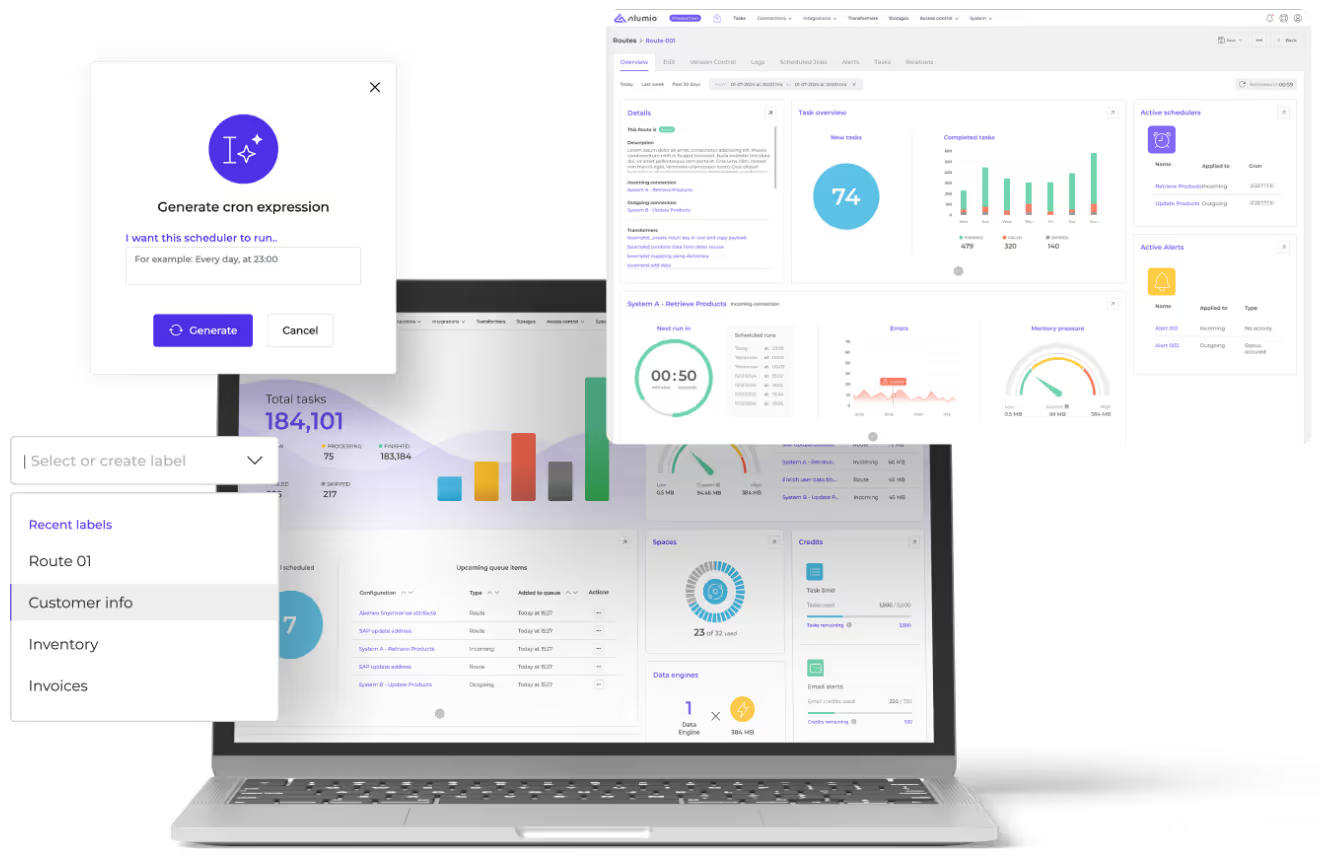
Laptop screen displaying the Alumio iPaaS dashboard, alongside pop-up windows for generating cron expressions, selecting labels and route overview.