


A Alumio vivid purple arrow pointing to the right, a visual representation of how to access more page material when clicking on it.
Go back

A guide to smarter SAP integrations

By
Saad Merchant
Published on
March 21, 2025
Updated on
June 24, 2026
IN CONVERSATION WITH
Email icon
Email icon

As one of the largest enterprise application software providers in the world, SAP serves as the backbone for managing business operations for over 400,000 organizations across 180 countries. However, as companies increasingly adopt modern cloud applications, it’s becoming increasingly challenging to integrate SAP with e-commerce, PIM, CRM, POS, AI solutions, and other third-party apps. As businesses struggle with fragmented systems, manual data transfers, and rigid integration solutions, the Alumio iPaaS (integration Platform as a Service) offers a more flexible and future-proof solution. Let’s explore how Alumio enables faster and more seamless integrations with legacy systems and modern applications!

Building smarter SAP integrations with the Alumio iPaaS

SAP recently announced that it will be phasing out mainstream support for its legacy ERP systems, namely SAP ECC, by the close of 2027 (extended support at a premium until 2030). This push is part of SAP's strategy to encourage migration to SAP S/4HANA, its more modern, cloud-based ERP system. This shift is not merely about upgrading software; it’s about embracing new capabilities like AI, advanced analytics, and the ability to integrate with newer cloud apps and SaaS solutions.

Attempting to build these modern integrations with traditional integration solutions, such as custom-coded integrations or legacy middleware, can be costly, time-consuming, and inflexible, especially as enterprises scale their operations. Before we understand the benefits of using next-gen, API-driven middleware like the Alumio iPaaS (integration Platform as a Service) to build smarter SAP integrations, it’s important to explore the key drawbacks of implementing traditional integration methods.

Why traditional SAP integrations fall short

Traditional integration methods often fail to meet the demands of today’s dynamic business environment. Here’s why:

  • Point-to-point integrations are fragile: Custom-coded connections between SAP and other systems are difficult to maintain and scale. A single update can disrupt the entire integration, leading to downtime, costly fixes, and time-consuming troubleshooting.
  • Legacy middleware is expensive to maintain: Solutions such as ESBs lack the agility to rapidly change or modify integrations as per requirement. It’s expensive to set up, drains budgets with high licensing fees, and requires specialized IT teams to manage.
  • Data silos and lack of real-time synchronization: Without seamless integration, data gets isolated in various apps and systems, causing inconsistencies, inefficiencies, and requiring manual data entry.
  • Security and compliance concerns: Manual data handling heightens the risk of breaches and makes it tougher to comply with regulations like GDPR or SOC2.

The key to smarter SAP integrations lies in adopting a centralized, low-code platform that connects systems seamlessly, enables real-time data synchronization, and ensures future-proof security and compliance. The Alumio iPaaS provides such a future-ready approach that eliminates the complexities of integrating legacy ERP solutions like SAP, empowering businesses to focus on growth rather than IT bottlenecks.

How the Alumio iPaaS helps build smarter SAP integrations

Alumio provides a cloud-native, low-code integration platform that helps integrate solutions like SAP with e-commerce platforms, PIM, CRM, WMS, AI solutions, and other cloud apps. Here are some of the many advantages of building SAP integrations via Alumio:

  1. Seamless, low-code integrations: As an API-driven solution, the Alumio iPaaS helps create, monitor, and manage SAP integrations via a user-friendly web interface, without the hassles of custom code. Choose from a rich library of Connectors and various connectivity methods to seamlessly connect SAP with third-party solutions.
  2. Centralized data hub: Alumio acts as a central integration layer, ensuring real-time data synchronization across all business systems. This eliminates redundant data entry, reduces errors, and provides teams with a unified, up-to-date view of business operations.
  3. Scalable and modular growth: Easily modify or extend integrations as your business grows without rebuilding it from scratch. Swiftly expand into new markets, adopt emerging technologies, or add new sales channels. Alumio’s modular architecture ensures new apps can be integrated, workflows can be updated in real time, and legacy systems can be modernized without disrupting existing processes.
  4. Future-proof migration: Alumio helps companies seamlessly migrate from legacy systems to cloud-based applications. Its future-ready architecture is designed to support hybrid IT landscapes, enabling seamless connectivity between on-premise systems, cloud applications, and emerging technologies.  Its API-driven approach ensures smooth data exchange and prevents loss of data integrity.
  5. Robust security and compliance: Alumio is a 27001-certified solution that’s built with enterprise-grade security measures. It ensures data compliance with global standards such as GDPR, SOC2, HIPAA, etc.

Apart from all these platform benefits, the Alumio iPaaS also provides Connectors and special API plugins for ERPs like SAP apps, which enhances the ERP with e-commerce integration capabilities.

Leverage the Alumio API plugin for faster SAP integrations

While SAP S/4HANA offers improved connectivity within the SAP ecosystem, integrating it — or its predecessor, SAP ECC — with third-party applications like e-commerce platforms, PIM solutions, and other cloud apps remains a significant challenge. Many organizations struggle with SAP missing crucial API points or web services that it needs to integrate with other third-party applications.

Traditionally, developing these API points within SAP would require extensive development work, custom coding, and complex middleware, driving up costs and extending project timelines. The Alumio iPaaS now provides a unique API plugin that natively installs the necessary API points directly within SAP ECC or SAP S/4HANA. Whether you're looking to streamline B2B or B2C transactions, the Alumio API Plugin ensures that SAP exchanges data with external systems, unlocking greater automation, efficiency, and scalability.


Read more about the Alumio API plugin for SAP →

Turn AI ambition into action

Portrait of Leonie Becher Merli, Business Development Manager at Alumio

Get a free assessment of your integration needs and next steps

Portrait of Leonie Becher Merli, Business Development Manager at Alumio

Case studies: Integrating SAP with e-commerce via the Alumio iPaaS

Many businesses are already benefiting from using the Alumio iPaaS to simplify their SAP-to-e-commerce integrations, enabling seamless data exchange and real-time synchronization. Here are two industry stories of how large organizations built fast, flexible, and future-proof SAP integrations with Alumio:

Pelican Products: Enhancing SAP ECC to Adobe Commerce integration

A renowned USA-based brand, Pelican Products specializes in the design and manufacture of protective case solutions and advanced portable lighting systems. Facing challenges when trying to integrate their Adobe Commerce web shop with SAP ECC, Pelican Products encountered the Alumio iPaaS and its unique SAP API plugin solutions. Installing essential B2B & B2C API endpoints directly in SAP ECC, made it significantly easier to integrate the ERP and e-commerce platform via the Alumio iPaaS. The integration ensured real-time product availability, pricing updates, order processing, and better shipping visibility.

Read the full case study here →

Dyka Group: achieving seamless SAP S/4HANA & Adobe Commerce connectivity

A leading provider of plastic pipe systems, the Dyka Group needed an integration solution to enhance their stock control, logistics, and customer service. By leveraging the Alumio iPaaS and SAP API Plugin, they successfully connected SAP S/4HANA with Adobe Commerce (Magento 2).

Alumio delivered 22 essential web services, enabling real-time B2B pricing, order simulation, and stock availability updates. With Alumio’s centralized integration layer, Dyka gained full control over their digital ecosystem, ensuring sustainable operation and seamless data exchange.

Read the full case study here →

Future-proof your SAP integrations with Alumio

As businesses navigate the shift to modern, cloud-based ERP solutions, integrating SAP with e-commerce, PIM, CRM, and other third-party applications has never been more crucial. Traditional integration methods are often rigid, expensive, and difficult to scale. The Alumio iPaaS offers a future-proof alternative—providing seamless, low-code integrations, real-time data synchronization, and robust security compliance. Whether you're modernizing SAP ECC, migrating to SAP S/4HANA, or expanding your digital ecosystem, Alumio empowers businesses to build smarter, scalable, and more efficient SAP integrations.

No items found.

FAQ

Integration Platform-ipaas-slider-right
Why are SAP integrations challenging for modern businesses?

SAP is designed for internal operational cohesion rather than external connectivity. SAP ECC relies on legacy integration mechanisms (BAPIs, IDocs, RFC calls) that require specialist knowledge and are not standard API protocols. Even S/4HANA's more modern OData and REST APIs expose complex, highly structured data models that differ significantly from how e-commerce, PIM, and CRM systems represent the same data. Custom code dependencies, SAP-specific data formats, and the cost of SAP consultancy compound the challenge.

Integration Platform-ipaas-slider-right
What is the smarter approach to SAP integrations?

The smarter approach is to use an integration platform with prebuilt SAP connectors that abstract the SAP-specific communication layer, so the team focuses on configuring data mapping rather than building the underlying connection. Alumio's config-first iPaaS provides connector templates for both SAP ECC and S/4HANA, handles the transformation between SAP's data structures and those of connected systems, and monitors every data exchange centrally so failures are visible and recoverable without manual intervention.

Integration Platform-ipaas-slider-right
What systems are most commonly integrated with SAP via Alumio?

The most commonly integrated systems alongside SAP are e-commerce platforms (Shopify, Adobe Commerce, Shopware), PIM systems (Akeneo, Pimcore) for product master data, CRM tools (Salesforce, Microsoft Dynamics CRM) for customer data, WMS platforms for fulfillment and stock, and marketplace connectors for B2B partner data exchange. For organizations running SAP as their ERP backbone, Alumio acts as the governed integration hub connecting SAP to the full surrounding ecosystem.

Integration Platform-ipaas-slider-right
How does Alumio handle the complexity of SAP data models?

Alumio's Transformer components handle the conversion between SAP's structured data formats (IDOC structures, BAPI return formats, OData entities) and the formats expected by connected systems. The transformation logic is configured in the platform rather than written in ABAP or custom middleware code, making it accessible to the integration team without requiring deep SAP development expertise for every field mapping change. When SAP or a connected system updates its data model, the Transformer configuration is updated in Alumio rather than rebuilding a custom connector.

Integration Platform-ipaas-slider-right
What should businesses consider when planning SAP integration projects?

SAP integration projects benefit most from starting with a thorough data mapping phase: documenting exactly which fields move between SAP and each connected system, what transformation rules apply, and which system is the master for each data type. Underestimating this mapping work is the most common reason SAP integrations take longer than expected or cause data quality issues after go-live. Involving SAP business consultants alongside integration specialists from the outset, as was done in successful projects like Body and Fit's Magento-to-SAP ECC integration, prevents the most common surprises.

Integration Platform-ipaas-slider-right
How does Alumio support migration from SAP ECC to S/4HANA while maintaining integrations?

Alumio supports the ECC-to-S/4HANA migration by providing connector templates for both systems, allowing integration Routes to be validated against S/4HANA before cutover. Because the transformation logic between SAP and connected systems is stored in Alumio rather than in SAP-specific custom code, adapting to S/4HANA's different data model is a configuration change in the platform rather than a development project. This means connected systems (e-commerce, PIM, CRM) continue to receive data correctly throughout the migration transition period.

Get a free assessment of your integration needs

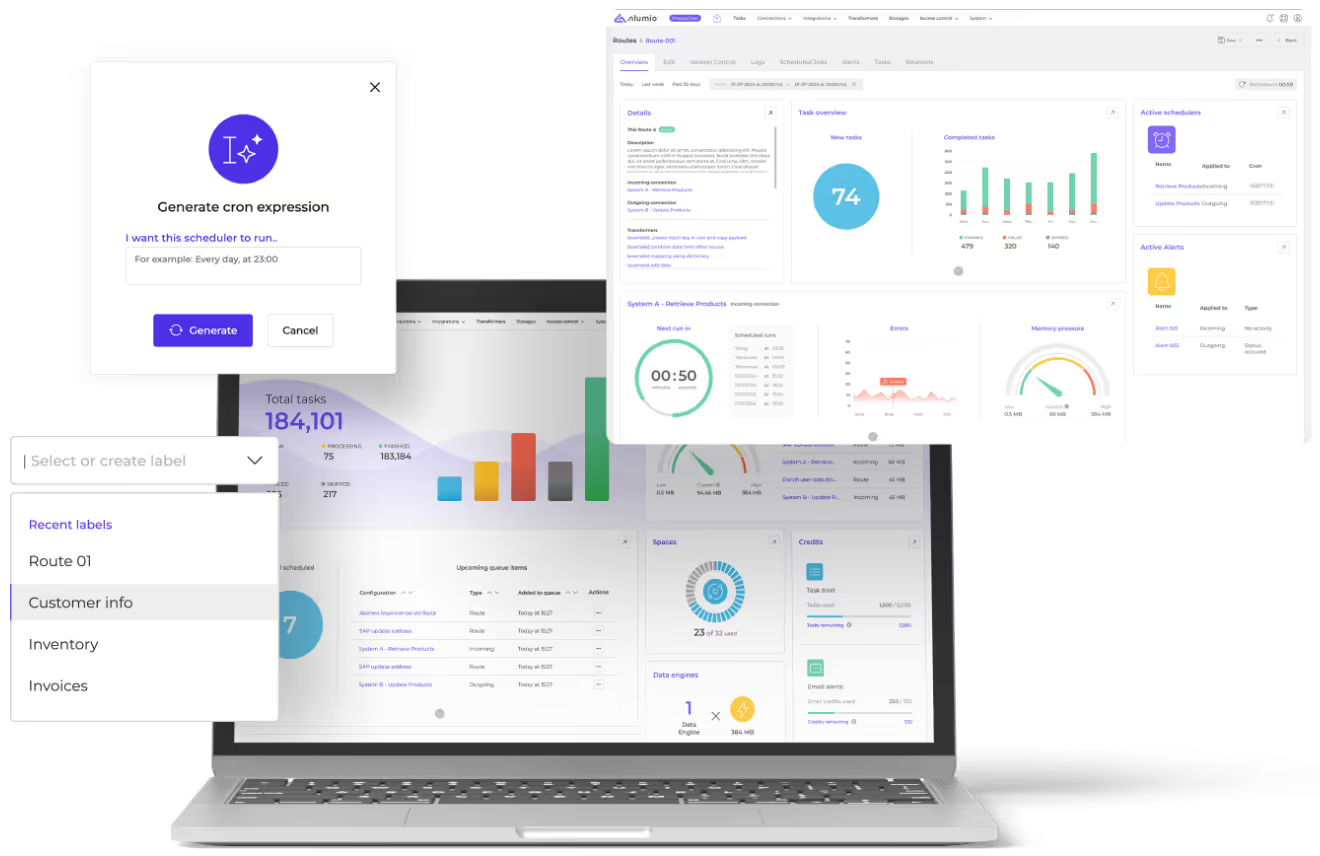
Laptop screen displaying the Alumio iPaaS dashboard, alongside pop-up windows for generating cron expressions, selecting labels and route overview.