

Built for manufacturers connecting ERP, MES, and PLM

Explore manufacturing
A Alumio vivid purple arrow pointing to the right, a visual representation of how to access more page material when clicking on it.
Go back

Engineering change management: why approved changes stall

By
Saad Merchant
Published on
August 7, 2026
Updated on
August 8, 2026
IN CONVERSATION WITH
Email icon
Email icon

A supplier flags that a component is going obsolete. Engineering issues a replacement, updates the drawing, and releases a new bill of materials revision. Two weeks later, a batch ships built to the old specification. Nobody skipped a step: the change was approved, recorded in the PLM system, and marked effective. It simply never reached the MES that the shop floor works from. No system was responsible for confirming that it had. Engineering change management is the discipline that governs how a change is proposed, assessed, approved, dated, and propagated to every system that acts on it. Most manufacturers have the first four covered and leave the fifth to chance. To carry an approved revision into ERP, MES, and supplier portals as one governed flow, and to record that each system received it, manufacturers need a layer that sits between them. That layer is an integration platform-as-a-service (iPaaS), and it is what turns a documented change into an executed one.

What engineering change management has to keep aligned

Every engineering change produces one authoritative answer to a narrow question: which revision of this part is valid, from which date, at which sites. Three systems need that answer. PLM holds the engineering record. ERP holds the procurement and costing record. MES holds the work instructions the floor executes against.

When those three disagree, it is rarely visible. Each system reports its own revision as current, and each is internally consistent. Nothing throws an error. The mismatch surfaces at inspection, in a customer complaint, or during an audit, weeks or months after approval.

This is why engineering change management gets measured badly. Teams track engineering change order cycle times, which tells them how long approval took. It does not tell them whether the approved change is in force everywhere it should be. A change that clears approval in three days and reaches the MES in three weeks still shipped the wrong part.

The five stages of the engineering change management process

The discipline breaks into five stages, and the terminology matters because each produces a different artifact.

  • Request: a quality engineer, supplier, or production lead raises an engineering change request (ECR) describing the problem and the proposed fix.
  • Assessment: engineering, quality, and procurement establish what the change touches, which assemblies, which suppliers, which open work orders.
  • Approval: the change board signs off, and the request becomes an engineering change order (ECO), the instrument that authorizes the change.
  • Effectivity: the change is dated, so every system knows from which serial number, batch, or date the new revision applies.
  • Propagation: the approved revision and its effectivity date reach every system and partner that acts on them.

Engineering change control is the governing framework around all five: who may approve what, and what evidence is retained. The first four stages happen inside one system, usually the PLM. The fifth crosses system boundaries, which is why it is the stage that fails.

Why approved changes still reach the floor late

Propagation fails in four recognizable ways, and none of them looks like a failure at the time.

Manual re-keying is the most common. An engineer emails the new revision to planning, someone types it into the ERP, and the transcription is correct until the day it is not.

Batch windows lose the effectivity date. A nightly sync carries the revision number but drops the date it becomes valid, so ERP treats the change as effective immediately while MES continues on the old instruction until its next refresh.

Structure conversion introduces silent drift. The engineering bill of materials in PLM is not shaped like the manufacturing bill of materials the ERP needs. When that conversion is scripted rather than governed, a substituted component can land on the wrong assembly. This is the same gap that breaks the digital thread more broadly.

Supplier notification stays informal. Revisions go out as email attachments, and the supplier has no reliable way to know whether the drawing they hold is current.

All four share one cause: once a change leaves the PLM, no system owns it.

Turn AI ambition into action

Portrait of Leonie Becher Merli, Business Development Manager at Alumio

Get a free assessment of your integration needs and next steps

Portrait of Leonie Becher Merli, Business Development Manager at Alumio

Ready to run engineering change management via an integration platform?

Ready to run engineering change management via an integration platform?

What happens when the change crosses plants and suppliers

Multi-site manufacturers face the same problem multiplied. A change approved at one plant may take effect there next Monday, and at a second plant only when existing stock is consumed two months later. Both dates are correct. Both have to be held simultaneously, per site, in systems that were never designed to disagree on purpose.

Suppliers add a second dimension. A contract manufacturer building to a customer drawing needs the revision, the effectivity date, and a record that they acknowledged both. Without that acknowledgment, a nonconformance becomes a dispute about who knew what and when, and the quality team spends days reconstructing a timeline from inboxes.

Handling this well means treating an approved change as a message with delivery guarantees rather than a document that gets circulated. Each recipient system and partner either confirms receipt or raises an exception, and the exception is visible to the engineering ops lead the same day rather than at the next audit.

The integration layer that carries an approved change everywhere

Delivering a change with those guarantees is what the integration layer is for. The Alumio iPaaS sits between PLM, ERP, MES, and supplier channels as the layer that executes propagation.

When PLM publishes an approved revision, a Route picks up the event. Transformers convert the engineering bill of materials into the structure the ERP expects, and the effectivity date travels as a mandated field rather than a free-text note. The same flow issues the supplier notification in the format that partner accepts, whether an API call or an EDI message.

Every message is logged at field level, so which systems received revision C, and when, has an answer that nobody has to reconstruct. Built-in Storage holds intermediate data for replay, so an MES down for maintenance is not a silent gap. Configuration handles the routing and mapping rules, so an engineering ops lead can adjust how a change propagates without waiting for a developer, with the Code Transformer covering rules configuration cannot express. The change then arrives dated and acknowledged on every system that acts on it.

Making engineering change management an execution guarantee

Most manufacturers do not have an approval problem. Their ECR and ECO workflows are documented, their authorities are named, and their PLM system holds a clean record of every decision. What they lack is any mechanism that guarantees a decision reached the systems and partners that act on it.

Closing that gap changes what the discipline delivers. Instead of a record of intent, engineering change management becomes a record of execution, with a date, a recipient, and a confirmation attached to every change. Quality stops reconstructing timelines. Procurement stops ordering against superseded specifications. Production stops building parts that were revised a month ago.

The manufacturers who get this right stopped treating propagation as an administrative step and started treating it as infrastructure, held to the same reliability standard as the production line.

No items found.

FAQ

Integration Platform-ipaas-slider-right
What is engineering change management?

Engineering change management is the discipline that governs how a product change moves from proposal to production. It covers five stages: raising a change request, assessing what the change affects, approving it through named authorities, setting an effectivity date, and propagating the approved revision to every system and partner that acts on it. It is distinct from the tooling used to run it, and the stage that most often fails is the last one.

Integration Platform-ipaas-slider-right
What is the difference between an ECR, an ECO, and an ECN?

An engineering change request (ECR) proposes a change and describes the problem it solves. An engineering change order (ECO) is the approved instrument that authorizes the change, issued once named reviewers have signed off. An engineering change notice (ECN) communicates the approved change to the people and organizations that must act on it, including suppliers. The three represent proposal, authorization, and communication.

Integration Platform-ipaas-slider-right
How does an integration platform support engineering change management?

An integration platform-as-a-service (iPaaS) handles the propagation stage, carrying an approved revision from the PLM system to ERP, MES, and supplier channels as one governed flow. It converts the engineering bill of materials into the structure each receiving system expects, carries the effectivity date as a required field, and logs which system received which revision on what date. That log is what makes a change auditable without manual reconstruction.

Integration Platform-ipaas-slider-right
How is an effectivity date handled across ERP and MES?

The effectivity date has to travel with the revision as structured data rather than as a note, because ERP and MES apply it to different things. ERP uses it to decide which specification open purchase orders and cost rollups follow. MES uses it to decide which work instruction the floor sees from a given batch or serial number. When the date is dropped in transit, the two systems act on the same revision at different moments.

Integration Platform-ipaas-slider-right
Does engineering change management require dedicated software?

Not usually. Most manufacturers already run the request, assessment, and approval stages adequately in their PLM or quality system. The gap is almost always propagation, which no single system owns because it crosses several. Before evaluating another change-management tool, it is worth establishing whether approved changes are arriving in ERP, MES, and supplier systems on their effectivity dates, because that is a different problem with a different fix.

Integration Platform-ipaas-slider-right
How do you know if your engineering change management process is failing?

The clearest signal is a gap between approval and execution rather than a slow approval cycle. Specific indicators: production has built to a superseded specification in the last year, a supplier nonconformance turned into a dispute about which drawing was current, or nobody can answer which systems hold revision C without opening each one individually. Short cycle times alongside any of these mean the process is fast at deciding and unreliable at delivering.

Get a free assessment of your integration needs

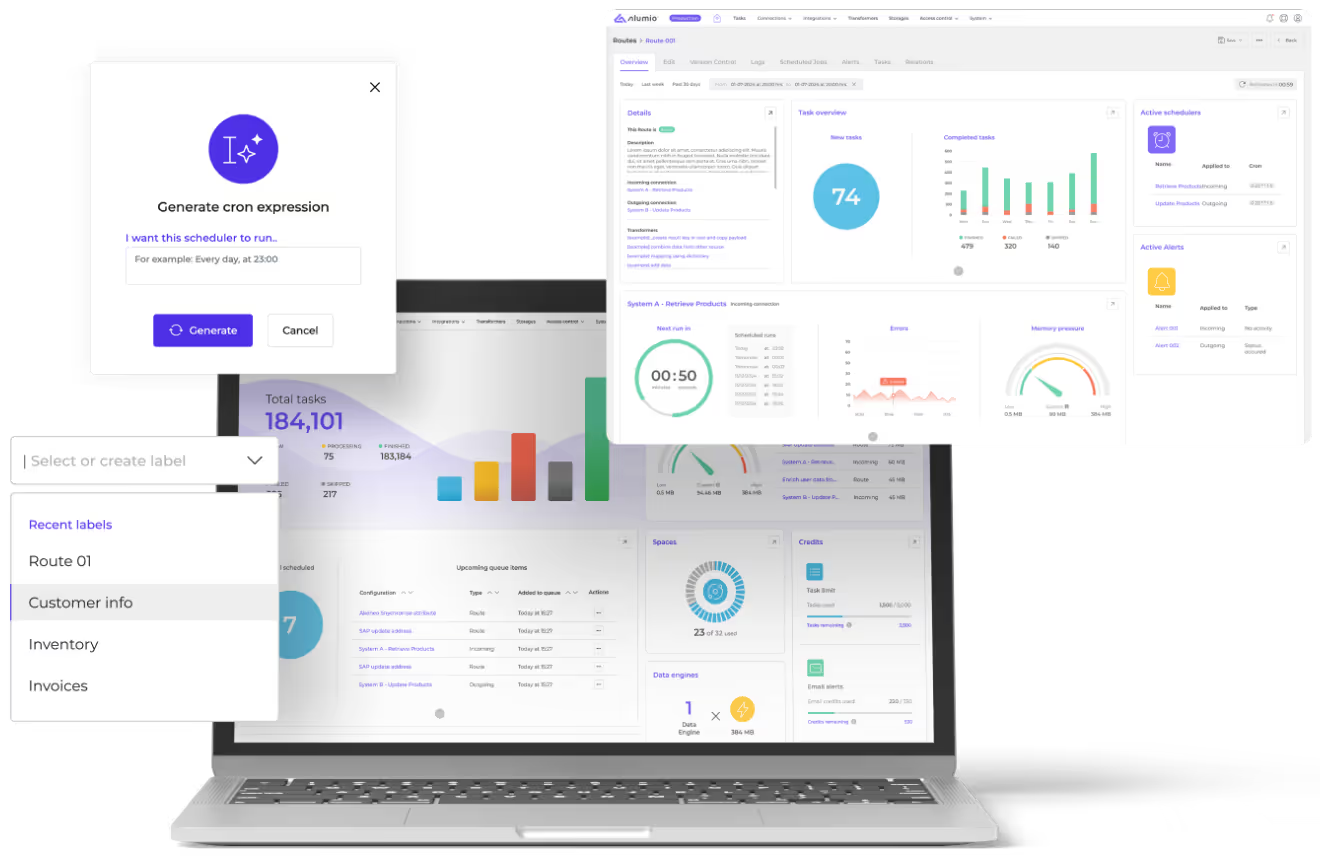
Laptop screen displaying the Alumio iPaaS dashboard, alongside pop-up windows for generating cron expressions, selecting labels and route overview.