

A Alumio vivid purple arrow pointing to the right, a visual representation of how to access more page material when clicking on it.
Go back

Enabling reliable connectivity and digital growth

By
Published on
December 14, 2020
Updated on
June 24, 2026
IN CONVERSATION WITH
Email icon
Email icon

For businesses to be successful, we genuinely believe it's vital to have a connected IT ecosystem. Everything and everyone in your digital ecosystem should connect across channels, devices, and platforms. This blog will give you one of the many reasons to be thinking of an integration strategy: connectivity.

A digital-first organization should be able to deliver all its services and operations digitally. However, the current situation of many companies is the opposite: their software is only partly connected for some critical data sets, e.g., e-commerce.

Although the customer doesn't care that you use multiple pieces of software for different activities, they do expect a short and seamless journey. With a coherent ecosystem, you will have a complete customer view.

For example: You may have some or all of the following methods for a customer to contact you: ticket system, chatbot, sales system, webshop, WhatsApp, SMS, social, and/or email. Information gathered by any of these need to be recorded and accessible across all systems and teams. This means it can be reported on and attributed to ROI. Machine learning and artificial intelligence can use this data to personalize the customer experience.

"The customer doesn't care that you use multiple pieces of software for different activities online. They want a short and seamless journey."

To become completely digital, you may need more solutions. Intelligent choices upfront make it easier to scale - and it doesn't all need to be installed at the same time. With defined priorities, it may take a few years to get things in place, and there is a lot to consider, like marketing automation, personalization, and paid advertising. But... that's just the beginning. With advancements in machine learning and artificial intelligence, these cloud-based tools will become more of a necessity than a nice-to-have. And yes, they all need connecting correctly as not to cause fragmentation of data.

Connectivity on digital messages and EDI
Electronic Data Interchange (EDI) is the computer-to-computer exchange of business documents in a standard electronic format between business partners. The Alumio iPaaS takes the complexity out of doing EDI or import digital orders (and messaging) by allowing you to easily map the files and transform them into messages which can be imported to your ERP. Be connected... Be in control!

This blog, 'Connectivity,' only showed one of the eight advantages of why it is interesting to include an integration platform in your IT infrastructure. Learn more about the benefits of an iPaaS in our other blogs or download the white paper: '8 Reasons to have an iPaaS solution in your IT ecosystem.'


Turn AI ambition into action

Portrait of Leonie Becher Merli, Business Development Manager at Alumio

Get a free assessment of your integration needs and next steps

Portrait of Leonie Becher Merli, Business Development Manager at Alumio

No items found.
Topics in this blog:
No items found.

FAQ

Integration Platform-ipaas-slider-right
What does reliable connectivity mean for a digital-first organization?

For a digital-first organization, reliable connectivity means that every system, application, and data source in the IT ecosystem can exchange data with every other component it depends on, in real time, without manual intervention and without failures going undetected. It means a customer placing an order triggers the correct downstream processes automatically, a product update in the PIM reaches all storefronts simultaneously, and an integration failure is surfaced and resolved before it affects operations. Connectivity is the infrastructure; reliability is what makes that infrastructure a business asset rather than a liability.

Integration Platform-ipaas-slider-right
Why is an integration strategy essential for digital business growth?

An integration strategy is essential for digital growth because every new digital capability (a new sales channel, a new AI tool, a new marketplace) depends on connecting to the existing system landscape. Without a strategy, each new capability is connected through whatever the fastest available method happens to be, creating a sprawl of undocumented, unmaintained connections that eventually limits rather than enables growth. A clear integration strategy defines how connections are built, governed, and extended, which is what allows digital investment to compound rather than cancel itself out through accumulated complexity.

Integration Platform-ipaas-slider-right
How does connectivity across channels, devices, and platforms benefit e-commerce businesses?

Connectivity across channels means a customer's data, order history, loyalty status, and product preferences are consistent and accessible regardless of which channel they use to interact with the business. Connectivity across platforms means the operational systems (ERP, WMS, finance) that fulfill and account for those customer interactions all work from the same current data. The business benefit is a customer experience that feels cohesive and an operational model that scales without proportional increases in manual reconciliation work between disconnected systems.

Integration Platform-ipaas-slider-right
What are the most common connectivity failures that limit digital business growth?

The most common connectivity failures are: inventory not synchronizing fast enough across channels (causing overselling), product data not reaching all storefronts when updated (causing inconsistent customer experiences), order data not flowing to ERP automatically (creating manual entry bottlenecks), and customer data fragmented across CRM and e-commerce (preventing personalized service). Each of these is a connectivity failure that limits growth: more channels and more volume amplify the problem rather than outgrowing it without a governed integration backbone in place.

Integration Platform-ipaas-slider-right
How does Alumio enable reliable connectivity across a business's IT ecosystem?

Alumio enables reliable connectivity through its cloud-native integration backbone: all data flows between systems are managed centrally, every exchange is logged and monitored, failures are surfaced in real time rather than discovered reactively, and the config-first architecture means new connections can be added quickly as the system landscape grows. The platform's prebuilt connector library covers the most common business systems, so connectivity to a new ERP, e-commerce platform, or marketplace starts from a pretested foundation rather than a blank page.

Integration Platform-ipaas-slider-right
What is the link between integration reliability and customer experience quality?

Integration reliability and customer experience quality are directly connected: when inventory synchronization fails, customers buy products that are out of stock; when product data is inconsistent across channels, customers make purchase decisions based on inaccurate information; when order data does not flow to the WMS automatically, fulfillment is delayed. Every customer-facing quality problem in e-commerce has a corresponding integration failure behind it. Investing in integration reliability is therefore simultaneously an operational investment and a customer experience investment.

Get a free assessment of your integration needs

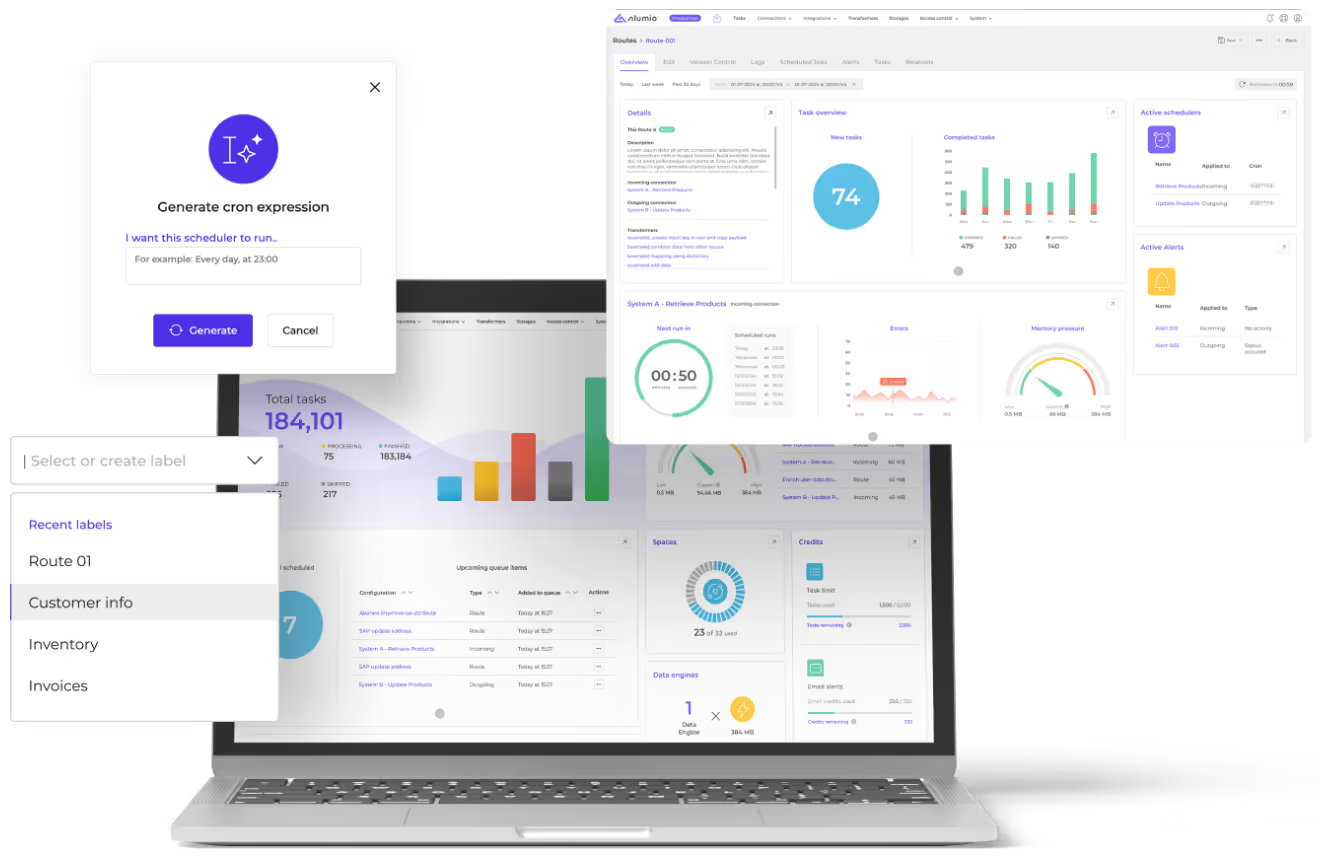
Laptop screen displaying the Alumio iPaaS dashboard, alongside pop-up windows for generating cron expressions, selecting labels and route overview.