What changes when a group acquires again and again
Every acquisition opens the same gap: synergies are expected in quarters, while system consolidation takes years. For a single merger, the case for connecting first and consolidating later is well established.
A buy-and-build group reopens that gap with every deal. Each add-on acquisition brings its own ERP, webshop, or warehouse system, and migrating each one before the next deal arrives builds a permanent queue. Carve-outs add the opposite pressure: a business leaving a group must separate its data by a fixed date.
Many groups choose hybrid or standalone integration, where each add-on keeps its own operations. The group still needs one view of customer, order, and stock, which is a data question rather than a systems one.
The pressure shows up differently in retail, wholesale and distribution, and manufacturing. The principle is the same in all three: after an acquisition, integrate the data, not the systems.
Does an acquired webshop need replatforming?
A retailer that buys a brand or a webshop inherits a second storefront, customer base, and stock position. Shoppers expect to be recognised across both, and finance expects one order book. Replatforming the acquired webshop turns the deal's first year into a migration project.
The two estates do not have to share one webshop platform for that view to exist. When both connect to a shared data layer, customer, order, and stock data from each storefront can be brought together and kept current, long before either webshop is retired.
Van Tilburg, one of the largest independent fashion stores in the Netherlands, faced this after acquiring Calico Jack and rebranding it as Calico Club. It started by connecting Calico Club's BigCommerce webshop to its own ERP, and that connection became its proof of concept for an integration platform.
How does a carve-out meet a fixed TSA deadline?
In wholesale and distribution, the timetable is often set by separation rather than by joining. When a business is carved out of a larger group, it usually keeps using the seller's systems for a fixed period under a transitional service agreement (TSA). That agreement has an end date nobody can move, and by then every order, price, and supplier flow has to run somewhere new.
The deal rarely sets the pace. Separating the data from the old group and rejoining it to the new owner does, and integrations written into either ERP have to be rebuilt to move. Integrations held as configuration in a separate layer can instead be split, duplicated, or handed over without being rebuilt.
So the work starts while the TSA still runs. Each flow the carved-out business depends on is mapped, moved onto a layer the new owner controls, and tested. Cutover then happens before the end date, not on it.
Can a manufacturing group report as one without one ERP?
Manufacturers that join plants or entities face a familiar instruction: harmonise on one ERP before anything else. That instruction is a common reason integration budget gets deferred, because nothing gets connected until harmonisation is funded and finished. Meanwhile, each site keeps reporting in its own codes, and group figures are reconciled by hand.
Joining plants does not require one ERP. An integration layer can give the group reporting and control while each site keeps running on the systems it has. The group can see what runs and who changed what.
Morssinkhof Groep, a family of companies that includes Morssinkhof Infra, Brinkman brick centre, and the garden hardware manufacturer Tuinvisie, works this way. Its 25 previously scattered applications now connect and synchronise through one integration layer.
Why the first deal sets the pattern for the next
In a buy and build, the first acquisition decides how every later one goes. If each deal starts a new migration, the backlog grows with every signature. If each deal connects to the same data layer, the new business adds its own connections. It reuses the definitions the group has agreed, so post-acquisition integration gets shorter each time.
An iPaaS is a cloud-based, central hub that a group connects its systems to. It transforms each system's data into one shared format and automates the exchange in real time or on a schedule.
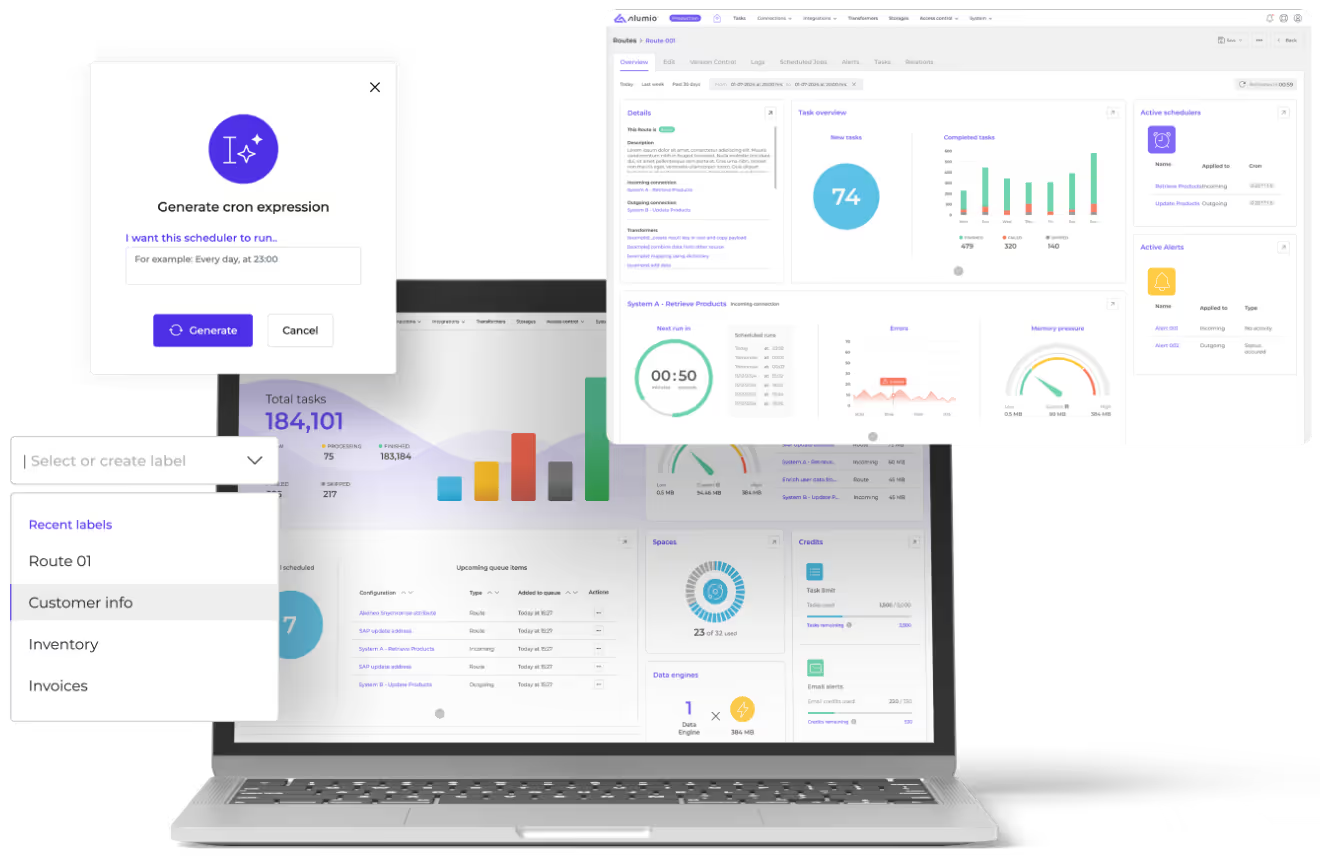
For a group that keeps acquiring, connecting systems is only the starting point. Those integrations carry business-critical flows across several companies. They also need control: who can change a flow, a record of every change, and building blocks the next deal can reuse. Alumio is a config-first integration platform built for that kind of multi-system integration, with features that can be configured around each entity in the group:
- A new acquisition joins the existing layer: the acquired ERP, webshop, or warehouse system connects through one of more than 180 connectors or a custom connection.
- One definition across the group: a Transformer maps customer, product, and supplier codes in transit, so each estate reads the same record without either system changing.
- Each business in its own environment: Alumio Spaces Core gives each company in the group its own isolated environment, which keeps a carve-out or a later migration contained.
- Every change is traceable and the data secured: role-based access, an audit trail, and configuration history show who changed which flow, and when. The platform is ISO 27001:2022 certified.
Where to start with buy-and-build integration
A buy-and-build strategy is judged on how quickly each acquisition starts working with the rest of the group. Every quarter spent waiting for a migration is a quarter of synergies reconciled by hand, and the next deal does not wait.
Starting with the data changes that order. Pick the view the deal case depends on most, usually customer, order, and stock, and connect each new business to one layer that delivers it. On an integration platform like Alumio, integrations typically go live in weeks, not months, so the combined view arrives on the deal's timetable.
Consolidation stays open as a choice rather than a precondition. A retailer can merge its webshops when it suits its customers, and a distributor can hand over a carved-out business without rebuilding its flows. A manufacturer can harmonise its ERP when the business case is ready. Until then, the group already works as one.