


Start managing multiple client integrations from one managed space.

Discover Aumio Spaces
A Alumio vivid purple arrow pointing to the right, a visual representation of how to access more page material when clicking on it.
Go back

Managing multiple clients, systems, and data models from one platform

By
Saad Merchant
Published on
April 25, 2026
Updated on
April 25, 2026
IN CONVERSATION WITH
Email icon
Email icon

System integrators, agencies, and consultants face an escalating operational problem as their client portfolios grow: every new client brings a different software ecosystem, a different data model, and a different set of integration requirements. Managing those environments through isolated, bespoke builds fractures technical resources, inflates maintenance costs, and creates a model where growth makes operations harder rather than easier. A multi-client integration platform changes that by providing a single hub from which delivery teams can build, govern, and monitor all client integrations, each in a secure, isolated environment, without losing visibility across the portfolio.

Why managing client integrations at scale breaks traditional delivery models

As agencies and system integrators expand their client base, the way most firms build integrations starts to work against them. Each environment is built separately, maintained separately, and monitored separately. What looks manageable at five clients becomes genuinely difficult at twenty.

Custom point-to-point builds do not produce reusable assets. They produce isolated dependencies. When a vendor updates their API, the custom script built for that client breaks. A developer has to context-switch into that environment, locate undocumented logic, and fix it under time pressure. Multiply that across a growing portfolio and maintenance consumes the capacity that should be going toward new delivery work.

There is also a knowledge problem. A well-structured workflow built for one client cannot easily be transferred to another if both environments are completely siloed. The same problem gets solved from scratch, and the cost is absorbed by the project margin.

The result shows up in three predictable ways:

  • Support workload increases as each broken integration requires individual diagnosis
  • Delivery timelines extend because there is no reusable foundation to start from
  • Managed service margins compress as monitoring isolated environments becomes increasingly expensive

These are structural problems that hiring more developers does not fix.


What a multi-client integration platform provides

A multi-client integration platform is a centralized solution designed for service providers governing multiple distinct client environments. Rather than maintaining separate tooling or a separate codebase per client, the delivery team operates from one unified interface.

The platform creates isolated, partitioned environments for each client within the central hub. Data routing, API credentials, transformation logic, and business rules are scoped to each client's environment. A consultant working in one client's space cannot affect another client's data flows. Each environment is independently governed but collectively visible from the same administrative layer.

This structure gives agencies full portfolio visibility from one place, combined with the security isolation each client environment requires. It also handles data format translation automatically, converting source data into the structure the destination system requires during routing, which removes the manual mapping overhead that typically consumes consultant time on every new engagement.


The operational benefits that follow

Faster delivery through reusable templates

A workflow built successfully for one client can be duplicated into a new client environment and adjusted for their specific field mappings and business logic. The underlying connection architecture does not need to be rebuilt each time. This reduces time between project kickoff and a working integration, which impacts both client satisfaction and how many projects the team can run in parallel.

Lower maintenance overhead

When integrations are built on standardized connectors within a governed platform rather than bespoke code, the maintenance burden shifts. If a software vendor updates their API, the platform updates the connector. Connections remain stable without requiring emergency developer intervention across individual client codebases.

A viable managed services model

Offering integration management as a recurring service is difficult to deliver profitably when each client environment requires individual monitoring. A centralized platform changes that. The support team monitors health status, API usage, and error logs across all client environments simultaneously from one dashboard. Issues are surfaced and resolved before clients are aware of them, which is the operational foundation of a credible managed service offering.


Turn AI ambition into action

Portrait of Leonie Becher Merli, Business Development Manager at Alumio

Get a free assessment of your integration needs and next steps

Portrait of Leonie Becher Merli, Business Development Manager at Alumio

Want to start orchestrating multiplle client integrations from one governed platform?

Want to start orchestrating multiplle client integrations from one governed platform?

How Alumio supports multi-client integration delivery

Alumio is a cloud-native, low-code integration platform-as-a-service (iPaaS) that connects systems, applications, and data sources through one central, governed environment. It provides pre-built connectors, visual data mapping, workflow automation, and centralized monitoring, giving delivery teams the infrastructure to manage complex integrations without depending on custom code for every connection.

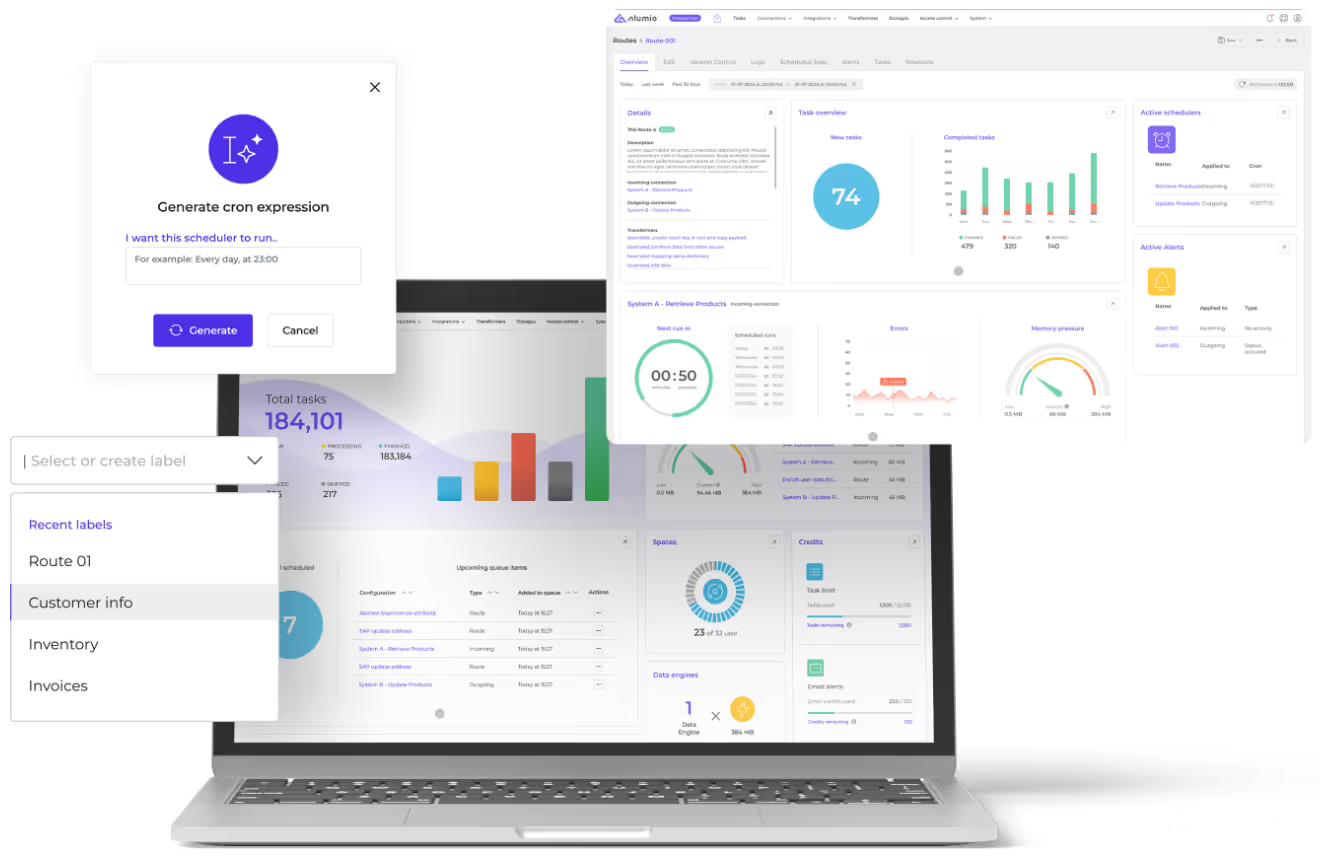
For agencies and system integrators managing multiple clients, Alumio offers a specific capability called Alumio Spaces. Each client gets a dedicated Space within the platform: a fully isolated environment with its Data Engine for processing performance, its own granular user access controls, and the ability to configure separate UAT and production environments per client.

Partners manage all client Spaces from a single central dashboard. New Spaces can be added as the portfolio grows without provisioning new infrastructure. Reusable connectors and templates apply across Spaces. And Alumio offers white-labelling, meaning agencies can deliver the integration platform under their own branding, owning the client relationship rather than surfacing a third-party interface.

The platform runs across every Amazon AWS region, which is relevant for agencies managing clients with localized compliance or data residency requirements. Alumio is also ISO 27001-certified and GDPR-aligned, with role-based access control and multi-factor authentication across all environments.


Centralized integration is how delivery becomes a scalable service

Clients continue to adopt new tools, replace existing systems, and expect faster implementation with each change. Agencies and SIs that rely on isolated custom builds to meet that demand find maintenance outpacing their capacity to take on new work.

A multi-client integration platform resolves the structural problem rather than the symptom. It replaces fragmented delivery with a governed, reusable model. It turns integration from a series of one-off projects into a scalable managed service. And it gives delivery teams the visibility and control to grow their portfolio without losing operational coherence as it scales. For agencies and system integrators building toward that model, Alumio and Alumio Spaces provide the dedicated, isolated, centrally governed environment to make it work in practice.

No items found.

FAQ

Integration Platform-ipaas-slider-right
What is a multi-client integration platform?

A multi-client integration platform is a centralized hub that allows agencies and system integrators to build, manage, and monitor integrations for multiple clients from a single unified interface. Each client operates in an isolated environment, keeping data, credentials, and business logic completely separate between accounts while remaining manageable from one administrative layer.

Integration Platform-ipaas-slider-right
‍How does a centralized platform help agencies scale integration delivery?

By providing reusable templates, standardized connectors, and shared delivery infrastructure, a centralized platform reduces the effort required for each new client engagement. Teams start from a proven foundation rather than an empty codebase and configure client-specific logic in an isolated layer. This allows more projects to run concurrently without a proportional increase in technical headcount.

Integration Platform-ipaas-slider-right
How does a multi-client platform keep client data secure?

Each client environment is strictly isolated within the platform. API credentials, routing logic, transformation rules, and business data are scoped to the individual client environment and cannot interact with others. Alumio is ISO 27001-certified and GDPR-compliant, with role-based access control and multi-factor authentication across all environments.

Integration Platform-ipaas-slider-right
Why is custom point-to-point integration a liability for growing agencies?

Custom integrations create isolated dependencies that require individual maintenance. When a vendor updates their API, each connection needs to be fixed separately. Across a growing portfolio, the cumulative maintenance workload consumes developer capacity that would otherwise go toward new delivery work, compressing margins and limiting how many clients the firm can effectively service.

Integration Platform-ipaas-slider-right
Can a multi-client integration platform support a managed services model?

Yes. Centralized monitoring across all client environments is one of the core operational advantages. The support team views health status, API usage, and error logs for every client workflow from one dashboard. When a data transfer fails, the platform surfaces the alert immediately, allowing the team to resolve issues proactively. The white-labelling option in Alumio Spaces also allows agencies to deliver integration management as their own branded service, strengthening the client relationship and the commercial value of the managed service offering.

Integration Platform-ipaas-slider-right
What is Alumio Spaces?

Alumio Spaces is a feature within the Alumio iPaaS that gives agencies and system integrators a dedicated environment to manage multiple client integrations from one central dashboard. Each client gets their own isolated Space with a dedicated Data Engine, separate user access controls, and independent UAT and production environments. Agencies can add new Spaces as their portfolio grows and optionally white-label the platform under their branding.

Get a free assessment of your integration needs

Laptop screen displaying the Alumio iPaaS dashboard, alongside pop-up windows for generating cron expressions, selecting labels and route overview.