


Leverage an integration platform for SIs & agencies

Learn more
A Alumio vivid purple arrow pointing to the right, a visual representation of how to access more page material when clicking on it.
Go back

What is an iPaaS for professional services

By
Saad Merchant
Published on
April 13, 2026
Updated on
April 13, 2026
IN CONVERSATION WITH
Email icon
Email icon

Professional services firms rely on a growing mix of tools to manage sales, project delivery, billing, support, and client relationships. A CRM tracks the pipeline. A project management platform runs delivery. A separate finance system handles invoicing. Time tracking lives somewhere else. When those systems do not work together, teams fill the gaps manually: copying data between platforms, chasing internal handoffs, and reconciling records that should never have diverged in the first place. An integration platform-as-a-service, or iPaaS, is what connects those systems, automates how data moves between them, and removes the manual overhead that accumulates when software operates in silos. Let’s explore what this means in practice for agencies, consultancies, and system integrators.

What do professional service firms need an iPaaS

Professional services sell time, expertise, and delivery quality. That means every hour lost to internal administration has a direct cost.

When software is disconnected, the same information often has to be entered multiple times across different systems. A salesperson closes a deal in the CRM, then someone else creates the project manually in the delivery tool. Billable hours are tracked in one platform, but invoicing happens in another. Support teams, project leads, and finance may all be working from slightly different versions of the same client data.

This creates three common problems:

  • more manual work across teams
  • slower project and billing workflows
  • less reliable reporting and visibility

The issue is not that firms use multiple tools. In many cases, that is necessary. The issue is that the tools are not connected in a way that supports the business as one coordinated operation.

What an iPaaS actually does for professional services

An iPaaS (integration Platform as a Service) is a cloud-based integration platform that sits between your business applications and manages how data moves between them.

In practical terms: when something happens in one system, the iPaaS can trigger the right actions in others automatically. A deal marked closed in the CRM creates the corresponding project in the delivery platform, pushes client data into finance, and notifies the responsible team, without anyone moving that information manually. A project milestone reached in the delivery tool triggers an invoice in the billing system. A support ticket resolved updates the client record in the CRM.

For professional services firms, this means having a central integration layer across the tools the business runs on: CRM, ERP, project management, billing, time tracking, and support platforms. Instead of relying on one-off custom scripts or manual workarounds to keep those systems in sync, the business has a structured, governed way to connect workflows across departments.

What changes when systems are connected

The value of an iPaaS is not just that it connects software. It changes how the firm operates on a daily level.

  • Less manual work across teams: When repetitive handovers are automated, people spend less time updating records, copying information between platforms, or following up on tasks that should have triggered automatically.
  • Faster project and billing workflows: When deal closure, project setup, milestone tracking, and invoice generation are connected, the time between a signed contract and active delivery shortens. Billing cycles move faster because data does not have to be manually sent.
  • More reliable reporting and visibility: When systems share a consistent data foundation, leadership can get an accurate view of sales, delivery, finance, and support without relying on manual reconciliation across separate platforms.
  • A foundation for growth Manual processes that work at one level of volume tend to break as the firm grows. Connected workflows scale more predictably because the system handles the coordination rather than the headcount.


Turn AI ambition into action

Portrait of Leonie Becher Merli, Business Development Manager at Alumio

Get a free assessment of your integration needs and next steps

Portrait of Leonie Becher Merli, Business Development Manager at Alumio

Integrate all your tools and customer systems with one scalable platform

Integrate all your tools and customer systems with one scalable platform

How an iPaaS reduces dependency on IT and development teams

One of the reasons iPaaS has become more relevant for professional services is that modern integration platforms are no longer designed only for specialist developers.

Low-code integration platforms make it possible for technical consultants, analysts, and operations teams to configure and manage standard workflows through visual interfaces. That does not remove the need for technical oversight, but it does reduce the number of everyday integration tasks that have to wait for senior developers. Teams can automate standard workflows without turning every requirement into a custom development project, while developers stay focused on higher-value or more complex work.

For agencies and system integrators, this also matters in a client delivery context. The same low-code approach that helps a firm connect its own internal systems can be applied to the integration work it delivers for customers, with the governance and reuse features that make that delivery more consistent across projects. Alumio, for example, is built to support exactly this: a low-code integration platform with the monitoring, multi-environment support, and data governance that professional services firms need both internally and in client-facing work.

Common iPaaS use cases in professional services

The most useful starting points are usually the workflows that cause the most friction between departments.

  • Lead to project: when a deal closes, project creation and internal handoff happen automatically
  • Quote to cash: approved quotes trigger downstream billing and finance workflows without manual re-entry
  • Client onboarding: customer data flows into the systems needed for delivery, finance, and support from a single source
  • Milestone billing: project milestones in the delivery tool trigger invoice generation in the finance system
  • Ticket to resolution: support events update client records, delivery tasks, or reporting environments automatically

These workflows often look small in isolation. Together, and handled manually across a growing client base, they represent a significant and recurring operational cost.

The iPaaS as an operational backbone for professional services firms

The tools professional services firms use are often good individually. The problem is that they operate independently, which forces people to act as the integration layer between them. That is time that could go toward client work, and it is a pattern that compounds as the firm grows.

An iPaaS replaces that manual coordination with a governed, automated connection between the systems the business depends on. For firms looking to reduce operational drag, deliver projects faster, and build a more scalable operating model, it provides the foundation that makes that possible. Platforms like Alumio are designed specifically for this: connecting the tools professional services teams actually use, with the visibility and control needed to manage those connections reliably as the business grows.

No items found.

FAQ

Integration Platform-ipaas-slider-right
What is an iPaaS?

An iPaaS, or integration Platform as a Service, is a cloud-based platform that connects different software applications and manages how data moves between them. It sits between your business systems and automates data flows, so changes in one application are reflected in others without manual intervention.

Integration Platform-ipaas-slider-right
How is an iPaaS different from custom integrations?

Custom integrations are built specifically for one connection between two systems and typically require developer expertise to build, maintain, and update. An iPaaS provides a centralized platform for managing all integrations in one place, with pre-built connectors, visual configuration tools, and monitoring features that reduce the need for custom development and make integrations easier to maintain over time.

Integration Platform-ipaas-slider-right
Why does an iPaaS matter specifically for professional services firms?

Professional services firms run on billable time, which means any hour spent on manual data entry or internal coordination between systems has a direct cost. An iPaaS automates the handoffs between CRM, project management, billing, and support tools, reducing administrative overhead, accelerating project delivery, and giving leadership a more reliable view of operations.

Integration Platform-ipaas-slider-right
Can non-technical team members use an iPaaS?

Modern low-code integration platforms are designed to be accessible beyond specialist developers. Technical consultants, analysts, and operations managers can configure and manage standard workflows through visual interfaces. Technical teams retain oversight of architecture and governance, but routine integration work does not have to wait in a development queue.

Integration Platform-ipaas-slider-right
What are the most common iPaaS use cases in professional services?

The most impactful use cases tend to be the workflows that create the most friction between departments: lead-to-project handoffs when a deal closes, quote-to-cash flows that connect approvals to billing, client onboarding that distributes customer data across delivery and finance systems, and milestone-triggered invoicing that removes manual assembly from the billing cycle.

Integration Platform-ipaas-slider-right
How should a professional services firm start with an iPaaS?

Start by identifying the workflows that consume the most manual effort or create the most coordination overhead between teams. Choose one or two repeatable, high-friction processes to automate first. Establish clear governance around who can build and monitor workflows before expanding adoption, and build on that foundation incrementally rather than trying to automate everything at once.

Get a free assessment of your integration needs

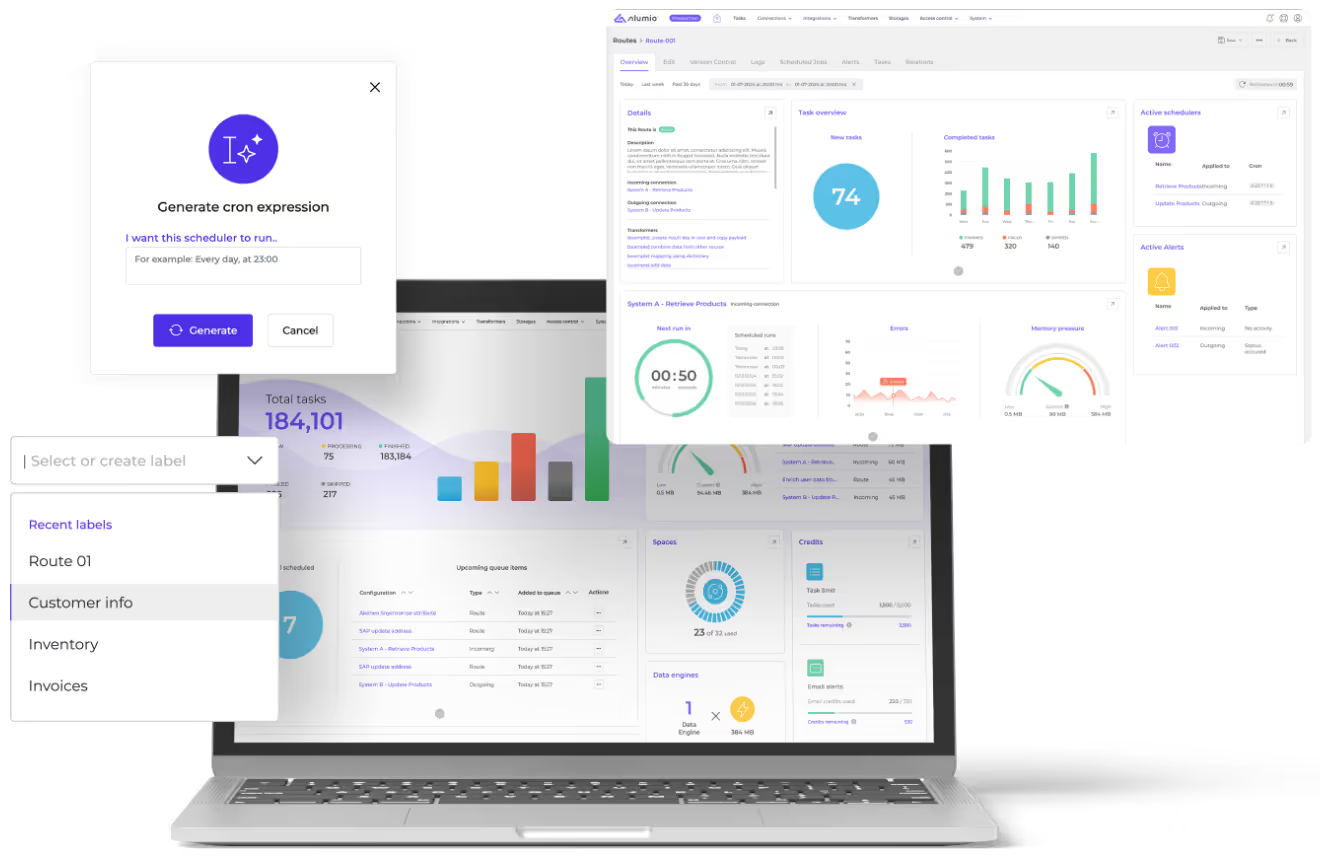
Laptop screen displaying the Alumio iPaaS dashboard, alongside pop-up windows for generating cron expressions, selecting labels and route overview.