


Integrate applications without custom code dependency

Connect now
A Alumio vivid purple arrow pointing to the right, a visual representation of how to access more page material when clicking on it.
Go back

Low-code integration for professional services

By
Saad Merchant
Published on
March 31, 2026
Updated on
April 3, 2026
IN CONVERSATION WITH
Email icon
Email icon

Relying on senior developers for every client integration creates a bottleneck that affects delivery speed and project profitability. Low-code integration platforms reduce that dependency by giving consultants and business analysts a visual interface to configure and deploy standard data flows themselves. But speed alone is not the point. The stronger argument for low-code in professional services is governance: integrations that live in a central, monitored platform are easier to support, hand over, and scale than a growing portfolio of custom scripts. For edge cases that visual tools cannot handle, platforms like Alumio include a Code Transformer that allows JavaScript to be written directly within the integration environment, keeping complex transformations inside a governed platform rather than handled elsewhere. The result is a delivery model that is faster on standard work, better controlled overall, and more flexible where the complexity genuinely demands it.

Why senior developer dependency slows integration delivery

Many agencies, consultancies, and system integrators still operate with a delivery model where consultants define the solution and developers handle the integration work. That creates a familiar gap between strategy and execution.

The problem is not that senior developers are too involved. It is that they often become the default route for work that does not always need to be hand-coded from scratch. When every mapping, workflow, and system connection waits in the same development queue, delivery slows and project pressure builds.

This typically shows up in three ways:

  • Project timelines stretch because execution depends on a limited number of specialists
  • Margins shrink when standard integration work takes too long to deliver
  • Long-term support becomes harder when knowledge is locked inside custom code that only one person fully understands

For firms handling multiple client projects at once, this model becomes difficult to sustain as the portfolio grows.

What low-code integration actually changes

Low-code integration does not replace technical expertise. It changes where that expertise is applied.

Instead of building every integration from scratch, teams work through a visual, configurable environment that supports connectors, mappings, workflows, and monitoring from one central platform. Routine integration work moves faster without turning the architecture into a collection of one-off scripts. The real shift is not from developers to non-developers. It is from fragmented execution to a more governed delivery model.

That matters because consultants and technical delivery teams usually understand the client process better than anyone else. They know which systems need to connect, what data needs to move, and what the outcome should look like. In a purely code-led model, that understanding still has to be translated through a separate handover before anything happens. A low-code integration platform reduces that friction by letting more of the standard work happen closer to the people designing the workflow, while technical governance remains in place.

The result is a better balance across the delivery team:

  • Consultants and delivery teams can move faster on standard workflows
  • Technical teams retain oversight over architecture and quality
  • Senior developers can focus on more complex or higher-value work

Why low-code still needs governance, visibility, and control

A visual interface on its own is not enough. Professional services firms still need clear control over who can build, edit, approve, and monitor integrations. They need visibility into how data moves, where failures happen, and how to support clients when systems change.

This is where the framing matters. Low-code integration is not primarily about making integrations easier to build. It is about making them easier to govern and manage as part of a scalable operating model. Centralized orchestration, auditability, compliance support, and reusable components are what make a low-code platform sustainable in professional services, not just the visual interface.

That is especially relevant for agencies and system integrators managing multiple client environments simultaneously, where delivery quality depends as much on consistency and supportability as on build speed.

Why low-code still needs room for edge cases

Low-code integration helps professional services teams move faster on standard, repeatable work. But client environments are rarely fully standard.

Complex mappings, unusual data structures, or client-specific business rules appear regularly in real projects. A visual interface handles most of it well, but there will be situations where it is not enough. That is why flexibility matters alongside governance.

Alumio's Code Transformer gives developers the option to write JavaScript directly within the integration environment when a transformation requires it, rather than handling it through a separate script outside the platform. An AI-assisted mode can also generate that code from a plain-language description, which makes it more accessible for team members who are comfortable with the logic but less so with the syntax.

The practical point is that low-code does not have to mean low flexibility. Standard delivery patterns are handled visually. Edge cases that need more are handled in code, but within the same governed environment rather than through isolated custom work that sits outside any monitoring or audit trail.


Turn AI ambition into action

Portrait of Leonie Becher Merli, Business Development Manager at Alumio

Get a free assessment of your integration needs and next steps

Portrait of Leonie Becher Merli, Business Development Manager at Alumio

Establish a low-code data backbone to scale and govern your integrations

Establish a low-code data backbone to scale and govern your integrations

How low-code integration improves delivery scalability

A more scalable delivery model does not come from removing technical people. It comes from using them more effectively. With a governed low-code integration platform, professional services firms can typically address a few recurring operational problems.

Standardize repeatable integration work: Common system combinations and recurring workflows can be configured consistently and saved as reusable templates instead of being rebuilt from scratch for each new client. That reduces build time and makes delivery easier to scope and price.

Reduce key-person dependency: When integrations live in a central platform rather than scattered across custom scripts, support and ownership become less dependent on whoever originally wrote the code. That matters both for internal continuity and for client handovers.

Improve monitoring and support: Centralized visibility makes it easier to detect failures, troubleshoot data flows, and respond to changes in a client's environment without relying on tribal knowledge about how a specific integration was built.

Free developers for higher-value work: Senior developers can focus on architecture, advanced custom logic, the Code Transformer for complex transformations, and extension work rather than becoming a bottleneck for every routine mapping task.

How to adopt low-code integration more effectively

Low-code is most useful when firms approach it as an operating model rather than just a tooling choice.

Step 1: Identify repetitive integration work

Look for workflows that appear frequently across projects, such as CRM-to-ERP syncs, client onboarding flows, or billing triggers. These are the best starting points because they offer the most reuse value.

Step 2: Separate standard work from real edge cases

Not every integration needs the same approach. Some flows can be handled visually and reused across clients. Others have enough complexity or client-specific logic to warrant deeper technical involvement. Knowing which is which helps allocate the right resources to each.

Step 3: Put governance in place early

Define who can build, review, approve, and monitor integrations before the platform is widely adopted. The structure is easier to establish at the start than to retrofit once multiple people are building across multiple client environments.

Step 4: Build for reuse

The goal is not only to deliver one project faster. It is to create a repeatable model where future projects can launch with less friction and more predictable effort.


Low-code integration is about delivery leverage, not just build speed

The strongest argument for low-code integration in professional services is not that it sounds faster. It is that it creates delivery leverage: the ability to handle more integration work, more consistently, without proportionally increasing the demands on specialist engineering capacity.

When standard integration work is handled through a governed, visible, and reusable platform, firms can reduce bottlenecks, improve supportability, and apply specialist talent where it creates the most value. For professional services firms looking to build that model, Alumio provides a low-code integration platform with a visual interface for standard data flows, a Code Transformer for complex transformations and edge cases, and the governance, monitoring, and multi-environment support that agencies and system integrators need to manage integration delivery at scale.

No items found.

FAQ

Integration Platform-ipaas-slider-right
What is low-code integration in a professional services context?

Low-code integration refers to using visual, configuration-driven platforms to connect client software systems rather than writing custom code for each integration. It allows technical consultants and business analysts to build and manage standard data flows without developer involvement, which can reduce delivery times and relieve backlog pressure on engineering teams.

Integration Platform-ipaas-slider-right
How does low-code reduce dependency on senior developers?

By providing pre-built connectors and visual mapping tools, low-code platforms allow consultants to configure routine integrations themselves. Senior developers are still needed for complex transformations and edge cases, but they are no longer required for every data flow, which frees their capacity for higher-complexity work.

Integration Platform-ipaas-slider-right
Can low-code platforms handle complex data transformation requirements?

For straightforward data mapping, yes. For more complex transformations or edge cases that visual tools cannot handle, most low-code platforms provide a code-level option. Alumio's Code Transformer lets users write JavaScript directly within the integration environment for these situations, with an AI-assisted mode that can generate the code from a plain-language description of the required transformation.

Integration Platform-ipaas-slider-right
Why does governance matter in a low-code integration model?

Making integration tools accessible to more team members does not remove the need for oversight. Access controls, connection security, monitoring, and audit logging still need to be defined and maintained by technical leadership. A centralized integration platform makes that governance more manageable by providing visibility across all data flows from one interface, which is particularly important for firms managing multiple client environments.

Integration Platform-ipaas-slider-right
How does reuse help professional services firms deliver more efficiently?

Successful integration workflows can be saved as templates and applied to future client projects with similar system combinations. This reduces build time for common use cases, makes delivery easier to scope and price, and supports a shift toward offering integration work as a repeatable managed service rather than a series of bespoke builds.

Integration Platform-ipaas-slider-right
What role do senior developers play in a low-code integration model?

They focus on work that genuinely requires engineering depth: complex data transformations using the code layer, custom application development, architecture decisions, and advanced logic that warrants proper review and version control. Low-code reduces their involvement in routine data mapping, not in the work where their expertise creates the most value.

Get a free assessment of your integration needs

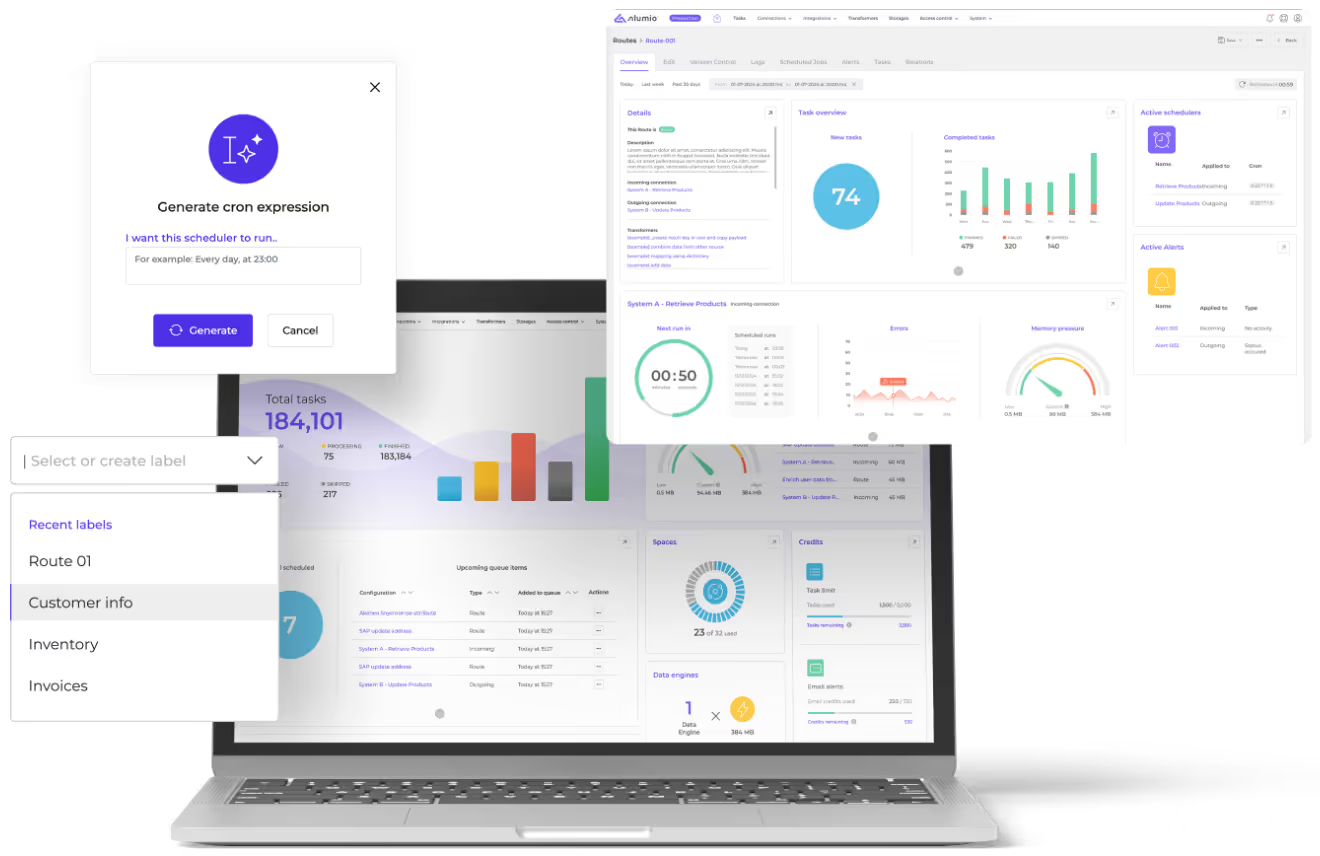
Laptop screen displaying the Alumio iPaaS dashboard, alongside pop-up windows for generating cron expressions, selecting labels and route overview.