

A Alumio vivid purple arrow pointing to the right, a visual representation of how to access more page material when clicking on it.
Go back

Unified commerce: The backbone of modern customer experiences

By
Carla Hetherington
Published on
November 22, 2024
Updated on
June 24, 2026
IN CONVERSATION WITH
Email icon
Email icon

In a world where customers are glued to their screens, the line between online and offline shopping has all but disappeared. Technology now shapes every move they make—from browsing for inspiration to making a purchase. Whether they're scrolling through an app, strolling through a store, or jumping between both, they expect the journey to be seamless. It’s no longer enough to simply exist on multiple platforms; businesses need to connect the dots. This is where unified commerce comes in—the game-changing strategy that turns scattered channels into a perfectly synchronized experience.

What is unified commerce?

Unified commerce goes beyond simply connecting sales channels. It integrates all customer interactions and backend operations—inventory management, payment processing, order fulfillment—into one centralized platform. This creates a real-time, 360-degree view of the business and its customers.

Unlike traditional models, unified commerce ensures that every system and channel operates from the same data set. For the customer, this translates to a seamless experience: they can start a purchase on one platform, modify it on another, and complete it elsewhere without missing a beat. For businesses, it means greater operational efficiency, real-time insights, and the ability to deliver truly personalized experiences.

Why unified commerce matters

Unified commerce isn’t just a technological upgrade; it’s a strategic necessity in today’s competitive landscape. Customers expect businesses to know them, understand their preferences, and anticipate their needs. Without a unified system, delivering this level of service becomes nearly impossible.

From a business perspective, unified commerce provides a wealth of benefits. It enhances decision-making by offering real-time insights into inventory, sales, and customer behavior. It also streamlines operations, reducing redundancies and improving efficiency across the board. Most importantly, it positions businesses to respond quickly to changing market dynamics and customer expectations.

Multichannel vs. Omnichannel vs. Unified commerce

To understand the importance of unified commerce, it helps to compare it with other commerce strategies.

In a multichannel setup, businesses operate multiple, often siloed, sales channels—think of a retailer managing separate systems for their website, physical stores, and social media platforms. While customers have several ways to interact, these channels don’t communicate with one another. This disconnection often leads to inconsistent experiences. For example, a customer might see a product online marked as "in stock" but find it unavailable in-store.

Omnichannel commerce takes it a step further by connecting these channels to create a more cohesive experience. Here, businesses aim to ensure consistency across touchpoints. A customer might browse a product online, add it to their cart, and complete the purchase in-store, with the system recognizing their journey across platforms. However, omnichannel often relies on patchwork integrations between systems, resulting in fragmented data and operational inefficiencies.

This is where unified commerce stands out. Imagine it as a symphony where every instrument plays from the same sheet of music. Unified commerce eliminates the need for patchwork by consolidating all systems into a single platform. Data flows freely and in real-time, providing both customers and businesses with a seamless, synchronized experience.

Explore the key differences between multichannel and omnichannel commerce →

The role of the iPaaS in multichannel, omnichannel, and unified commerce

Ultimately, whether a business is navigating the waters of multichannel, omnichannel, or unified commerce, the key to success lies in the seamless integration of systems. All three approaches hinge on the ability to connect and synchronize data across platforms and devices in real-time. This is where an iPaaS (Integration Platform as a Service) becomes indispensable. Acting as a central hub, an iPaaS like Alumio bridges the gap between disparate systems, enabling real-time data exchange and flexible workflow automation. It ensures that every touchpoint within your commerce strategy, from inventory and sales to customer interactions, operates in harmony, guaranteeing a smooth interchange of data that prevents information from being lost in the process. With its scalable, cloud-based infrastructure and API-driven capabilities, an iPaaS empowers businesses to adapt, grow, and deliver consistent, engaging experiences—no matter where customers choose to shop.

Key technical advantages of Alumio:

  • Centralized integration: Alumio enables businesses to integrate their various applications and data sources through a single platform. This eliminates silos and ensures that every system operates from the same data pool.
  • Real-time data synchronization: With Alumio, data is updated in real time across all channels. This means that when a customer makes a purchase online, inventory levels reflect the change instantly, both in-store and on the website.
  • Automated workflows: Alumio allows businesses to automate critical workflows, such as order processing, inventory updates, and customer notifications. This reduces manual effort and minimizes the risk of errors.
  • Scalability and flexibility: As your business grows, Alumio’s modular architecture makes it easy to flexibly integrate new systems and channels without disrupting existing operations.
  • Enhanced security and compliance: Alumio ensures that data flows securely across systems, adhering to global compliance standards and upholding the highest security quality principles during development.

By leveraging an iPaaS solution like Alumio, businesses can transition to a unified commerce model with minimal friction, unlocking the full potential of their operations and delivering exceptional customer experiences.

Conclusion

Unified commerce is more than a buzzword; it’s a blueprint for thriving in today’s digital-first world. By integrating all customer touchpoints and backend systems into a single platform, businesses can offer the seamless, personalized experiences that modern customers demand. Achieving this requires robust integration, and that’s where an iPaaS like Alumio shines. Acting as the glue between systems, an iPaaS ensures real-time data synchronization, automates workflows, and unifies operations, enabling businesses to deliver personalized, frictionless experiences across all channels. In today’s increasingly demanding digital world, unified commerce powered by an iPaaS is the key to staying competitive and meeting ever-evolving customer expectations.


Turn AI ambition into action

Portrait of Leonie Becher Merli, Business Development Manager at Alumio

Get a free assessment of your integration needs and next steps

Portrait of Leonie Becher Merli, Business Development Manager at Alumio

No items found.
Topics in this blog:

FAQ

Integration Platform-ipaas-slider-right
What is unified commerce and how does it differ from omnichannel?

Unified commerce is an evolution beyond omnichannel: while omnichannel connects existing separate channel systems so customer data and inventory are consistent across them, unified commerce aims for a single back-end platform that natively serves all channels from one system rather than connecting independent systems after the fact. In practice, the distinction matters for architecture: omnichannel solutions integrate separately deployed channel systems; unified commerce architectures build all channels on a shared data model from the start. For most organizations, the omnichannel integration approach with a strong iPaaS backbone delivers the customer experience benefits of unified commerce without replacing all existing channel systems simultaneously.

Integration Platform-ipaas-slider-right
What are the key components of a unified commerce backbone?

The key components are: a single inventory management system visible to all channels in real time, unified customer identity that links all touchpoints to the same customer profile, a shared order management system that processes orders from all channels consistently, a PIM as the single product data source for all channel presentations, a CRM that aggregates customer interaction history from all channels, and an integration backbone that governs the data flows between all components. The integration platform is the practical enabler of unified commerce for most organizations: it creates unity across existing systems without requiring all systems to be replaced by a single monolithic platform.

Integration Platform-ipaas-slider-right
Why is the line between online and offline shopping disappearing?

The line is disappearing because customers do not distinguish between channels when they form expectations and make decisions: they research products on mobile, buy in-store, track delivery online, return through a different channel, and expect the brand to recognize them and their history throughout. Technology accelerated this convergence: smartphones made digital commerce accessible in physical retail contexts, in-store digital screens and apps extend the online experience into physical spaces, and unified customer data platforms allow brands to personalize interactions regardless of channel. Businesses that still manage channels independently create the friction of inconsistent experiences that customers increasingly notice and penalize with disengagement.

Integration Platform-ipaas-slider-right
How does Alumio help businesses achieve unified commerce experiences?

Alumio enables unified commerce by connecting all channel systems to the shared data sources that create consistency: inventory from ERP or WMS reaches all digital and physical channels in real time, product data from PIM is consistent across all touchpoints, customer data from all channel interactions flows to a unified CRM or CDP, and orders from all channels flow into a single ERP for unified processing and financial management. The integration backbone creates the functional equivalent of unified commerce across existing systems: eliminating the data silos that produce inconsistent customer experiences without requiring all systems to be replaced simultaneously.

Integration Platform-ipaas-slider-right
What customer experience improvements mark the transition to unified commerce?

The customer experience improvements that mark unified commerce transition are: accurate inventory promises across all channels (customers never encounter out-of-stock situations they could not have anticipated), smooth cross-channel returns (bought online, returned in-store without friction), consistent loyalty recognition everywhere (points, rewards, and tier status apply regardless of channel), complete service history access (any service agent can see the full relationship history regardless of channel), and personalized interactions that reflect the full customer relationship rather than only the most recent channel interaction. Each improvement requires a specific integration flow connecting the relevant back-end system to the customer-facing channel.

Integration Platform-ipaas-slider-right
What is the business case for investing in unified commerce infrastructure?

The business case for unified commerce infrastructure rests on three pillars: customer lifetime value improvement (unified commerce customers consistently demonstrate higher LTV than channel-specific customers: industry data suggests 30 percent or more in retail), operational cost reduction (unified inventory management, order processing, and customer service infrastructure are more efficient than duplicated per-channel systems), and revenue protection (consistent product information, accurate inventory promises, and smooth cross-channel experiences reduce the abandonment and returns that inconsistent channel experiences generate). The integration backbone investment is the shared infrastructure cost that enables all three outcomes simultaneously.

Get a free assessment of your integration needs

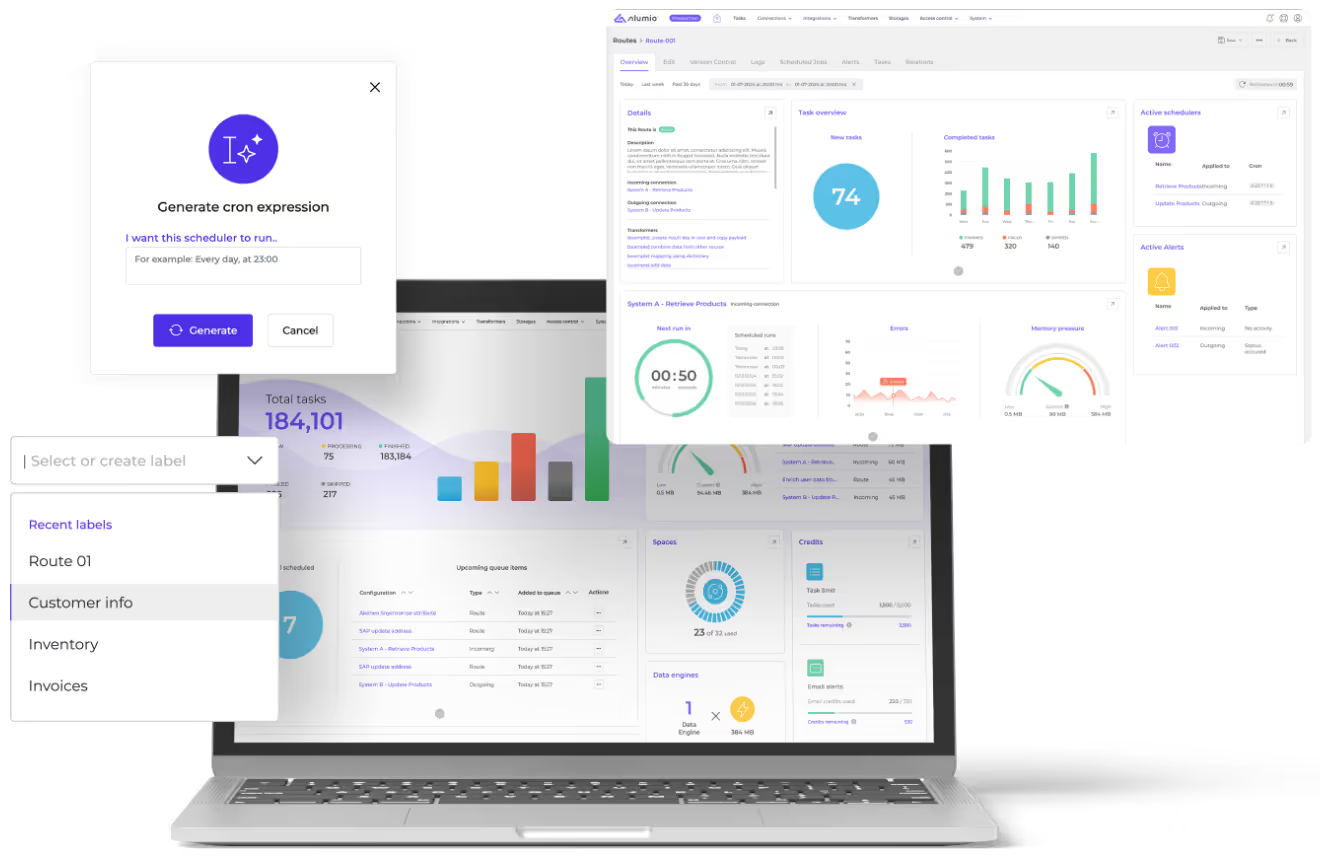
Laptop screen displaying the Alumio iPaaS dashboard, alongside pop-up windows for generating cron expressions, selecting labels and route overview.