




.svg)


So, why is the security of your data so important?
Data security is of paramount importance for businesses due to several key reasons:
- It protects sensitive information such as customer data, financial records, and trade secrets, preventing unauthorized access and potential damages.
- It helps businesses maintain customer trust, as data breaches can result in reputational damage and customer churn.
- It protects valuable intellectual property, ensuring a business's competitive advantage remains intact.
- It ensures business continuity by mitigating the impact of cyberattacks or data loss incidents.
- It guarantees compliance with data protection regulations such as GDPR (General Data Protection Regulation) is critical to avoid hefty fines and penalties.
In sum, by implementing robust data security measures, businesses can establish a solid foundation for growth, protect sensitive information, maintain trust, comply with regulations, safeguard intellectual property, ensure business continuity, and prioritize employee privacy and protection.
What are the risks of not prioritizing your data security? Some facts and figures
There are many risks to not putting data security at the top of your priority list.
For starters, cyber threats are increasing with each passing day, and data breaches can result in severe financial and reputational damage. Although data collection can be an incredibly effective tool for businesses to create personalized, targeted marketing with significantly higher conversion rates, customers are worried about their data, given the high-number of consumer data breaches:
In the last year alone, there were 270 cyber-attacks (unauthorized access of data, applications, services, networks or devices) per company, and this number has increased by 31% compared to 2020. -Accenture
Additionally, compliance with data protection regulations is crucial to avoid penalties and legal consequences. According to the European Comission, If a company fails to adhere to GDPR standards, it can receive a fine of up to €20 million or 4% of the business's total annual worldwide turnover.
Why should you invest in an iPaaS to ensure data security?
For any iPaaS, SaaS application, or cloud service, security is crucial, and data safety should be a top priority.
As businesses integrate more software into their IT landscape, the risk of scattered, lost, or inaccessible data increases. This threat applies not only to company-sensitive information but also to customer data. When integrations are done through custom code or plugins maintained by multiple partners, the accountability for data security becomes spread out and third-party dependent.
An iPaaS (integration Platform as a Service) like Alumio offers a cost-effective solution that eliminates the need for constantly updating security features or investing in multiple integration solutions. By centralizing integrations on our platform, you gain full control over your data, reduce the risk of data loss, and maintain accountability for data security.
How does Alumio prioritize data security?
Our security and risk management team adheres to industry standards to safeguard your data, while our product team upholds the highest security quality principles during development. We conduct extensive and continuous monitoring of our platform to ensure compliance with internationally recognized high standards.
How does this look in practice?
Built-in monitoring and logging features
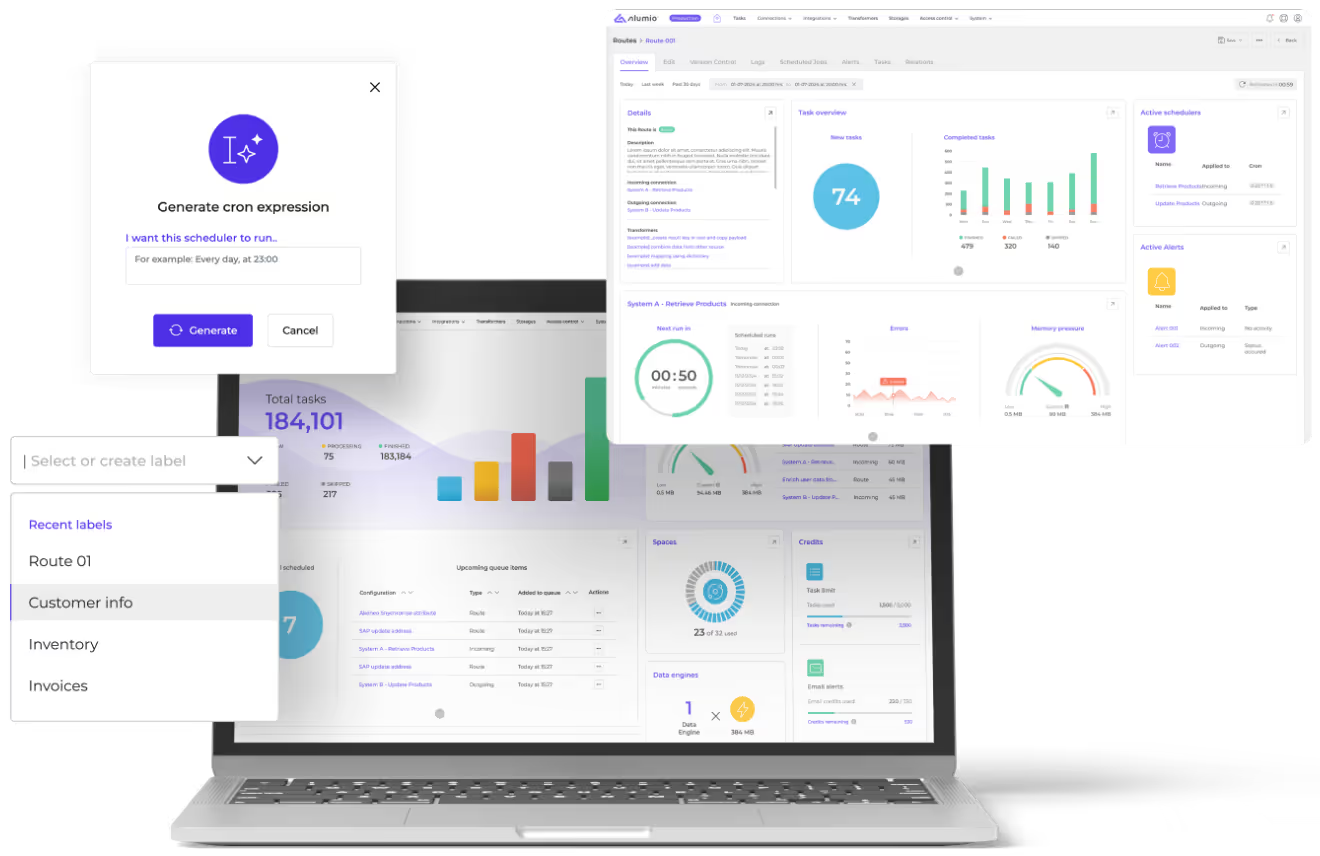
Our integration platform moves data from one system to another, containing critical information about your company, financial-related data, and your customers' Personal and Identifiable Information (PII). As such, our mission is to ensure your data security through extensive end-to-end monitoring and logging features. Alumio ensures a complete record of data processes with comprehensive logging of all data and events. Logs are securely stored in an Elastic Stack data log, allowing you to set up triggers for alerts on multiple task failures within an hour. Furthermore, our platform conducts continuous health checks and notifies you of security hacks or data errors, so you can quickly resolve conflicts and monitor integrations with basic technical expertise.
Cloud-native platform
Being cloud-native, the Alumio iPaaS leverages the power of clustered microservices technology, enabling exceptional performance, scalability, and data security. By enabling microservices-based isolation it provides greater security advantages, such as reducing attack surface, enhancing data resilience, enabling customizable security configurations, and ensuring regulatory compliance. The architecture of a cloud-native integration platform is designed to ensure business continuity even in the face of unexpected events, such as hardware failures, software glitches, or cyberattacks.
Alumio uses AWS (Amazon Web Services) hosting services and therefore relies on AWS security measures. As such, the platform offers dedicated storage and isolation for each customer's data, minimizing the risk of breaches and unauthorized access and allowing for customizable security configurations aligned with specific requirements.
Ensured privacy compliance
With Alumio, businesses stay compliant with crucial privacy legislations like GDPR, SOC2, CCPA, FERPA, HIPAA, and more, allowing them to prove how they track and manage customer data every step of the way. Alumio enhances the existing individual customer rights over their data by allowing them:
- A right to erasure and the right to be forgotten
- The right to have data deleted from multiple connected software
- The right to receive personal data on a user-friendly interface
- The right to notice, access, change, and object to personal data being shared
- The right to remove data from (external) sources
- The right to choose what personal information can be collected
Learn more about Alumio's commitment to security and compliance.
Learn more about relevant privacy legislation.
Access control
Alumio implements strong identity and authentication mechanisms, such as multi-factor authentication, to ensure that only authorized users can access the platform. Furthermore, the platform enables businesses to define and enforce granular access policies, ensuring that only approved users or applications can interact with sensitive data. This prevents unauthorized access to data and reduces the risk of data breaches.
Adherence to the latest security standards
Alumio ensures that businesses stay updated with the latest security standards by adhering to the best industry practices, security frameworks, and evolving threats, thus providing a secure and reliable integration platform that meets the highest security requirements. If businesses were to use their own in-house integration solution, they would have to invest time and money in constantly updating their security to be up to par with the latest standards instead of having it automated as they would with Alumio.
Read more about how the Alumio iPaaS helps businesses comply with data privacy regulations →
Conclusion
At Alumio, we understand that losing customer data or sensitive information is every company's worst nightmare. That's why we offer a centralized cloud-based platform that gives businesses full control over their software integrations and data, simplifying data security management.
Our platform continuously monitors and logs all software connections, providing 360-degree customer insights and immediate error detection. With Alumio, you can ensure that customer data is never exposed to unauthorized parties and remains secure between integrated systems, as our three-pronged security approach guarantees comprehensive protection for your valuable data. Additionally, we implement security measures at all layers, preventing unauthorized access and ensuring the safety of your data during transfer between systems. You can access your data anytime, anywhere, knowing that it is securely stored and readily available.
Choose Alumio for a centralized cloud-based platform that empowers you to securely manage your software integrations and data—benefit from continuous monitoring, valuable insights, and immediate breach detection.
Learn about Alumio's technical security measures.




.svg)
.svg)
.svg)
.svg)
.svg)
.svg)
