
A Alumio vivid purple arrow pointing to the right, a visual representation of how to access more page material when clicking on it.
Go back

The business benefits of having an integrated IT ecosystem

By
Carla Hetherington
Published on
February 20, 2023
Updated on
June 24, 2026
IN CONVERSATION WITH
Email icon
Email icon

Every day, customer demands and expectations rise to new heights, increasing the demand for digital and real-time services. As a result, modern businesses are keen on investing in digital transformation and business automation, which involves integrating various software solutions (SaaS) and cloud applications. By integrating these systems, businesses can digitalize and automate business processes across Marketing, Sales, Customer Service, HR, and all other departments. These integrated systems become integral parts of a business' IT ecosystem.

However, with each new software solution that a business integrates with, managing these connections and the resulting data exchange becomes more challenging. Without a proper platform to integrate all these systems, the benefits of digital transformation and business automation are overshadowed by a significant problem: an entangled IT ecosystem.

An entangled IT ecosystem consists of data silos and a jungle of crisscrossing data flows. It also involves many partially connected software solutions managed by multiple integration partners, overlapping and connecting disorganizedly. Because of the imagery that such an entangled ecosystem evokes, it is also known as an ‘IT Spaghetti ecosystem.’

Want to learn how Alumio can ensure an integrated IT ecosystem? Keep reading to find out the benefits and added value of Alumio to modern companies.

The business benefits of integrating your IT ecosystem with Alumio

The Alumio integration platform helps businesses integrate systems, software solutions, and cloud applications across on-premise and cloud environments in a streamlined fashion, thus avoiding the tangling of IT ecosystems.

With Alumio, businesses have access to the following:

Reduced TCO (Total Cost of Operations):

  • Alumio makes integrations simple for developers and non-coding professionals, thus significantly reducing operational costs regarding hiring, outsourcing, and third-party dependency.
  • The platform's Monitoring and Logging features help keep track of every process, data transfer, request, and change across all integration, instantly detecting any integration errors or API conflicts, which users can swiftly troubleshoot and resolve via an intuitive dashboard, saving significant time and labor costs.
  • Alumio eliminates black boxes and budget overruns by making all integrations and data flows visible on one user-friendly interface, which developers, project managers, and business owners can understand and collaborate upon.

Improved TTM (Time to Market):

  • Alumio enables businesses to freely experiment with removing or exchanging a new solution without losing data integrity.
  • Alumio's connector packages are an integration shortcut to help develop integrations significantly faster.
  • The platform enables the automation of complex sequences of workflows, such as simultaneously sending real-time product stock updates from the ERP system to the e-commerce platform and PIM system.

Increased ROI (Return on Investment):

  • Alumio helps businesses skip the high costs, time, and risks involved in developing, maintaining, and troubleshooting internal integration solutions, often devours a business' ROI.
  • With Alumio, businesses can avoid spending on platform security, updates, and compliance since the platform is constantly updated to meet evolving industry standards regarding performance and security. As such, Alumio guarantees the highest levels of data security, scalable infrastructure, and cloud space, saving businesses from investing resources in constantly improving or expanding such features. Furthermore, businesses stay compliant with crucial privacy legislations like GDPR, SOC2, CCPA, FERPA, HIPAA, and more, allowing businesses to prove how they track and manage customer data.
  • Thanks to the platform's centralized view of all integrations and data, businesses can get 360-degree data insights, identifying where they are losing money and what touchpoints need to be improved. This includes tracking overall customer engagement and identifying process inefficiencies. These insights can be used to optimize the targeting of marketing activities; ad spends, and budgets for business improvements.

When it's all said and done…With Alumio, businesses can enjoy a fully untangled and integrated IT ecosystem that can accommodate digital transformation and growth.

Alumio empowers businesses to create their first software integrations, and complex omnichannel experiences, upgrade or migrate old system integrations quickly, and integrate new software solutions and applications to improve digital growth.

In this way, Alumio helps businesses hit the ground running with their digital transformation journey by providing a ready-to-use integration platform to fulfill all software integration needs, helping them connect software solutions for business automation quickly and flexibly. And, most importantly, at predictable prices.

…If you'd like to get a complete explanation of the business benefits of Alumio, read our white paper on "The Cost Optimization Benefits of the Alumio platform.”


Turn AI ambition into action

Portrait of Leonie Becher Merli, Business Development Manager at Alumio

Get a free assessment of your integration needs and next steps

Portrait of Leonie Becher Merli, Business Development Manager at Alumio

No items found.
Topics in this blog:
No items found.

FAQ

Integration Platform-ipaas-slider-right
What are the main business benefits of having an integrated IT ecosystem?

The main benefits are: real-time data availability across all business functions (sales sees live inventory, finance sees current orders, customer service sees the full interaction history), automation of cross-system business processes (order processing, inventory management, product distribution, customer communication) without manual handoffs, the ability to adopt new digital capabilities faster by connecting them to existing systems rather than building standalone processes, reduced operational errors from manual data handling, and the agility to respond to market changes by adjusting integration flows rather than rebuilding individual system configurations.

Integration Platform-ipaas-slider-right
How does an integrated IT ecosystem support customer experience quality?

An integrated IT ecosystem supports customer experience quality by ensuring every customer-facing interaction is informed by complete, current data: the storefront shows accurate inventory (because WMS and ERP data flows to it in real time), product descriptions are consistent and enriched (because PIM data governs all channels), order confirmations are accurate and fulfillment is triggered automatically (because e-commerce and WMS are integrated), and customer service agents have the complete order and interaction history (because CRM is integrated with all channels). Customer experience failures almost always trace back to integration gaps rather than to the quality of individual customer-facing systems.

Integration Platform-ipaas-slider-right
What is the connection between digital transformation investment and integration quality?

Digital transformation investment produces returns proportional to integration quality: a new AI tool that cannot access current operational data from ERP and e-commerce produces unreliable outputs; a new marketing automation platform that receives customer data only in nightly batches misses the real-time behavioral triggers that drive highest conversion; a new analytics platform that does not receive data from all source systems produces an incomplete picture. Every digital capability depends on data flowing from the systems that generate it to the tools that use it, which means integration infrastructure is the multiplier that determines how much value each digital investment actually delivers.

Integration Platform-ipaas-slider-right
What types of digital growth initiatives require a connected IT ecosystem?

Digital growth initiatives that require a connected IT ecosystem include: multichannel and marketplace expansion (each new channel needs product, pricing, and inventory data from back-office systems), AI and personalization (AI tools require clean, synchronized data from all relevant systems), composable commerce adoption (components require a backbone connecting them to each other and to back-office systems), supply chain digitalization (real-time supply chain visibility requires connected ERP, WMS, and logistics systems), and international expansion (multilingual content, multi-currency pricing, and regional logistics all require coordinated data flows across the expanded system landscape).

Integration Platform-ipaas-slider-right
How does Alumio help businesses build and maintain a connected IT ecosystem?

Alumio builds and maintains connected IT ecosystems through its governed integration backbone: prebuilt connectors for the systems businesses actually run, config-first Routes that keep all data flows visible and maintainable, and central monitoring that makes the health of the entire ecosystem observable from a single dashboard. As the ecosystem grows, each new system connects to the existing Alumio backbone rather than requiring new custom integrations to all existing systems. The result is an IT ecosystem that grows in capability with each new system added rather than growing in complexity and maintenance overhead.

Integration Platform-ipaas-slider-right
What is the ROI of investing in an integrated IT ecosystem?

The ROI of an integrated IT ecosystem comes from multiple simultaneous value sources: operational cost reduction (automation replacing manual data handling), revenue protection (accurate inventory and order processing preventing lost sales), revenue enablement (faster connection of new channels and capabilities), AI and analytics value amplification (all digital tool investments perform better on integrated data), and risk reduction (proactive monitoring versus reactive discovery of failures). The combined effect is that each additional system connected to the integrated backbone delivers more value than the same system in a disconnected landscape, which is the compounding return that makes integration infrastructure investment one of the highest-ROI categories in enterprise digital investment.

Get a free assessment of your integration needs

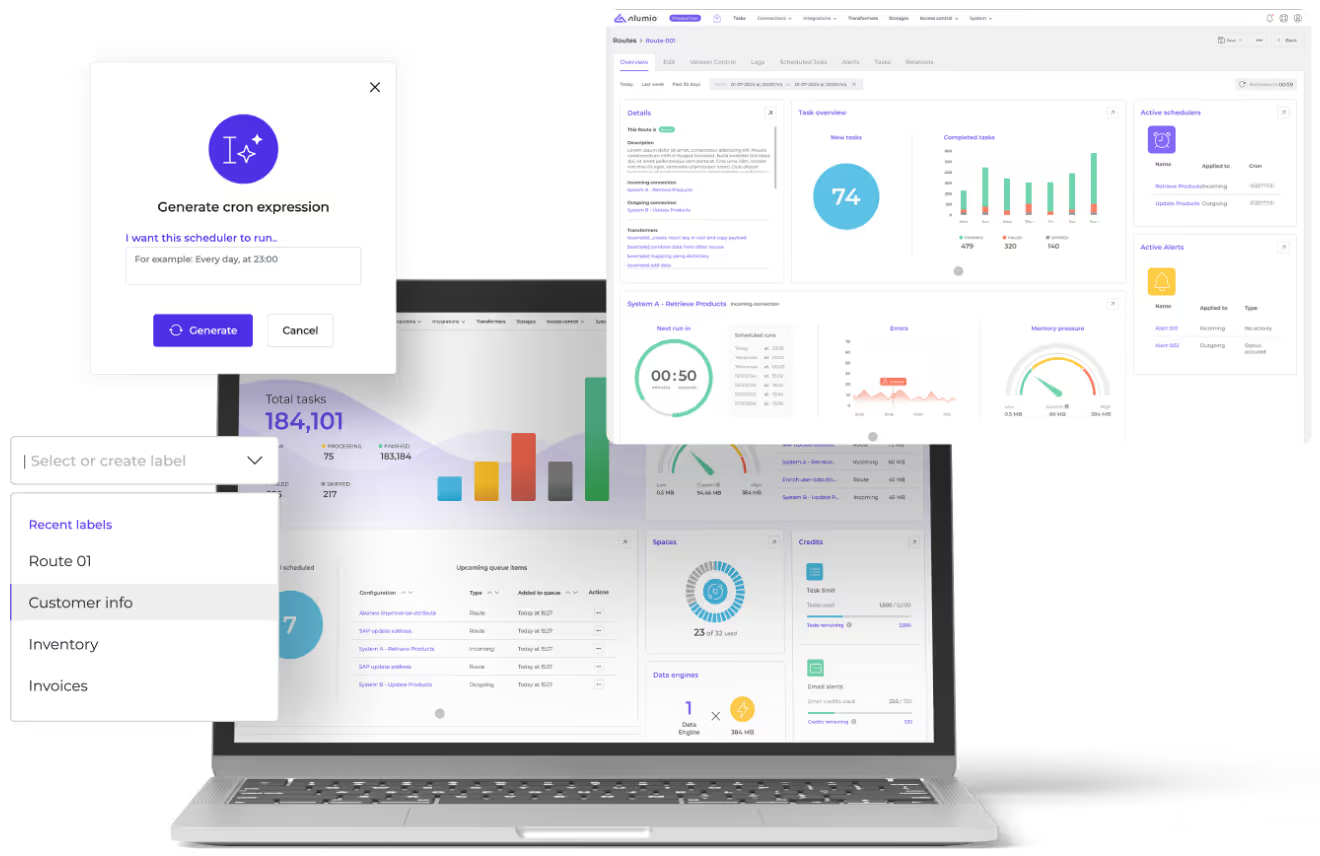
Laptop screen displaying the Alumio iPaaS dashboard, alongside pop-up windows for generating cron expressions, selecting labels and route overview.