




.svg)



In honor of Valentine’s Day, we are proud to introduce: Software Love Stories, a collection of tales featuring pairs of star-crossed software.
This particular tale follows the story of SAP ECC (the brokenhearted singleton), Adobe Commerce (the beau), Mio (the matchmaker), and Alumio (the solution).
1. The brokenhearted singleton
Meet SAP ERP Central Component (SAP ECC), a leading on-premise enterprise resource planning (ERP) system designed to help large and midsize organizations optimize essential operational business processes. SAP ECC is extremely popular among finance, sales, manufacturing, supply chain, and service management and has many attractive qualities, such as a set of modules that can operate independently or be integrated to fulfill the entirety of a business’s needs and guarantee data integrity.
So…why was this seemingly eligible bachelor a brokenhearted singleton?
Prior to being single, SAP ECC was in a tumultuous relationship with a stand-alone accounting software solution. This caused collateral damage to online business platforms by way of financial and inventory management errors. As a result, the rocky relationship between the two software solutions ended, leaving SAP ECC without a partner to share a platform with and some commitment issues…
2. The beau
Meet Adobe Commerce (previously known as Magento), an advanced e-commerce development platform designed for online businesses wanting to create optimal B2C and B2B shopping experiences. Adobe works with implementation partners, extensions, and third-party integrations to provide businesses with extensive e-commerce customization. Adobe Commerce stores are frequently integrated with ERP systems to boost efficiency and synchronize inventory, orders, customer data, and shipping between selected business systems.
Thus, while compatibility with an ERP system such as SAP ECC was seemingly not an issue, SAP ECC was afraid to be heartbroken again…
3. The matchmaker
Meet Mio, an Alumio "iPaaS Advocate," "Integrations Influencer," and, of course, "Certified Software Matchmaker." As a champion of true love, Mio makes it his mission to match software with the ideal, compatible partner, ensuring a fruitful and prosperous relationship that always results in a positive business impact. He has enjoyed a successful career in the matchmaking business thanks to none other than Alumio: the secret weapon behind his unparalleled matchmaking abilities and the solution to lonely software.
4. The solution
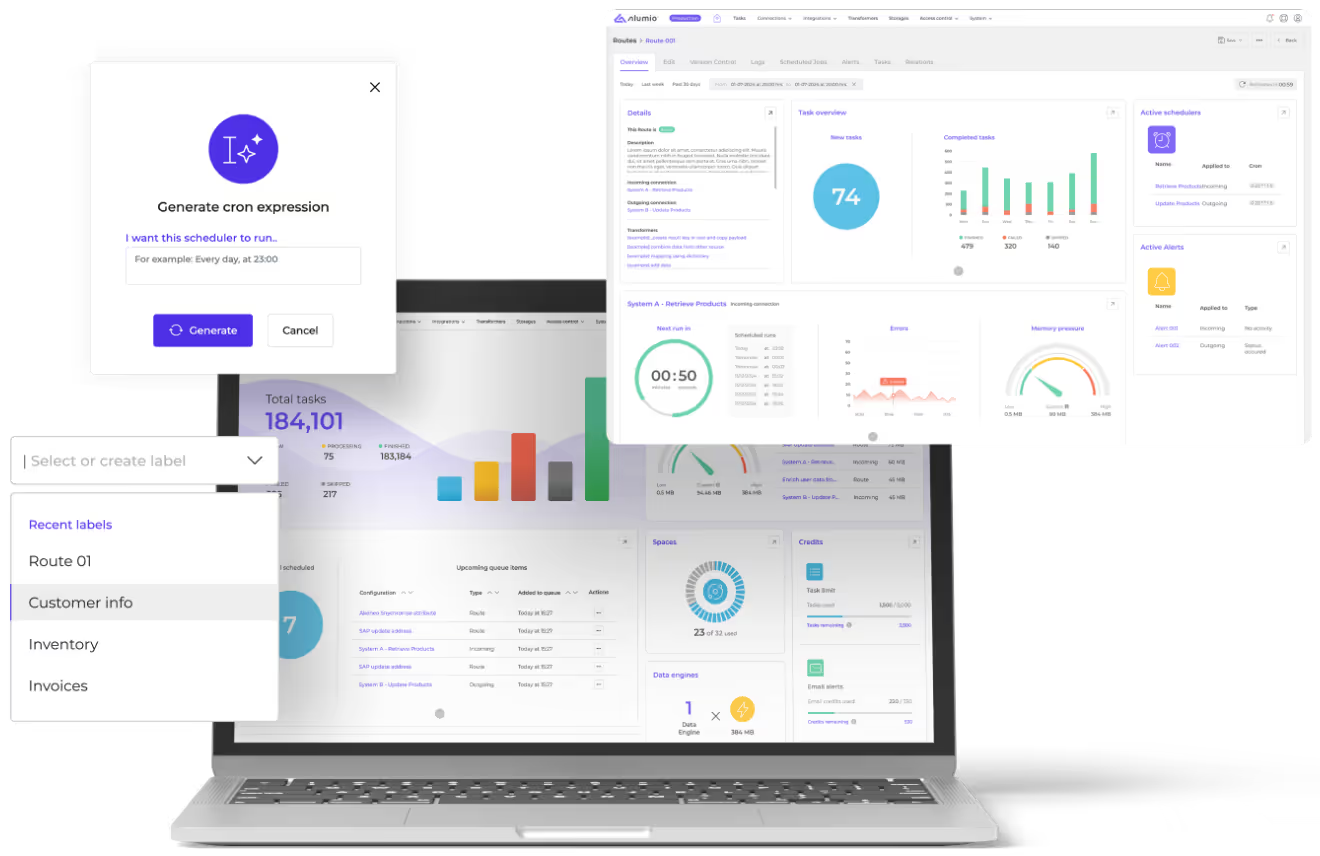
Meet Alumio, a cloud-based, low-code iPaaS (integration Platform as a Service)that enables the seamless connection of SAP to any e-commerce software. With Alumio, businesses can monitor, manage, and modify their connections via one central, user-friendly interface. More specifically, Alumio allows businesses to:
- Have complete control over all their API data
- Detect integration errors and API conflicts
- Get 360-degree performance insights
- Seamlessly transform data into the desired formats
As a middleware solution, Alumio can establish a seamless bidirectional integration between SAP ECC and Adobe Commerce (Magento), enabling the synchronization of data objects between the two. As such, it is a cost-effective solution to integrate SAP and e-commerce software in a fast, flexible, and future-proof way, allowing customers to scale their company and fulfill their business needs anytime, anywhere. After all, a well-run business is a well-integrated business!
In this case, however, some extra help was needed to mend SAP ECC’s broken heart, and so Alumio’s SAP API Plugin solution came to assist. Although compatible, connecting ERP systems like SAP ECC with an e-commerce platform such as Adobe Commerce was not an easy task since SAP was a bit reluctant to form a new attachment and lacked key B2B & B2C data points or web services required to effectively do so.
Soon enough, Alumio’s SAP API Plugin managed to install the necessary web services to enhance the integration capabilities of SAP ECC, thus avoiding what would usually be a long and expensive bespoke integration project. Once the SAP API Plugin was configured and installed, creating the full Adobe Commerce to SAP ECC integration via Alumio’s low-code integration platform was a piece of cake, and the software pair began opening up to each another.
And so it turned out, this successful integration proved extremely beneficial for businesses worldwide. One business in particular, Pelican Products, was able to deliver an optimized, real-time e-commerce experience to its customers. “How did this happen?” you may be wondering.
While attempting to lift the spirits of a recently single SAP ECC, Pelican Products decided to bring on board Corra, a renowned global digital commerce agency based in the US designed to accelerate digital commerce growth specializing in lifestyle brands and B2B organizations. Investigating the most effective way to create the e-commerce to ERP integration for Pelican Products, Corra reached out to Mio for assistance, and the rest is history…
“The collaborative approach really sparked our interest at Pelican. Both Corra and Alumio approached the integration in a collaborative way, finding answers to our requirements - that gave us the confidence that this project would be a success.”
Pelican Products.
Thanks to Mio’s solution, SAP ECC got a second chance at love and, together with Adobe, built a lasting relationship focused on helping those with e-commerce businesses achieve success. This is not just a story about love but one about collaboration and resilience. At the risk of sounding cliche, it seems as though teamwork does actually make the dream work. Here’s to many more successful collaborations!
Want to learn more about the Alumio SAP API plugin? Click here and discover a world of integrated possibilities!
Want to discover more Software Love Stories powered by Alumio?





.svg)
.svg)
.svg)
.svg)
.svg)
.svg)
