Why manufacturing ERP migrations carry such high operational risk
Most manufacturers have run their ERP for years, sometimes decades. Over that time, the system accumulates customized workflows, non-standard data formats, and business logic that was built to solve specific operational problems and never formally documented. It also becomes the central data source for a wide range of surrounding systems: Manufacturing Execution Systems (MES) that govern what happens on the factory floor, Warehouse Management Systems (WMS) that track inventory and fulfillment, procurement platforms, financial tools, and more.
Attempting to replace all of that in a single cutover creates a compressing margin for error. Data extracted from a legacy system often needs significant reformatting before a modern cloud ERP can accept it. If inventory counts or bill of materials data transfer incorrectly, production orders cannot be executed accurately. If the connections between the old ERP and peripheral systems break during the cutover, those systems lose data access until each one is individually rebuilt.
The phased migration approaches that address this risk, including the strangler fig pattern and parallel run validation, are covered in our blog on ERP modernization in manufacturing. In this blog, we focus on the infrastructure that makes those approaches technically possible: what an iPaaS actually does during the migration and why it matters.
Bridging legacy and modern systems during the transition
The safest way to upgrade a critical manufacturing ERP is to avoid disconnecting the old system the moment the new one is introduced. Both need to coexist and share data accurately for as long as the transition takes. Delivering the infrastructure that makes that possible, an integration platform or iPaaS is a cloud-based platform that sits between your business systems and manages how data moves between them.
In context of migration, the iPaaS acts as a central layer between the legacy ERP, the new ERP, and all connected factory applications. Data from the factory floor flows into the platform, which routes it to both systems concurrently. Both databases stay accurate and up to date throughout the transition. Operations teams continue working in the familiar legacy environment while IT configures and validates the new system using live production data rather than synthetic test records, which is a significantly more reliable basis for testing than anything staged or artificial.
This parallel operation also protects the systems connected to the ERP. Without a central integration layer, a change to the ERP risks breaking every integration attached to it. With the iPaaS sitting between them, those connections are managed centrally and remain stable while the migration progresses around them.
Migrating manufacturing data incrementally and accurately
Moving large volumes of records from a legacy ERP to a modern cloud platform requires more precision than a single bulk transfer can deliver. A common failure point in ERP migrations is attempting to move everything at once, which makes it difficult to identify where errors occur and nearly impossible to recover cleanly if something goes wrong.
An iPaaS supports a more controlled approach: incremental migration, where specific datasets are transferred and validated in stages. A manufacturer might migrate supplier master data in one wave, active inventory counts in the next, and open purchase orders after that. At each stage, the iPaaS automatically translates legacy data formats to match the new ERP's requirements during transit, removing the need for manual data cleaning before each transfer.
If a specific record fails due to a formatting error, the platform quarantines it, logs the issue, and alerts the team without halting the rest of the migration batch. Problems surface as manageable exceptions rather than migration-stopping failures, which makes a significant practical difference when moving millions of records across an extended transition period.
Enabling a controlled, department-by-department rollout
One of the advantages of keeping both systems connected through a central integration layer is that it removes the pressure to migrate everyone at once. Individual departments can move to the new ERP in sequence, at a pace that the business can absorb.
Consider a manufacturer that transitions the procurement team first. When a procurement officer raises a purchase order in the new system, the iPaaS automatically routes that record back to the legacy ERP, so the finance team, still operating on the old software, can process the corresponding invoice without any disruption to their existing workflow. When finance is ready to migrate, the same logic applies in the other direction.
This approach contains risk and change management effort at each phase. If a workflow issue appears in the new system for one department, it can be investigated and resolved without affecting the rest of the operation. Employee training can be targeted one team at a time rather than pushed across the organization simultaneously, which is rarely realistic in a production environment.
Managing legacy data archiving during the transition
A practical challenge in any ERP migration is deciding what actually needs to move to the new system. Modern cloud ERPs often price partly on storage volume, which means migrating decades of completed work orders, obsolete product specifications, and historical transactions can inflate costs without adding operational value to the new platform.
This is where the routing intelligence of an iPaaS becomes useful beyond just migration. The platform can apply filtering rules during the transfer process, evaluating each record against defined business criteria before deciding where it goes. Recent, active records transfer to the new ERP. Historical records beyond a defined threshold, such as orders completed more than two years ago, route automatically to a lower-cost data warehouse or cold storage environment. The new ERP stays lean and responsive while historical data remains accessible for regulatory compliance and financial auditing.
What to look for in an iPaaS for manufacturing ERP migration
Not every integration platform is built to handle the demands of a manufacturing ERP migration. The capabilities that matter most in this context are pre-built connectors for major manufacturing and legacy systems. This reduces the custom development required to establish the transitional architecture, and per-record error handling that quarantines individual failures without stopping the wider migration batch.
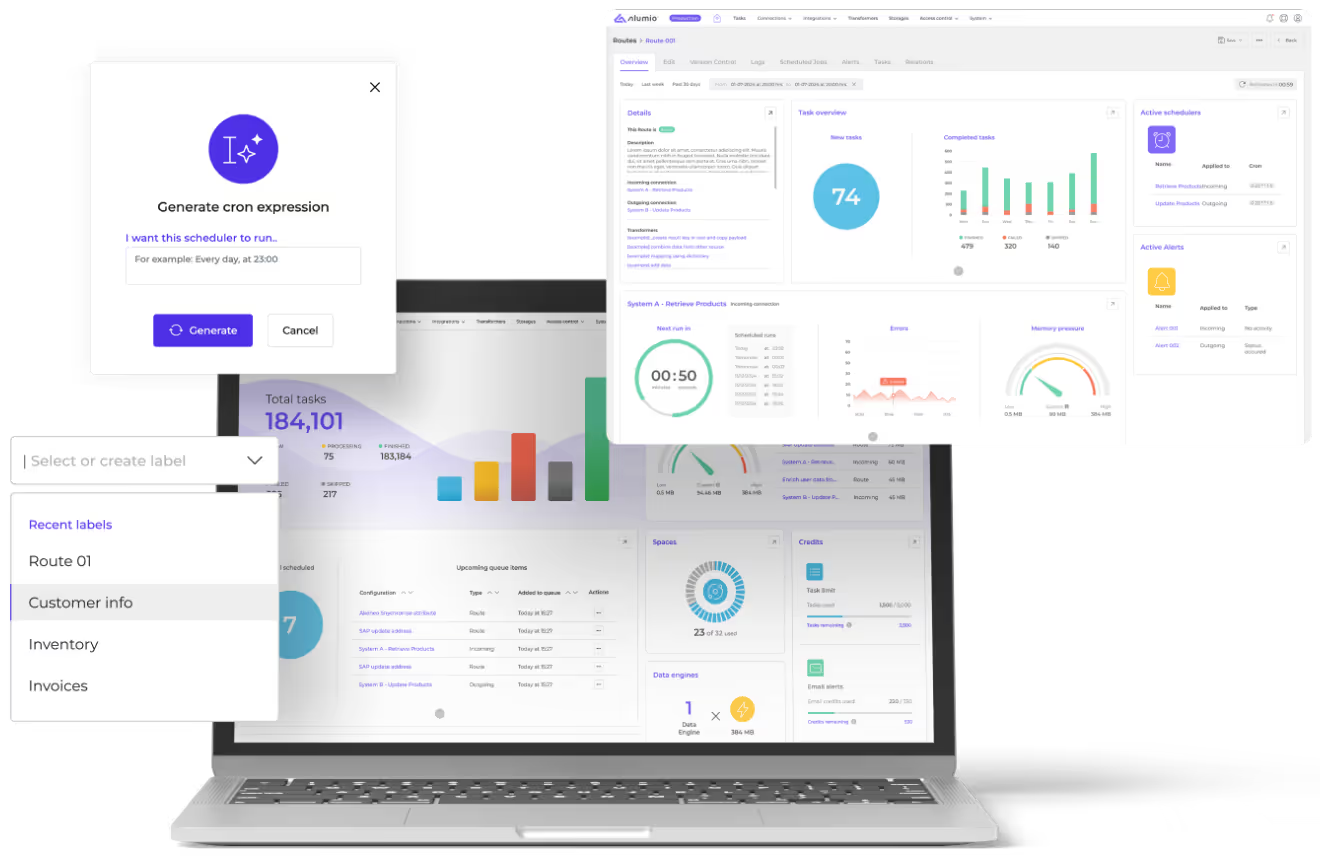
Real-time monitoring across all data flows gives IT teams visibility into what is transferring, what is failing, and why, without having to investigate each connection individually. Manufacturing data also often includes proprietary product designs, supplier contracts, and commercially sensitive pricing, and this is why it is crucial that the integration platform being employed should encrypt data in transit and at rest and provide a full audit trail of all data movement.
An integration like Alumio is ISO 27001-certified and GDPR-aligned, which matters for manufacturers operating across multiple jurisdictions or subject to industry compliance requirements.
The iPaaS makes phased ERP modernization operationally viable
ERP replacement in manufacturing does not have to be a high-stakes, all-or-nothing event. When an iPaaS acts as the transitional layer between legacy and modern systems, the risk profile of the migration changes fundamentally. Both environments stay accurate during the transition. Records move incrementally with automated format translation rather than in a single high-risk bulk transfer. Departments migrate one at a time, and issues stay contained. Historical data is archived selectively rather than carried wholesale into a system that does not need it.
For manufacturers working toward a structured ERP modernization, Alumio provides the integration infrastructure to act as that transitional bridge: connecting legacy and modern systems, managing data flows throughout each phase, and adapting as the migration progresses without requiring a rebuild at every step.




.svg)







.svg)
.svg)
.svg)
.svg)
.svg)
.svg)
