


Start integrating ERP, MES, WMS, CRM 3X faster

Connect now
A Alumio vivid purple arrow pointing to the right, a visual representation of how to access more page material when clicking on it.
Go back

How to connect ERP, MES, WMS, CRM: iPaaS vs custom code

By
Saad Merchant
Published on
March 20, 2026
Updated on
March 23, 2026
IN CONVERSATION WITH
Email icon
Email icon

Manufacturing businesses operate in an environment where precision and speed dictate success, yet many organizations still rely on brittle, custom-coded connections to link their critical software systems. However, writing point-to-point scripts to connect an Enterprise Resource Planning (ERP) system with a Manufacturing Execution System (MES), a Warehouse Management System (WMS), or a Customer Relationship Management (CRM) platform, inadvertently creates an unsustainable web of technical debt. Every system update or new software addition requires extensive code rewrites, leading to escalating maintenance costs and prolonged system downtime. To eliminate this bottleneck, forward-thinking manufacturers are adopting the integration platform-as-a-service (iPaaS) as a centralized middleware solution. By replacing custom code with the an iPaaS like Alumio, businesses can leverage low-code manufacturing capabilities to visually configure, monitor, and manage data flows. This transition helps establish a scalable integration architecture that guarantees scalability connectivity (without scaling complexity) across the entire digital ecosystem.

The hidden cost of custom point-to-point integrations

Integration projects often start with a simple requirement, like syncing customer orders from a CRM into an ERP. A developer writes a script and it works. Then the business needs inventory updates between ERP and WMS, material availability between WMS and MES, and production confirmations flowing back into the ERP.

As these flows multiply, point-to-point scripting turns into a tangled architecture. The issue is not just “more connections.” It’s the dependency chain you create. If the WMS vendor changes an API or updates a data model, every script touching that system can break. Then IT pauses normal work to locate the failure, patch the code, retest downstream flows, and hope nothing else snaps.

That is technical debt in practice. The shortcut becomes a long-term liability, and the maintenance burden grows faster than the integration landscape itself. It also increases key-person dependency: when the original script authors leave, the remaining team is left to decode undocumented logic under pressure.

Spaghetti code vs an iPaaS in modern manufacturing

Spaghetti code is what happens when direct connections accumulate without a central operating model. Data routing, transformation rules, and error handling end up hardcoded across separate scripts, servers, and tools. There is no consistent monitoring layer. When an integration fails, finding the root cause is time-consuming and usually reactive.

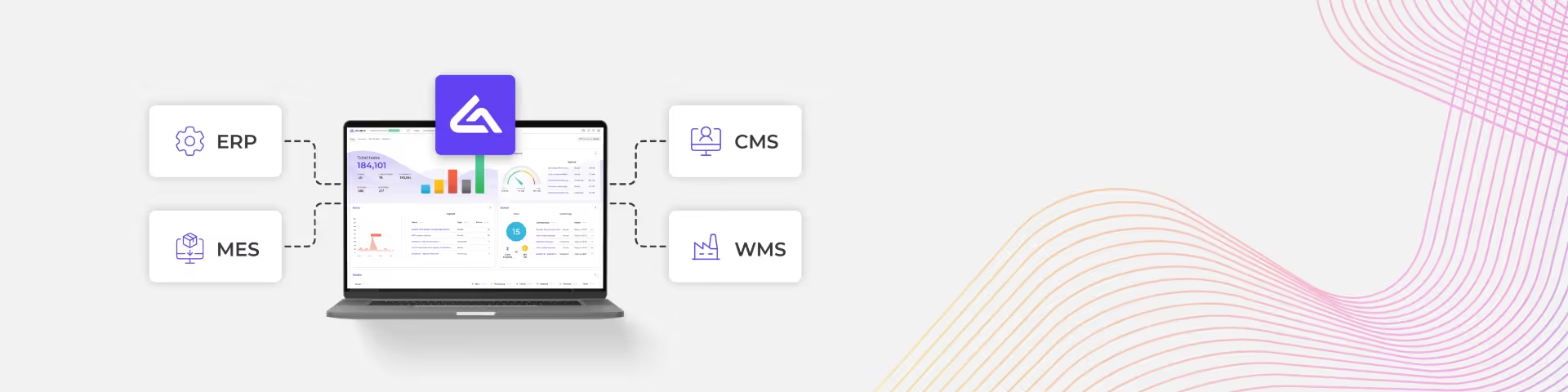
An iPaaS solves this by acting as a central data routing hub. Instead of connecting ERP directly to MES, WMS, and CRM in every possible combination, each system connects to the iPaaS. The platform becomes the place where you manage routing, mapping, transformation, scheduling, and error handling with centralized visibility.

The biggest structural advantage is decoupling. If you replace an older WMS with a modern cloud warehouse solution, you do not need to rebuild everything around it. You swap the endpoint in the integration layer and reuse the existing flows. ERP, MES, and CRM remain stable because they are not directly tied to the old system’s quirks.

Establish scalable integration architecture with Alumio

Alumio provides an integration platform designed to help manufacturers replace scattered scripts with a managed integration layer. Instead of relying on custom code as the primary integration mechanism, teams can configure and operate integrations through a visual interface that supports low-code implementation.

The practical benefit is not to replace developers, rather it means lesser one-off builds and troubleshooting. You can standardize how data is mapped, how workflows trigger, and how exceptions are handled, without burying integration logic across separate codebases.

Centralized monitoring is where this becomes operationally meaningful. If a payload from the MES fails to reach the ERP because of an invalid field, Alumio can detect the error quickly and keep it traceable to a specific flow and message. That reduces time-to-diagnosis and helps prevent bad data from silently spreading through core systems.


Turn AI ambition into action

Portrait of Leonie Becher Merli, Business Development Manager at Alumio

Get a free assessment of your integration needs and next steps

Portrait of Leonie Becher Merli, Business Development Manager at Alumio

Explore how Alumio helps integrate your manufacturing tech stack

Explore how Alumio helps integrate your manufacturing tech stack

Delivering maintainable integration across ERP, MES, WMS & CRM

A scalable architecture only matters if it works for data flows manufacturers depend on every day. Here are the core integration loops where an iPaaS typically replaces manual work and brittle scripting.

Synchronizing production data between ERP and MES

An ERP is the planning and financial backbone, and an MES runs execution on the factory floor. Alumio can automate the exchange between them so production intent and production reality stay aligned.

Typical flows include:

  • ERP sends production orders, BOM data, and routing information to MES
  • MES returns confirmations, yields, scrap, and execution outcomes back to ERP

When these flows are automated and consistent, financial costing, inventory valuation, and production reporting become more reliable with less manual reconciliation.

Automating inventory control between WMS and ERP

Inventory accuracy is a manufacturing constraint, not a reporting preference. Batch files and manual updates create timing gaps that lead to stockouts, production delays, and bad planning decisions.

With an integration layer, you can keep inventory signals aligned:

  • WMS receipts update ERP inventory records
  • Consumption and movements update ERP availability and planning signals
  • Exceptions and adjustments become traceable rather than “found later”

The result is fewer discrepancies and faster response when inventory reality changes.

Unifying customer and order context across CRM and ERP

Sales and customer service teams need operational truth to set realistic expectations. If order status and inventory availability are trapped in ERP, CRM becomes a partial view of the customer.

Common flows include:

  • Closed-won deals in CRM trigger sales order creation in ERP
  • ERP order, production, and shipment updates flow back to CRM
  • Account teams see order progress without chasing operations for updates

This reduces manual order entry, lowers error rates, and improves customer communication.

Building a future-ready integration backbone

Manufacturing excellence requires an IT landscape that can change without constant rebuilds. Point-to-point scripting creates a rigid environment where every update becomes a potential incident. ERP, MES, WMS, and CRM connectivity needs to be treated as an operational capability, not a series of custom projects.

A low-code iPaaS approach helps manufacturers replace spaghetti code with a governed integration layer. With the Alumio integration platform, teams can centralize integrations, standardize data handling, and operate flows with monitoring and traceability. The payoff is straightforward: fewer brittle dependencies, faster changes, and a scalable integration architecture that supports growth without multiplying complexity.

No items found.

FAQ

Integration Platform-ipaas-slider-right
What is the difference between custom code and iPaaS for system integration?

Custom code establishes direct, point-to-point connections between systems, leading to complex technical debt and high maintenance. An iPaaS offers a centralized, low-code platform to manage and orchestrate integrations, reducing complexity and risk.

Integration Platform-ipaas-slider-right
How does iPaaS improve maintainability in manufacturing environments?

iPaaS centralizes all integration workflows with visual tools and monitoring, making it easier to update, troubleshoot, and scale connections without rewriting custom scripts for every new requirement.

Integration Platform-ipaas-slider-right
Can Alumio iPaaS connect ERP, MES, WMS, and CRM systems in real time?

Yes. Alumio enables real-time and scheduled data flows between multiple manufacturing systems, supporting synchronous and asynchronous integrations to ensure up-to-date information across platforms.

Integration Platform-ipaas-slider-right
What are the benefits of replacing spaghetti code with an integration platform?

Replacing spaghetti code with an integration platform like Alumio reduces manual errors, accelerates deployment of new integrations, streamlines maintenance, and provides stronger data governance and visibility.

Integration Platform-ipaas-slider-right
Is low-code integration suitable for complex manufacturing processes?

Low-code integration platforms like Alumio are well-suited to complex environments. They allow rapid configuration, automated error handling, and easy adaptability as new software solutions are introduced.

Integration Platform-ipaas-slider-right
How does an integration platform help future-proof my manufacturing IT architecture?

A modern iPaaS lets you add, remove, or update systems without disrupting your entire landscape, supporting scalability and reducing long-term operational costs as technology and business needs evolve.

Get a free assessment of your integration needs

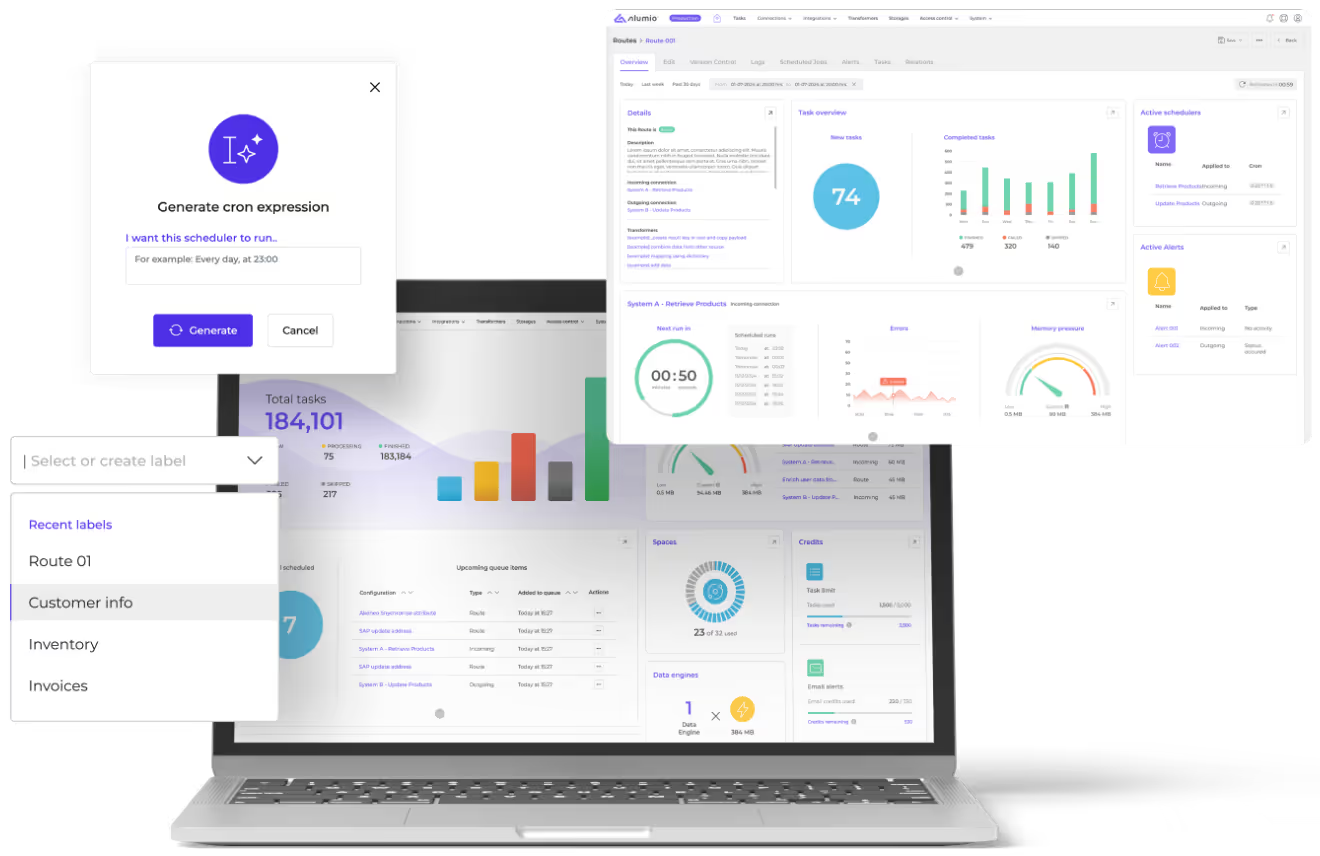
Laptop screen displaying the Alumio iPaaS dashboard, alongside pop-up windows for generating cron expressions, selecting labels and route overview.