


Start integrating SAP ECC with any other system(s)

Connect now
A Alumio vivid purple arrow pointing to the right, a visual representation of how to access more page material when clicking on it.
Go back

Migrate SAP ECC to SAP S/4HANA with Alumio

By
Saad Merchant
Published on
March 21, 2026
Updated on
March 23, 2026
IN CONVERSATION WITH
Email icon
Email icon

Migrating from SAP ECC to SAP S/4HANA is no longer just a long-term modernization goal for many enterprises. With SAP Business Suite 7 core applications, including SAP ERP 6.0, under mainstream maintenance only until the end of 2027, and optional extended maintenance available until the end of 2030, businesses still running ECC need a realistic transition plan. But for most enterprises, the bigger risk is not simply moving ERP. It is protecting the web of integrations around it. E-commerce platforms, WMS, MES, CRM, PIM, EDI, finance tools, and customer-facing applications all depend on stable SAP data flows. That is why migrating from SAP ECC to SAP S/4HANA is not only an ERP upgrade. It is an integration project. Using the Alumio iPaaS as a central integration layer helps businesses manage that transition with more control, lower risk, and less disruption to the systems around SAP.

How to migrate from SAP ECC to SAP S/4HANA with no integration risk

Migrating an ERP system as foundational as SAP ECC presents major challenges. For decades, businesses have built custom integrations and workflows around the ECC environment. Order flows from digital commerce platforms, warehouse updates, production data, supplier messaging, customer records, and finance processes may all pass through or depend on ECC in some way.

The more tightly those flows are coupled to the old ERP, the harder the migration becomes. In many cases, these connections are also brittle, poorly documented, and built point-to-point, creating an environment that is difficult to change without disruption.

Key challenges to consider when migrating from SAP ECC to SAP S/4HANA include:

  • Integration disruption: Direct connections to SAP ECC may need to be rebuilt or adapted when migrating to S/4HANA due to changes in data models, integration methods, and system architecture. Reworking each of these integrations individually can become costly and time-consuming.
  • Data integrity risks: The migration involves moving large volumes of complex business data. Without a proper validation and transformation layer, businesses risk inconsistencies between the new ERP and connected systems.
  • Operational disruption: A big-bang migration, where the entire system is switched over at once, carries a high risk of downtime. If the new S/4HANA environment fails to communicate with critical systems such as WMS or MES, manufacturing and fulfillment operations can be affected immediately.

The Alumio iPaaS approach: an integration-first migration strategy

To overcome these challenges, a modern integration strategy is essential. The Alumio iPaaS acts as a central hub, decoupling the ERP from the rest of the IT landscape. This allows businesses to modernize their digital core without dismantling the surrounding ecosystem.

Instead of maintaining a web of direct connections between SAP ECC and every surrounding system, businesses can centralize those integrations in Alumio. That means the applications around SAP connect to the integration layer, while Alumio handles the orchestration, routing, transformation, and monitoring of data flows between systems.

This changes the migration dynamic significantly. Rather than rebuilding every surrounding integration from scratch during the move to S/4HANA, businesses can keep the integration layer stable and focus primarily on updating the ERP-side connection and related mappings.

The main migration problems Alumio helps solve

This architectural shift provides several distinct advantages:

  • Centralized control and visibility: Alumio provides a single dashboard to monitor, manage, and log data flows. This visibility is critical during migration, allowing teams to track synchronization in real time and identify issues faster.
  • Automated data transformation: SAP S/4HANA introduces a simplified data model. Alumio’s graphical data mapper helps transform data from legacy ECC formats to new S/4HANA structures, supporting consistency without relying on extensive custom code.
  • Phased, lower-risk deployment: An iPaaS supports a phased migration strategy. Businesses can run SAP ECC and SAP S/4HANA in parallel, using Alumio to synchronize data between both systems. This allows for testing and validation before the final cutover, reducing risk.


Turn AI ambition into action

Portrait of Leonie Becher Merli, Business Development Manager at Alumio

Get a free assessment of your integration needs and next steps

Portrait of Leonie Becher Merli, Business Development Manager at Alumio

Want to streamline your migration to SAP S/4HANA with Alumio?

Want to streamline your migration to SAP S/4HANA with Alumio?

Lowering ERP migration total cost of ownership with Alumio

An ERP migration is a significant investment, and the total cost of ownership extends far beyond software licensing and implementation fees. One of the most overlooked costs is the manual effort and operational disruption caused by broken integrations.

A traditional migration often requires developers to rework integration points individually. This is expensive and diverts IT resources from other strategic initiatives. Any resulting downtime or data errors can also lead to direct financial losses.

By using the Alumio iPaaS, businesses can reduce many of these hidden costs. The investment in the platform helps offset:

  • Reduced development hours: Eliminating the need to rebuild every integration from scratch saves substantial custom development effort.
  • Minimized operational risk: A more controlled migration helps prevent interruptions to manufacturing, sales, and fulfillment.
  • Future-proof architecture: An iPaaS creates a scalable integration foundation where future systems can be added or replaced with less effort.

Executing the migration with Alumio

The migration process with Alumio follows a structured approach designed to reduce disruption and improve control.

1. Establish the integration layer

The first step is to connect peripheral systems such as MES, WMS, CRM, e-commerce platforms, and others to the Alumio iPaaS. This creates a stable integration layer that abstracts the surrounding systems from the ERP.

2. Initial data synchronization and testing

Next, the new SAP S/4HANA environment is connected to Alumio. Businesses can then begin a phased data migration, starting with master data such as materials and customers. Alumio helps extract data from ECC, transform it where needed, and load it into S/4HANA. Both systems can run in parallel while teams test and validate the new environment.

3. Go live with confidence

Once data is validated and processes are tested, the final cutover can be executed. Within Alumio, live data flows can be rerouted from SAP ECC to SAP S/4HANA. Because surrounding systems are already connected through the iPaaS, the transition becomes more controlled for the rest of the organization.

Enabling a scalable SAP ECC to SAP S/4HANA migration with Alumio

Migrating from SAP ECC to SAP S/4HANA is as much about protecting business continuity as it is about modernizing ERP. SAP’s support timeline makes the need to plan this transition increasingly real, but the real success factor is how well businesses protect the integrations around the ERP during the move.

Alumio helps simplify that journey by acting as a central integration layer between SAP and the rest of the enterprise, making it easier to manage data flows, reduce point-to-point complexity, and support a more phased migration approach. The result is a more controlled transition to S/4HANA and a more flexible architecture for what comes next.

No items found.

FAQ

Integration Platform-ipaas-slider-right
Is SAP ECC being phased out in favor of SAP S/4HANA?

Yes. SAP ECC remains supported for now, but businesses still running it need to plan their transition path carefully as SAP continues steering customers toward SAP S/4HANA.

Integration Platform-ipaas-slider-right
Why is integration such a big issue in an SAP ECC to SAP S/4HANA migration?

Because SAP rarely operates alone. Most ECC environments are connected to other critical systems such as WMS, MES, CRM, e-commerce, PIM, and EDI. If those integrations are tightly coupled to ECC, changing the ERP can create wider disruption across the business.

Integration Platform-ipaas-slider-right
How does Alumio help simplify SAP migration?

Alumio provides a central integration layer between SAP and surrounding systems. This helps businesses decouple applications from the ERP, manage data flows more centrally, support phased migration, and reduce dependence on brittle point-to-point integrations.

Integration Platform-ipaas-slider-right
Can SAP ECC and SAP S/4HANA run in parallel during migration?

Yes. A phased migration approach can allow businesses to keep both environments active while testing processes, validating data flows, and gradually transitioning operations toward S/4HANA.

Integration Platform-ipaas-slider-right
Does Alumio support both SAP ECC and SAP S/4HANA?

Yes. Alumio supports integration scenarios involving both SAP ECC and SAP S/4HANA, helping businesses connect SAP to the surrounding application landscape before, during, and after migration.

Integration Platform-ipaas-slider-right
Is an iPaaS only useful during the migration project?

No. After migrating to SAP S/4HANA, the iPaaS continues to serve as the integration backbone for connecting new applications, automating processes, and managing data flows more flexibly across the wider IT landscape.

Get a free assessment of your integration needs

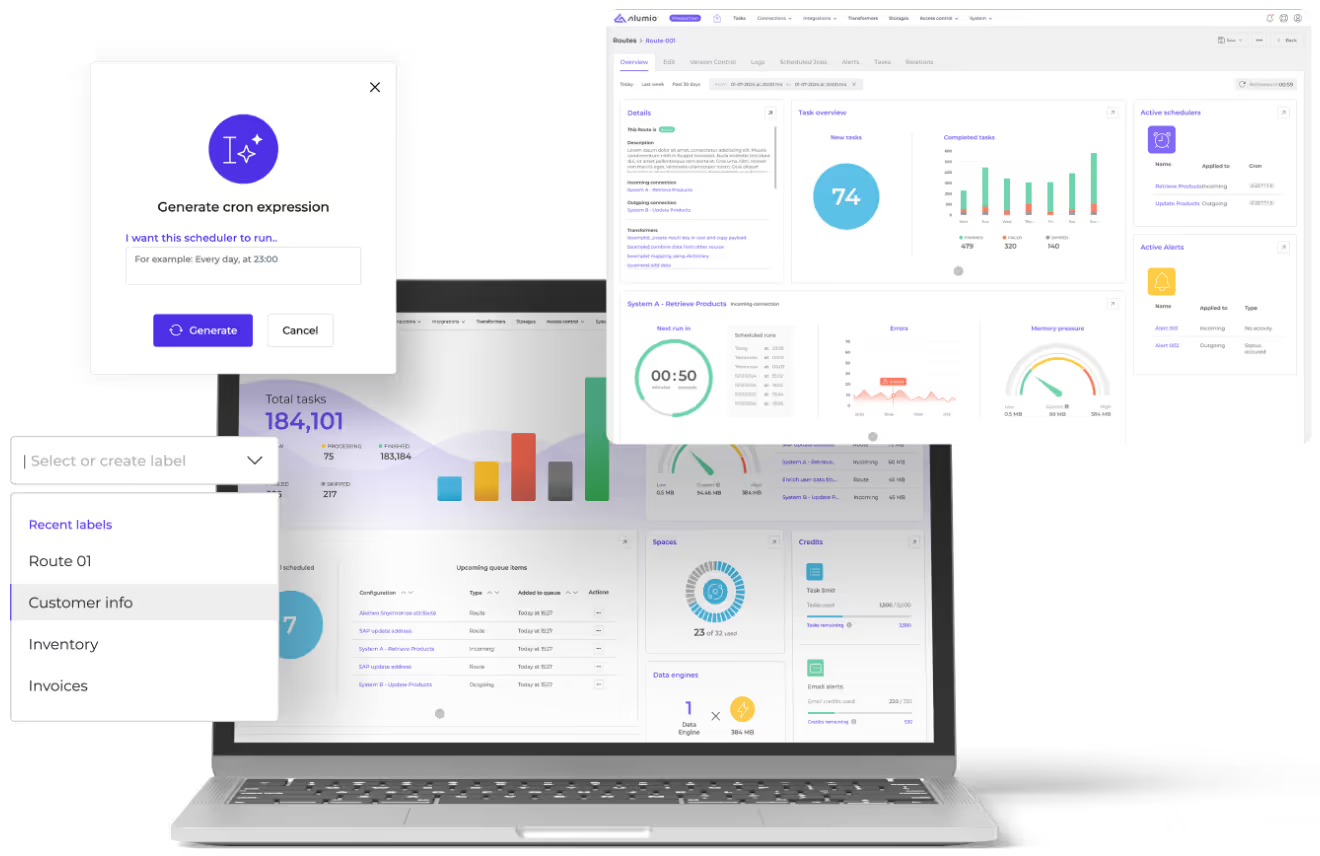
Laptop screen displaying the Alumio iPaaS dashboard, alongside pop-up windows for generating cron expressions, selecting labels and route overview.