


One platform to connect your entire commerce ecosystem

Explore commerce
A Alumio vivid purple arrow pointing to the right, a visual representation of how to access more page material when clicking on it.
Go back

E-commerce innovation without replatforming

By
Saad Merchant
Published on
July 17, 2026
Updated on
July 17, 2026
IN CONVERSATION WITH
Email icon
Email icon

The innovation wishlist at most e-commerce businesses looks the same: launch on a marketplace, add click-and-collect, offer subscriptions, put AI behind search. And the answer that kills each item is also the same: our platform can't do that. From there the conversation jumps to replatforming, a quote arrives measured in quarters and six figures, and the wishlist goes back in the drawer. E-commerce innovation stalls this way not because the platform is truly out of road, but because the capabilities being asked for are connection problems wearing a platform costume. Almost every item on that wishlist is a specialized system that needs to exchange data with the existing stack, which makes it an integration project, not a migration. An integration platform is what turns those blocked features into connections: the core stays, the new capability plugs in beside it, and the business ships in weeks instead of waiting out a rebuild.

Why e-commerce innovation gets blamed on the platform

When a capability is missing, the platform takes the blame because the platform is what everyone can see. The storefront is the visible surface of the stack, so "we can't do subscriptions" reads as a storefront defect. But subscriptions, loyalty, marketplaces, and search are not storefront features. They are separate systems that need order, customer, stock, and product data flowing to and from the core.

What actually blocks them is the state of the connections. A stack held together by point-to-point links and plugin sprawl has no clean way to feed a new system, so every addition threatens what already runs. The diagnosis error matters commercially: businesses replace a platform that was never the constraint, spend a year migrating, and arrive on the new platform with the same brittle integration web underneath.

Which e-commerce capabilities need integration, not replatforming?

Most of them. A marketplace launch is a data flow: products, prices, and stock out, orders and returns back in. Click-and-collect is the webshop and store systems agreeing on stock and order status. Subscriptions are a billing engine connected to customers and orders. AI-driven search and personalization are read flows from clean product and behavior data. None of these requires replacing the platform underneath; each requires connecting a specialized system to it.

This is the practical face of composable commerce: adding best-of-breed components around a core that keeps doing its job. The stack evolves capability by capability instead of generation by generation. The precondition is that connections are managed in one place, because adding five specialized systems over five years is only sane when each one plugs into a governed layer rather than into every neighbor.

The phased path: add capabilities, keep the core

The phased approach treats modernization as a sequence of additions and targeted swaps rather than one big bang. The new capability goes live beside the existing systems, proves itself on real traffic, and only then takes over more of the load. If a piece of the stack does eventually need replacing, it gets swapped as one connection on the layer while everything else keeps running.

The trade-off deserves stating: phasing means living with the old core longer, and an integration layer is an investment made before the first capability ships. What it buys is the removal of the all-or-nothing bet. No revenue-critical cutover weekend, no two-year project that has to be right in one shot, and each increment justified by its own return.


Turn AI ambition into action

Portrait of Leonie Becher Merli, Business Development Manager at Alumio

Get a free assessment of your integration needs and next steps

Portrait of Leonie Becher Merli, Business Development Manager at Alumio

Ready to ship new capabilities on an iPaaS instead of a new platform?

Ready to ship new capabilities on an iPaaS instead of a new platform?

When is replatforming actually the right call?

When the platform itself is the ceiling: the vendor has end-of-lifed it, licensing costs outrun its value, or its architecture genuinely cannot meet the load and experience the business needs. Those cases are real, and pretending integration solves them wastes time in the other direction. The honest test is whether the blocked capability needs data the platform cannot exchange, or behavior the platform cannot perform. Only the second justifies replacement.

Even then, the integration work is not wasted. A business that has moved its connections onto an independent layer replatforms by rebuilding one link instead of dozens, which is why replatforming with composable commerce starts from the integration layer rather than ending with it. The layer is what makes the migration a controlled swap instead of open-heart surgery.

Adding e-commerce capabilities on an integration backbone

This is the working model of an iPaaS (integration Platform as a Service): every system, current and future, connects once to a managed hub that routes, transforms, and monitors the data between them. A new capability becomes one new connection with its flows visible in dashboards, instead of another hand-built link that only its author understands.

Dutch menswear retailer Jac Hensen, which runs 12 physical stores alongside its webshop, shows what that looks like without a replatform. It kept its custom ERP, connected it with its ComfortFashion store systems and Adobe Commerce through the Alumio iPaaS, and shipped the omnichannel capabilities on its wishlist: full catalog synchronization, integrated refunds, and delivery with track-and-trace. About 30% of its web orders now originate inside physical stores, which is innovation delivered on the stack it already owned.

E-commerce innovation as an integration capability

The businesses shipping new customer experiences fastest are rarely the ones on the newest platforms. They are the ones whose stacks can accept a new system without drama, because the connections are governed in one layer instead of scattered through custom code. That is a property a business can build this quarter, on the platform it already runs.

Treated this way, e-commerce innovation stops being a periodic replatforming decision and becomes a steady operating rhythm: identify the capability, connect the system that provides it, ship, repeat. The platform question comes up when the platform genuinely earns it, and by then the integration layer has made even that decision smaller.

No items found.

FAQ

Integration Platform-ipaas-slider-right
What is e-commerce replatforming?

E-commerce replatforming is the migration of a webshop from one commerce platform to another, including its data, integrations, and customizations. It is a major project, typically taking months and requiring every connected system to be re-integrated with the new platform. Businesses replatform when the current platform genuinely limits performance, cost, or capabilities, though many blocked capabilities turn out to be integration gaps rather than platform limits.

Integration Platform-ipaas-slider-right
What is a phased approach to e-commerce modernization?

A phased approach modernizes the stack capability by capability instead of replacing it in one project. New systems are added alongside the existing core through an integration layer, proven on real traffic, and expanded gradually, and individual systems are swapped one at a time when needed. It avoids the risk of a single large cutover and lets each step justify its own return.

Integration Platform-ipaas-slider-right
How do you add a new sales channel without replatforming?

The new channel, a marketplace, B2B portal, or additional storefront, is connected to the existing systems through an integration layer rather than directly to the platform. Products, prices, and stock flow out to the channel, and orders and returns flow back into the ERP and warehouse systems, in the formats each side expects. The core platform keeps running unchanged while the channel goes live.

Integration Platform-ipaas-slider-right
How does an integration platform extend an existing e-commerce stack?

An integration platform sits between the stack and any new system, so each addition connects once to a managed hub instead of being wired into the platform. The hub transforms data between formats, applies business rules in transit, and monitors every flow. This lets a business add subscriptions, loyalty, search, or channels as configuration projects, with the existing systems untouched.

Integration Platform-ipaas-slider-right
When is replatforming the right choice instead of integrating?

When the platform itself is the constraint: it is end-of-life, its costs outrun its value, or its architecture cannot deliver the required performance or experience. Integration solves data and connection problems; it cannot fix behavior the platform fundamentally cannot perform. The practical test is whether the blocked capability needs data the platform cannot exchange or functionality it cannot execute.

Integration Platform-ipaas-slider-right
Is an iPaaS still worth it if you plan to replatform later?

Yes, and arguably more so. An iPaaS (integration Platform as a Service) decouples every connection from the platform, so the eventual migration means reconnecting one system to the layer instead of rebuilding every integration from scratch. The flows, mappings, and monitoring built before the replatform survive it. Businesses that integrate first consistently report smaller, safer migrations.

Get a free assessment of your integration needs

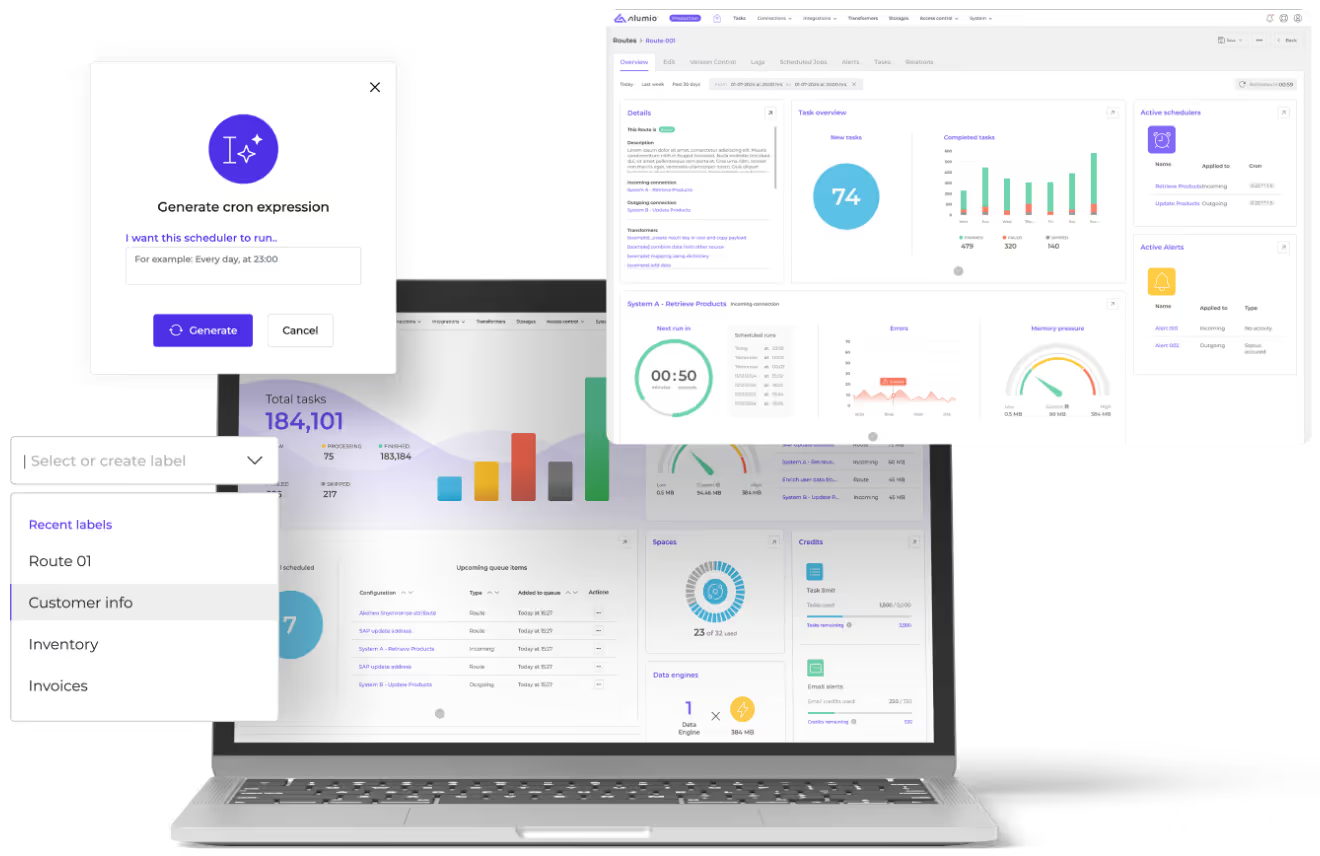
Laptop screen displaying the Alumio iPaaS dashboard, alongside pop-up windows for generating cron expressions, selecting labels and route overview.