


Start replatforming wih the most popular e-commerce web shops.

Integrate now
A Alumio vivid purple arrow pointing to the right, a visual representation of how to access more page material when clicking on it.
Go back

Turning e-commerce replatforming failures into success

By
Saad Merchant
Published on
April 24, 2026
Updated on
April 25, 2026
IN CONVERSATION WITH
Email icon
Email icon

E-commerce replatforming is one of the most operationally complex projects a digital retail business can undertake. It is not a website redesign. It is a replacement of the central system that connects your inventory, payments, order management, CRM, and marketing tools. When it goes wrong, the consequences are immediate: revenue stops, orders stall, and customer data becomes unreliable. Most replatforming failures are not caused by the new software. They are caused by underestimating what is actually being replaced, rushing the transition, and not having the right integration architecture in place to keep surrounding systems connected throughout the move. This blog covers the three most common failure points and what a structured approach to each one looks like in practice.

Why most e-commerce replatforming projects fail before launch

Replatforming failures are rarely software failures. They cluster around the same three causes: misaligned stakeholders who surface requirements too late, data that was not prepared before migration begins, and a launch strategy that concentrates all risk into a single moment with no fallback. Understanding where projects break down is the starting point for structuring one that does not.

Replatforming scope: why it is more than a storefront replacement

The most expensive mistake in replatforming is treating it as a front-end redesign rather than an infrastructure overhaul.

An e-commerce platform connects directly to inventory management, payment gateways, marketing automation, CRM tools, logistics providers, and financial systems. Replace the core platform and every one of those connections needs to be rebuilt or reconfigured for the new environment. If those dependencies are not mapped accurately before the project begins, they surface as structural failures mid-migration at the worst possible moment.

Cross-functional alignment before vendor selection

Before evaluating any software vendors, establish a cross-functional steering committee with representatives from engineering, marketing, sales, finance, and customer support. Require each department to document their mandatory requirements and daily operational workflows.

This step surfaces requirements that would otherwise arrive as mid-project change requests. A marketing team that realizes the new platform lacks a capability they depend on after development has begun forces expensive custom workarounds. Discovering that requirement in week one is a planning exercise. Discovering it in week twelve is a crisis.


E-commerce data migration: the most underestimated replatforming challenge

Data migration is the most technically demanding element of any replatforming project and the one most consistently underestimated in initial scoping.

Migrating product records, historical order data, and customer accounts from a legacy system to a new platform is not a bulk export and import operation. Legacy systems store data in formats, structures, and relationships that rarely map cleanly to a new platform's schema. Product variations can separate from parent SKUs. Customer shipping addresses can fail field mapping. Pricing structures stored in non-standard formats can corrupt on import. Attempting to clean this data after a failed migration causes delays that cascade across the entire project timeline.

Building a data migration strategy that prevents failure

Start with a comprehensive data audit before moving anything. Identify obsolete product catalogs, duplicate records, and inactive customer accounts and archive them permanently. Migrate only clean, essential data, not a complete copy of everything the legacy system ever held.

Use automated data mapping tools to translate between formats and validate output before it reaches the new platform. Every data type being migrated should have a defined mapping and a defined validation test. If a category of records cannot be validated accurately, it should not be migrated until it can.

The big bang launch: why a hard e-commerce cutover creates unacceptable risk

A big bang launch means switching off the legacy system and activating the new platform simultaneously. In theory it is clean. In practice it concentrates every integration risk, data risk, and performance risk into a single moment with no recovery position if something goes wrong.

If a payment gateway fails during a hard cutover or a checkout error appears under live traffic, the entire revenue stream stops while the team troubleshoots under pressure. Testing environments rarely surface every issue. Live consumer traffic on a newly launched platform reliably exposes things that did not appear in staging.

Phased rollout strategies for safer e-commerce replatforming

A phased rollout moves transition risk from a single concentrated event to a series of controlled, reversible steps.

If the business operates across multiple geographic markets, launch the new platform in a smaller secondary market first. Monitor performance, resolve issues, and optimize the checkout flow using real traffic before rolling out to primary markets. Alternatively, migrate a specific product category to the new system while leaving the rest of the catalog on the legacy platform. This contains technical risk to a defined area and protects primary revenue channels while the new environment is validated.

The principle mirrors phased ERP migrations: validate at each stage before committing to the next. The legacy system stays operational until the new one has demonstrated it works reliably under real conditions.


Turn AI ambition into action

Portrait of Leonie Becher Merli, Business Development Manager at Alumio

Get a free assessment of your integration needs and next steps

Portrait of Leonie Becher Merli, Business Development Manager at Alumio

Want to start replatforming your e-commerce with a governed integration backbone?

Want to start replatforming your e-commerce with a governed integration backbone?

How an integration platform prevents replatforming failures at the connectivity layer

Even a well-planned, phased replatforming project can fail at the integration layer. When the new platform goes live, it needs to communicate accurately with the ERP, WMS, CRM, and payment systems that were connected to the old one. Custom point-to-point connections built for the legacy platform often break during migration, causing inventory discrepancies and stalled order fulfillment at exactly the moment the business is most exposed.

What an iPaaS does during e-commerce replatforming

An integration platform-as-a-service, or iPaaS, is a cloud-based platform that sits between your business systems and manages how data moves between them. Rather than rebuilding fragile custom connections for the new platform from scratch, each system connects once to a central integration layer that handles routing, data format translation, and error management across all connected applications.

Keeping legacy and new systems connected during a phased rollout

During a phased transition, the iPaaS keeps legacy and new systems exchanging data accurately in parallel. Peripheral systems like the warehouse management platform and finance tools do not lose connectivity while the storefront migrates. Each phase of the rollout can proceed without the surrounding ecosystem going dark.

Isolating integration failures before they cascade

If a data transfer error occurs between the new storefront and a connected system, the integration layer isolates the failure and logs it with enough diagnostic context for the IT team to act on it directly. Without a central layer, that failure can propagate across the connected environment silently, surfacing as an inventory discrepancy or a missed order rather than a traceable integration error.

Building an integration architecture that survives the migration and beyond

The integration layer established during replatforming does not just support the transition. It becomes the operational foundation for how the new platform connects to everything around it going forward. Rather than inheriting the fragile custom scripts that served the old platform, the business moves onto a governed, monitored integration architecture that is easier to maintain, adapt, and extend as the commerce stack evolves.

Alumio provides this central integration layer for e-commerce replatforming projects: connecting the new commerce platform to ERP, WMS, CRM, and other systems through a governed layer that stays stable throughout the migration and adapts as the rollout progresses.

E-commerce replatforming success depends on a connected, phased approach

The new platform is rarely the reason replatforming fails. Misaligned scope, unprepared data, and a launch strategy that leaves no room for recovery are the causes that end most projects before they deliver value. These are not software problems. They are planning and execution problems and they are preventable when the right structure is in place from the start.

What holds a well-planned replatforming together at the technical level is the integration architecture behind it. An iPaaS keeps legacy and new systems exchanging data accurately throughout a phased rollout, protects surrounding systems from losing connectivity during the transition, and isolates failures before they cascade. It also means the business does not inherit a web of fragile custom scripts when the new platform goes live.

For e-commerce businesses looking to replatform without the risk that typically comes with it, Alumio provides the integration infrastructure to connect the new commerce environment to the systems around it and keep everything running reliably throughout the move.

No items found.

FAQ

Integration Platform-ipaas-slider-right
Why do e-commerce replatforming projects fail?

Most replatforming failures come down to three causes: stakeholder misalignment that surfaces requirements too late, underestimating the complexity of migrating data between systems with different structures, and a big bang launch strategy that concentrates all risk into a single cutover with no recovery position if something breaks.

Integration Platform-ipaas-slider-right
What does e-commerce replatforming actually involve beyond replacing the storefront?

Replacing an e-commerce platform means rebuilding or reconfiguring every connection between the new platform and surrounding systems, including inventory management, payment gateways, CRM, marketing tools, and logistics providers. These dependencies need to be fully mapped before the project begins, not discovered mid-migration.

Integration Platform-ipaas-slider-right
Why is data migration the hardest part of e-commerce replatforming?

Legacy systems store data in formats and structures that rarely map cleanly to a new platform's schema. Product records, customer accounts, and order histories often require significant transformation before they can be imported accurately. Attempting to clean data after a failed import is far more costly and disruptive than auditing and preparing it before migration begins.

Integration Platform-ipaas-slider-right
What is a phased rollout strategy in e-commerce replatforming?

A phased rollout transitions the business to the new platform gradually rather than all at once. A common approach is launching in a smaller market or with a specific product category first, monitoring performance under real traffic, resolving issues, and expanding only once the platform has proven stable. This contains risk and preserves a recovery position if problems emerge.

Integration Platform-ipaas-slider-right
What is the big bang launch risk in e-commerce replatforming?

A big bang launch switches off the legacy platform and activates the new one simultaneously. If a critical error occurs at that moment, the entire digital storefront goes down with no fallback. Troubleshooting a live failing platform under pressure leads to rushed fixes and secondary failures. Phased rollouts exist specifically to avoid this scenario.

Integration Platform-ipaas-slider-right
How does an integration platform support e-commerce replatforming?

An iPaaS connects the new e-commerce platform to surrounding systems like ERP, WMS, and CRM through a central integration layer rather than through custom point-to-point connections. During a phased rollout, it keeps legacy and new systems exchanging data accurately so peripheral systems stay connected throughout the transition. It also isolates and logs data transfer failures rather than allowing them to cascade across the connected environment.

Get a free assessment of your integration needs

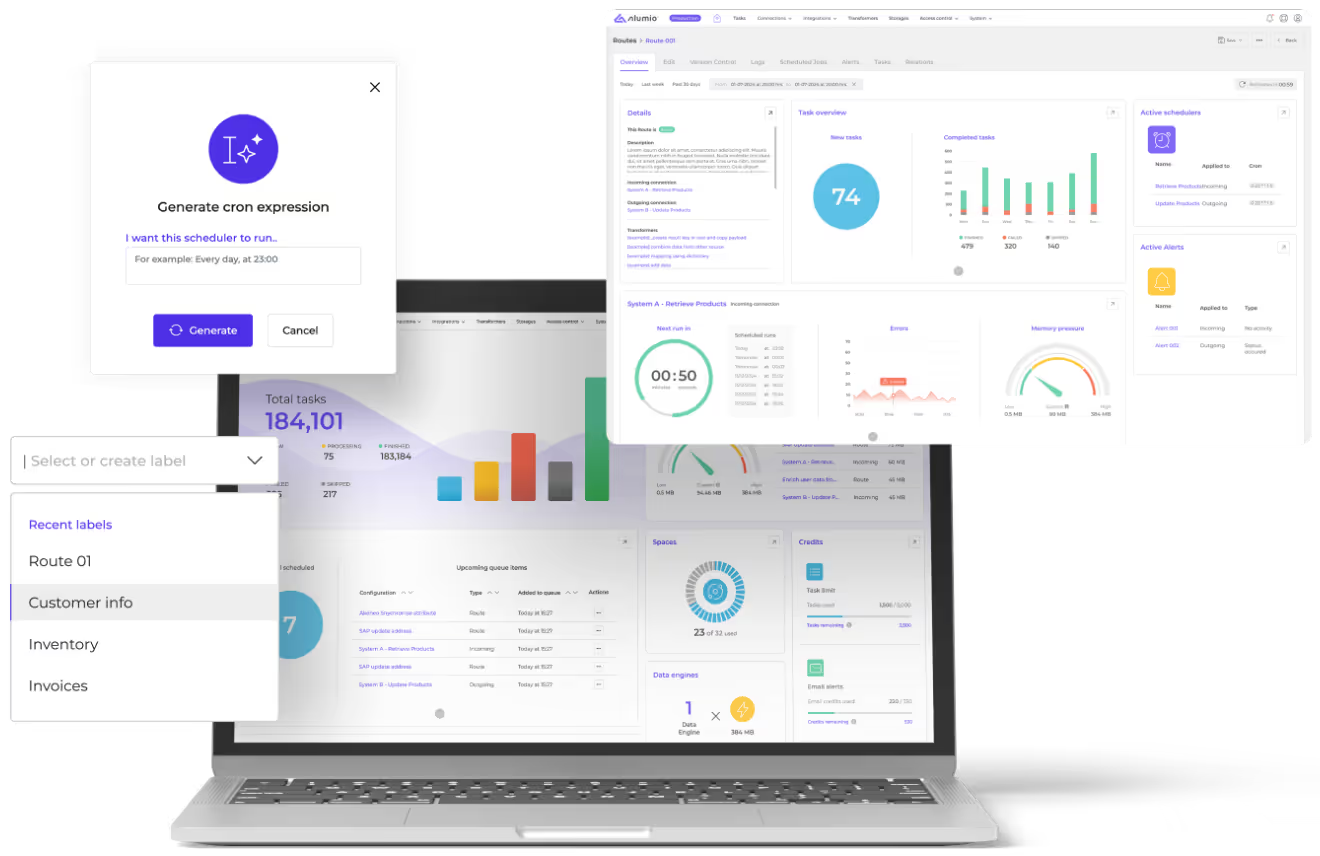
Laptop screen displaying the Alumio iPaaS dashboard, alongside pop-up windows for generating cron expressions, selecting labels and route overview.