What CMMS integration shares between maintenance and production
Maintenance and production need four things from each other, and each currently sits on one side of the divide.
- Asset runtime: preventive maintenance triggers on hours run or cycles completed, which the machine and the production system know and the CMMS often estimates
- The production commitment: which lines are committed to which orders and when, which decides whether a maintenance window is available at all
- Spare parts availability: whether the part needed is in stock, which sits in the ERP or the warehouse system rather than in the CMMS
- Failure history against output: which breakdowns happened during which runs, which is what makes the maintenance case arguable in financial terms
Only the first is a machine measurement. Runtime sits in the PLCs and the production system, so machine data has to cross into the business layer before a preventive schedule can trigger on it. The other three are business data, which is why a CMMS running in isolation produces a maintenance plan that is technically sound and operationally unrealistic.
Why does preventive maintenance get deferred?
The maintenance schedule gets proposed after the production plan is committed. A window requested against a line already promised to a customer order is a request to break a commitment, and the commitment usually wins.
Estimated runtime makes it worse. Where the CMMS triggers on calendar intervals rather than actual hours, services get scheduled on machines that have barely run and skipped on machines running double shifts. The team then learns that the schedule is approximate, which weakens the case for protecting any particular window.
Parts availability is the third failure. A window that arrives without the spare part is a window wasted, and after that happens twice, planning starts treating maintenance requests as provisional. The credibility loss is what makes the next request easier to defer.
What does weak CMMS integration cost?
Deferred maintenance costs arrive in sequence, and only the last one is visible enough to get attention:
- Windows negotiated rather than planned: supervisors spend time arguing schedules that could have been agreed once
- Services performed at the wrong interval: calendar-based triggers over-service idle assets and under-service busy ones, so the maintenance budget is misallocated before any work happens
- Wasted windows: the line stops, the team arrives, and the part is not in stock
- Breakdown during a committed run: unplanned downtime lands on the order that mattered most, because that is the line running hardest
- Expedited recovery: emergency parts, overtime, and a missed delivery, at a multiple of what the planned service would have cost
Only the last item reaches a budget review, and by then it is recorded as a breakdown rather than as a deferral. The four above it are absorbed as normal operating friction. What builds up alongside them is a set of standing conflicts: planning treats maintenance requests as provisional, maintenance asks for windows it expects to lose, and each side defends a schedule the other cannot see.
CMMS integration is a scheduling problem, not a maintenance one
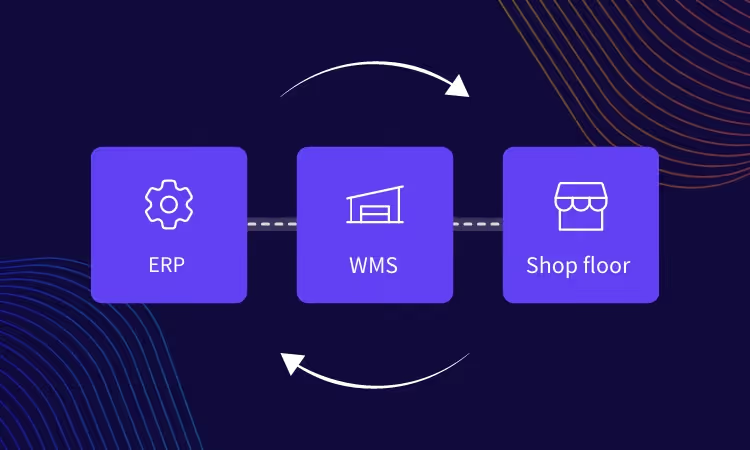
The conflict is built into how the two systems divide the work. The ERP decides how hard each machine runs, and that decision creates the maintenance requirement the CMMS will raise weeks later. The service then has to come out of production time, which changes the plan that created the requirement. Neither side can see the half it does not own, since the ERP has no view of accumulating wear and the CMMS has no view of future load.
Plants usually respond by improving the CMMS: better asset registers, tighter preventive schedules, more detailed job plans. That improves the quality of a plan that still cannot be executed, because the constraint was never the maintenance schedule.
Both sides are also right by their own measure. A planner protecting a committed delivery is doing the job as defined, and a maintenance lead protecting an interval is doing the same. The deferral is rational for the planner and expensive for the plant, which is why no amount of maintenance discipline resolves it.
What breaks the loop is the maintenance requirement reaching the planner before the plan is committed, in the same view. A service due in the next 200 running hours is a scheduling input like capacity or materials. The same service requested against a committed line is an interruption. The information is identical, and the timing decides which one it is.
How an integration platform connects CMMS to production
Manufacturers approach the split three ways. Some ERP suites include a maintenance module, which solves the divide by consolidation and generally trails a dedicated CMMS on capability. Some CMMS products ship prebuilt connectors for the common combinations. Those hold until the ERP is customized or a second plant runs different software, which is the recurring limit in ERP integration in manufacturing. Most plants run the two separately and reconcile in a weekly meeting, which is where the negotiation happens.
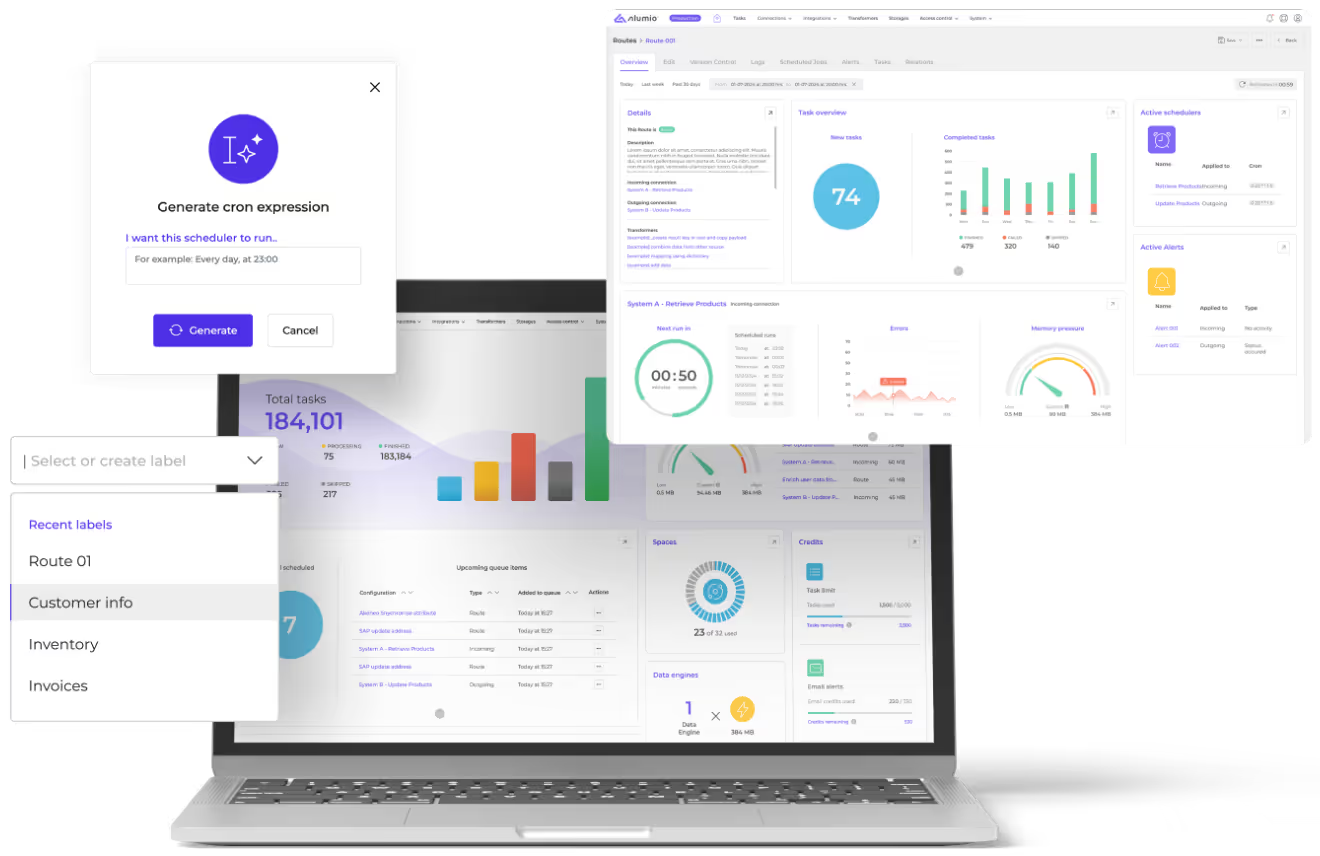
An integration platform-as-a-service (iPaaS) connects them without moving either. On the Alumio iPaaS that work takes four forms:
- Triggers on real runtime: an event-driven data Route carries actual hours and cycle counts from the production systems into the CMMS, so preventive schedules fire on use rather than on the calendar
- Maintenance visible to planning: a scheduled data Route pushes upcoming requirements into the ERP as a planning constraint before the production plan is committed, rather than as a request afterward
- Parts checked before the window: a data Transformer enriches the job’s parts list with current warehouse stock levels, so a shortage surfaces while there is still time to order
- Failure history tied to output: detailed Logs link breakdown events to the runs they interrupted, which is what turns a maintenance business case into evidence
Those flows are configured rather than hand-built per plant, with the Code Transformer available where configuration cannot express a rule. The second site reuses the first site’s logic.
What CMMS integration returns
Maintenance is measured on cost and judged on failures, which is a difficult position because the cost is visible and the avoided failure is not.
Connecting the schedules changes the argument. When the maintenance requirement appears as a constraint alongside capacity and materials, it competes on the same terms as everything else in the plan rather than as an interruption to it. That is a better position than any amount of internal maintenance discipline can produce on its own.
A plant that runs this way does not do less maintenance. It does the same work at intervals matched to how hard each asset actually runs. The windows hold, and the emergency stops landing on the order the plant could least afford to miss.





.svg)







.svg)
.svg)
.svg)
.svg)
.svg)
.svg)
