


Start enabling real-time data sync with popular systems.

Connect now
A Alumio vivid purple arrow pointing to the right, a visual representation of how to access more page material when clicking on it.
Go back

Enabling real-time inventory sync: ERP, WMS, and Production

By
Saad Merchant
Published on
April 25, 2026
Updated on
April 25, 2026
IN CONVERSATION WITH
Email icon
Email icon

Manufacturing and distribution enterprises require absolute precision to manage global supply chains effectively. Relying on batch data updates between your Enterprise Resource Planning (ERP) system, Warehouse Management System (WMS), and the production floor creates critical information gaps that disrupt operations. By implementing an event-driven architecture, you establish real-time inventory visibility across your entire technological stack. This instantaneous data exchange guarantees precise stock synchronization, eliminates costly production halts, and optimizes your Available to Promise (ATP) calculation. By replacing outdated manual data transfers with automated, event-driven workflows, operations leaders can secure supply chain agility, reduce unexpected stockouts, and execute complex production schedules with complete confidence.

Why batch-based inventory updates break manufacturing operations

Industrial supply chains break down when software systems operate in isolation, and the problem is compounded when those systems update on different schedules. The issue is not that individual systems are inaccurate in isolation. It is that they reflect different points in time, creating windows where departments are making decisions based on data that no longer reflects physical reality.

When a warehouse receives a shipment of raw materials, the WMS registers the new stock immediately. If the ERP relies on an overnight batch update to receive that information, procurement and sales teams spend the entire business day working on outdated numbers. Sales representatives may turn away orders because the ERP shows insufficient stock, while the materials sit idle on the warehouse floor. A production team may start a manufacturing run based on raw material figures the WMS has already allocated to a different order.

These are not edge cases. They are the predictable consequences of applying a batch-based data architecture to environments where inventory moves continuously throughout the day.


How event-driven WMS and ERP sync eliminates inventory data latency

The architectural response to batch-based delays is event-driven synchronization. Rather than updating systems on a schedule, a specific action in one system triggers an immediate data update across all connected platforms.

When a forklift operator scans a barcode to consume a pallet of components on the shop floor, that scan is the triggering event. The WMS registers the consumption and pushes a notification to the central integration platform. The platform translates the data and updates the ERP inventory ledger within milliseconds. Every department, including procurement, sales, production planning, and finance, sees the same stock number at the same moment because the update has already propagated across all systems before anyone has time to act on stale data.

This continuous WMS and ERP sync does not just improve data accuracy. It changes what operational decisions are possible and how confidently they can be made.


Real-time stock synchronization and its effect on ATP calculation accuracy

A manufacturer's ability to commit to customer delivery dates depends directly on the accuracy of the Available to Promise (ATP) calculation. ATP determines how much inventory is genuinely available to sell after accounting for current stock levels, incoming purchase orders, and existing production allocations. It is one of the most operationally sensitive metrics in manufacturing, and it is only as reliable as the data feeding it.

When systems synchronize on a delay, ATP calculations reflect a version of stock reality that may already be outdated. If materials were damaged on the shop floor an hour ago and the ERP has not received the update, the sales algorithm treats that inventory as available. The result is a delivery commitment the business cannot keep, with downstream consequences including expedited shipping costs, customer dissatisfaction, and strained relationships, all of which are entirely preventable.

Event-driven stock synchronization keeps ATP calculations current because every material movement updates the central database as it happens. Sales teams can quote delivery timelines based on inventory numbers that reflect the actual physical state of the warehouse and production floor at that moment.


Production planning and shop floor execution with accurate real-time inventory data

Efficient manufacturing depends on precise material orchestration. Production planners build schedules to maximize machine uptime and labor efficiency, and those schedules depend on knowing exactly what materials are available and when.

When ERP and WMS systems are synchronized with shop floor execution systems in real time, planners have immediate visibility into raw material availability. If a supplier delays a critical shipment, the integrated system surfaces the gap immediately rather than allowing it to be discovered when the production run is already scheduled to begin. Planners can shift to products that use currently available inventory, preventing downtime that would not have been visible until it was too late to avoid.

The practical effect is a production planning process that is responsive rather than reactive, because the data it depends on is current when the decision is being made.


Turn AI ambition into action

Portrait of Leonie Becher Merli, Business Development Manager at Alumio

Get a free assessment of your integration needs and next steps

Portrait of Leonie Becher Merli, Business Development Manager at Alumio

Start integrating real-time and scheduled data flows across your manufacturing tech stack.

Start integrating real-time and scheduled data flows across your manufacturing tech stack.

Scaling real-time inventory sync across multiple manufacturing facilities

As manufacturing enterprises grow and inventory needs to be managed across multiple facilities, maintaining accurate stock synchronization becomes significantly more complex. Custom point-to-point scripts connecting a growing number of warehouses, production sites, and ERP instances introduce the same fragility problems that affect any custom integration architecture at scale: API changes break connections, monitoring is scattered, and maintenance overhead compounds with every new system added.

A centralized integration platform-as-a-service (iPaaS) is a cloud-based platform that sits between your business systems and manages how data moves between them. Rather than building and maintaining separate connections for each system pair, each application connects once to the integration platform. The platform handles data format translation, routing logic, API health monitoring, and error handling in one governed environment.

Centralized governance across distributed inventory environments

For manufacturers managing multiple facilities, a stock movement in a regional warehouse reaches the central ERP through the same governed infrastructure as a movement in the primary facility. Monitoring happens in one place. When a connection fails, the failure is logged and isolated rather than discovered from a downstream data discrepancy. When new facilities or systems are added, they connect to the integration layer rather than requiring new point-to-point connections to every existing system.

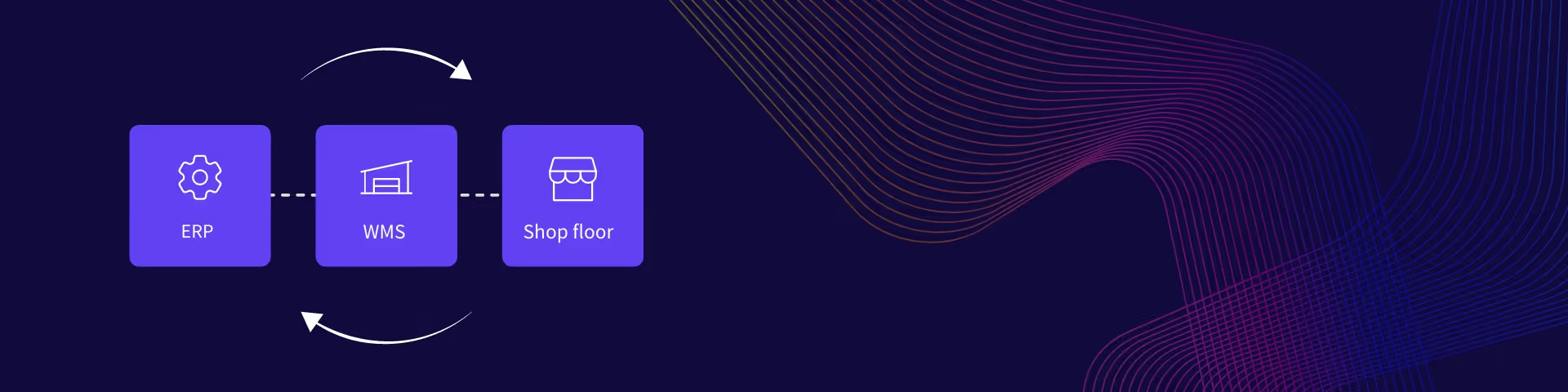
The Alumio integration platform is built for exactly this kind of multi-system, multi-facility manufacturing environment. It connects ERP, WMS, and shop floor execution systems through a central integration layer. It supports event-driven, real-time data flows alongside scheduled batch processes where those remain the right approach, with the monitoring, error handling, and governance that manufacturing environments require.

Event-driven ERP and WMS integration is the foundation of supply chain agility

Batch-based inventory updates made sense when systems were less connected and data volumes were lower. In a manufacturing environment where stock moves continuously, orders are committed in real time, and production schedules depend on material availability being accurate at the moment of planning, the latency they introduce creates operational risk at every layer.

Event-driven synchronization between ERP, WMS, and shop floor systems removes that latency. ATP calculations stay current. Production planners work from accurate data. Sales teams make commitments the operation can actually keep. And as the business scales, a centralized integration layer ensures that accuracy is maintained across every facility without the technical debt of a growing web of custom connections.

No items found.

FAQ

Integration Platform-ipaas-slider-right
What is real-time inventory visibility in manufacturing?

Real-time inventory visibility is the ability to see the exact quantity, location, and status of raw materials and finished goods across the entire operation at any given moment, without waiting for scheduled batch updates or manual data entry. It requires all connected systems, including ERP, WMS, and shop floor execution platforms, to exchange data as events occur rather than on a fixed schedule.

Integration Platform-ipaas-slider-right
Why is event-driven WMS and ERP sync better than batch processing for manufacturing?

Batch processing introduces a time gap between when an inventory event occurs and when connected systems reflect it. In manufacturing environments where stock moves continuously and decisions depend on current availability, that gap creates operational errors: oversold stock, production runs started without materials, and procurement decisions based on outdated figures. Event-driven sync eliminates that gap by updating all systems as each event happens.

Integration Platform-ipaas-slider-right
How does real-time stock synchronization affect ATP calculation accuracy?

ATP determines how much inventory can genuinely be committed to customers after accounting for existing allocations and incoming stock. If the data feeding that calculation is delayed, the ATP figure reflects a past state rather than the current one. Real-time synchronization keeps ATP accurate because every stock movement updates the central database immediately, giving sales teams reliable figures to base delivery commitments on.

Integration Platform-ipaas-slider-right
What causes poor inventory accuracy in manufacturing environments?

The most common causes are disconnected systems that synchronize on a delay, manual data entry that introduces errors between physical movements and digital records, and point-to-point integrations that break when one system updates its API. Each creates windows where different systems hold different versions of stock reality.

Integration Platform-ipaas-slider-right
How does real-time inventory data improve production planning?

When production planners have accurate, current visibility into raw material levels, they can build schedules that reflect actual availability rather than planned availability. If a material shortage or supplier delay surfaces in real time, planners can adjust before the production run is affected rather than discovering the gap when the line stops.

Integration Platform-ipaas-slider-right
Why do manufacturers need a central integration platform for real-time inventory sync?

Manufacturing environments typically run multiple systems that were not designed to communicate directly with each other. A central integration platform manages the connections between ERP, WMS, and shop floor systems, handling data format translation, routing logic, and error management in one governed layer. This is more stable and easier to maintain than custom point-to-point connections, particularly as the number of connected systems and facilities grows.

Get a free assessment of your integration needs

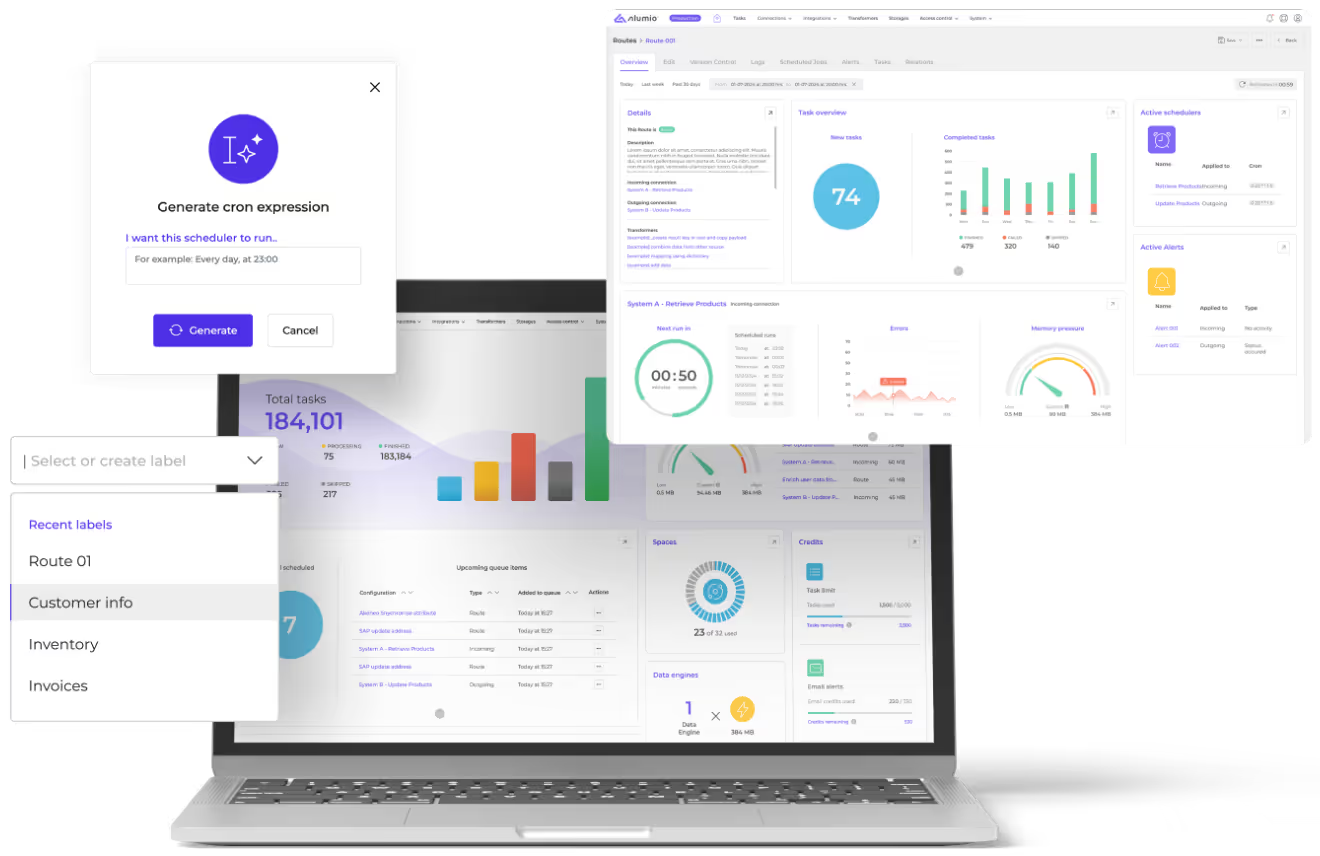
Laptop screen displaying the Alumio iPaaS dashboard, alongside pop-up windows for generating cron expressions, selecting labels and route overview.