


Want to learn how Alumio helps manufacturers integrate the digital value chain?

Learn more
A Alumio vivid purple arrow pointing to the right, a visual representation of how to access more page material when clicking on it.
Go back

Connecting machine data to enterprise systems: a modern IT/OT integration layer

By
Saad Merchant
Published on
May 8, 2026
Updated on
May 8, 2026
IN CONVERSATION WITH
Email icon
Email icon

Manufacturing data lives in two worlds that were never designed to talk to each other. On the shop floor, PLCs, SCADA systems, sensors, and industrial gateways generate operational data continuously, often using protocols designed for industrial control rather than enterprise consumption. On the top floor, ERP, MES, CRM, and analytics platforms run the business but are largely blind to what is happening at the machine level until someone manually transcribes it. Bridging this IT/OT divide is the central architectural challenge of digital manufacturing. Modern approaches now combine MQTT Sparkplug B and the Unified Namespace to organize OT data at the edge with an integration platform that routes that data into the IT systems where business decisions get made. The result is a layered architecture where machine-level events flow reliably into enterprise systems without forcing direct, fragile connections between PLCs and ERP.

Why machine data is harder to integrate with enterprise systems than enterprise data is with itself

The split between IT (Information Technology) and OT (Operational Technology) in manufacturing is not a recent inconvenience. It is a structural reality. IT systems were designed for transactional, structured data and human-driven workflows. OT systems were designed for industrial control, continuous data streams, and machine-level reliability. They use different protocols, different update frequencies, different security models, and different organizational owners.

For most of the Industry 3.0 era, the two worlds operated in parallel, and the disconnect was tolerable. Industry 4.0 changed that. Predictive maintenance needs production data flowing into analytics platforms in real time. AI-driven quality control needs OT signals integrated with PLM and ERP context. Live OEE dashboards need machine state to reach business intelligence layers. None of this works when OT data stays trapped at the shop floor.

The cost of the IT/OT divide for manufacturers

When OT and IT are not connected, manufacturers operate on two separate versions of reality. The plant manager sees one set of numbers in the SCADA system. The operations director sees another in the ERP. Production decisions and procurement decisions get made on data that does not align, because the systems generating each view are not exchanging information continuously. This is the operational cost of leaving the IT/OT layer unsolved.

MQTT Sparkplug B and the Unified Namespace at the OT edge

The modern answer to the OT-side data problem is a publish-subscribe architecture. MQTT is a lightweight messaging protocol designed for environments with constrained networks and many devices. MQTT Sparkplug B adds structure, metadata, and state awareness on top of MQTT, making it suited specifically for industrial IoT use cases.

The Unified Namespace (UNS) is the architectural concept that organizes that data into a centralized, semantically structured layer. Rather than every system pulling from individual PLCs and sensors directly, all OT data is published to the UNS using a hierarchical naming structure such as enterprise/site/area/line/machine. Any consumer that needs that data subscribes to the relevant topic, regardless of where the data originally came from. This decouples producers from consumers and turns the OT data layer from a tangle of point-to-point connections into a clean, scalable data fabric.

Where most IT/OT architectures break: the bridge to enterprise systems

A common architectural mistake is to treat the UNS as the destination, then attempt to connect ERP, MES, and analytics platforms directly to MQTT topics. This rarely works well in production. Enterprise systems were not designed to consume high-frequency telemetry data. ERP databases would be overwhelmed by raw sensor streams. Direct coupling between OT brokers and IT systems also creates organizational and security tensions that most manufacturers want to avoid.

The architecturally cleaner approach is a layered model. The UNS handles OT data normalization. A separate integration layer sits between the UNS and the enterprise systems, transforming, filtering, and routing only the data each business system actually needs, in the format and frequency it can handle.


Turn AI ambition into action

Portrait of Leonie Becher Merli, Business Development Manager at Alumio

Get a free assessment of your integration needs and next steps

Portrait of Leonie Becher Merli, Business Development Manager at Alumio

Want to start building a modern IT/OT integration layer?

Want to start building a modern IT/OT integration layer?

How an iPaaS functions as the IT/OT convergence layer

An integration platform-as-a-service (iPaaS) is the layer that bridges the normalized OT data layer to enterprise systems. It subscribes to the UNS or industrial gateway, transforms the data into the structures each IT system expects, and routes it to ERP, MES, PLM, CRM, or analytics platforms based on business rules.

This is where the iPaaS earns its place in the architecture. Real-time machine data does not need to land in the ERP at full frequency. The integration layer can aggregate, filter, and contextualize OT events into the format the ERP cares about, such as completed work orders, consumed materials, or quality exceptions. It can also pass higher-frequency data to time-series databases, AI models, or analytics platforms that can use it.

The iPaaS also handles the IT-side integration patterns that the OT layer does not provide natively. Synchronous APIs for ERP queries. Batch synchronizations for end-of-shift reporting. Event-driven triggers for production milestones. Centralized monitoring across every flow, with audit trails and error handling that the OT environment cannot guarantee on its own.

What this looks like in a working manufacturing architecture

In practice, the IT/OT integration architecture has three layers. At the edge, PLCs, SCADA systems, sensors, and industrial gateways publish data using MQTT Sparkplug B or OPC-UA into a Unified Namespace organized to ISA-95 or Purdue Reference Model standards. In the middle, the iPaaS subscribes to the UNS, applies transformation logic, and routes contextual data into enterprise systems. At the top, ERP, MES, CRM, and analytics platforms consume the data they need in the format they expect.

Alumio fits into this architecture as the IT-side bridge. It connects to the UNS or industrial gateway layer, transforms machine-level data into structures the ERP and MES can consume, and provides centralized monitoring across every flow. Manufacturers building this kind of layered architecture get the real-time visibility of an IIoT-native OT layer with the governance and reliability of a managed IT integration platform on top.

A modern IT/OT integration layer is a foundation, not a feature

The manufacturers building a credible Industry 4.0 architecture are doing it in layers. MQTT Sparkplug B and the Unified Namespace organize the OT side. An integration platform handles the IT side. The two layers together create a continuous, governed flow of data from machine to enterprise system, without forcing fragile direct connections between systems that were never designed to talk to each other.

For manufacturers building toward this architecture, Alumio provides the IT/OT convergence layer that turns shop floor data into business system data, reliably, at scale, and with the governance enterprise IT environments require.

No items found.

FAQ

Integration Platform-ipaas-slider-right
What is IT/OT convergence in manufacturing?

IT/OT convergence describes the integration of information technology systems, such as ERP, MES, and analytics platforms, with operational technology systems, such as PLCs, SCADA, sensors, and industrial gateways. It enables continuous data flow from the shop floor to enterprise business systems, supporting use cases like predictive maintenance, real-time OEE, and AI-driven quality control.

Integration Platform-ipaas-slider-right
What is MQTT Sparkplug B and why is it used in industrial IoT?

MQTT Sparkplug B is a specification built on top of MQTT that adds structure, metadata, and state awareness to industrial messaging. It enables consistent topic naming, automatic device discovery, and reliable state tracking across PLCs, sensors, and gateways. This makes it well-suited to organizing OT data into a Unified Namespace at the edge of a manufacturing network.

Integration Platform-ipaas-slider-right
What is a Unified Namespace and how does it support IT/OT integration?

A Unified Namespace is an architectural concept that organizes operational data into a centralized, semantically structured publish-subscribe layer. Rather than connecting every system directly to every PLC or sensor, all OT data is published to the UNS using a hierarchical naming structure. Any consumer system, including IT systems through an integration layer, subscribes to the relevant topics. This decouples producers from consumers and replaces tangled point-to-point connections with a scalable, governed data fabric.

Integration Platform-ipaas-slider-right
Why is connecting PLCs directly to ERP systems a poor architectural choice?

Direct PLC-to-ERP integration creates tight coupling between operational technology and business systems that were not designed to handle each other's data patterns. ERP databases would be overwhelmed by raw machine telemetry. PLCs were not designed to manage enterprise-grade authentication or governance requirements. Direct coupling also creates organizational tensions around security, data ownership, and system reliability. A layered architecture with an integration platform between the UNS and the ERP avoids these problems.

Integration Platform-ipaas-slider-right
What role does an iPaaS play in IT/OT convergence?

An integration platform-as-a-service connects the normalized OT data layer, such as a Unified Namespace or industrial gateway, to enterprise IT systems. It transforms high-frequency machine data into the formats and frequencies each business system can consume, routes events to the right destinations based on business rules, and provides centralized monitoring, audit trails, and error handling across every flow. It is the IT-side bridge that makes OT data usable in enterprise contexts.

Integration Platform-ipaas-slider-right
How does Alumio support IT/OT integration for manufacturers?

Alumio acts as the IT/OT convergence layer between the OT data fabric and enterprise systems. It connects to a Unified Namespace or industrial gateway, transforms machine-level data into the structures ERP, MES, PLM, and CRM systems expect, and routes events into those systems with centralized monitoring and governance. Manufacturers using Alumio combine the real-time capabilities of an IIoT-native OT layer with the reliability and auditability of a managed IT integration platform.

Get a free assessment of your integration needs

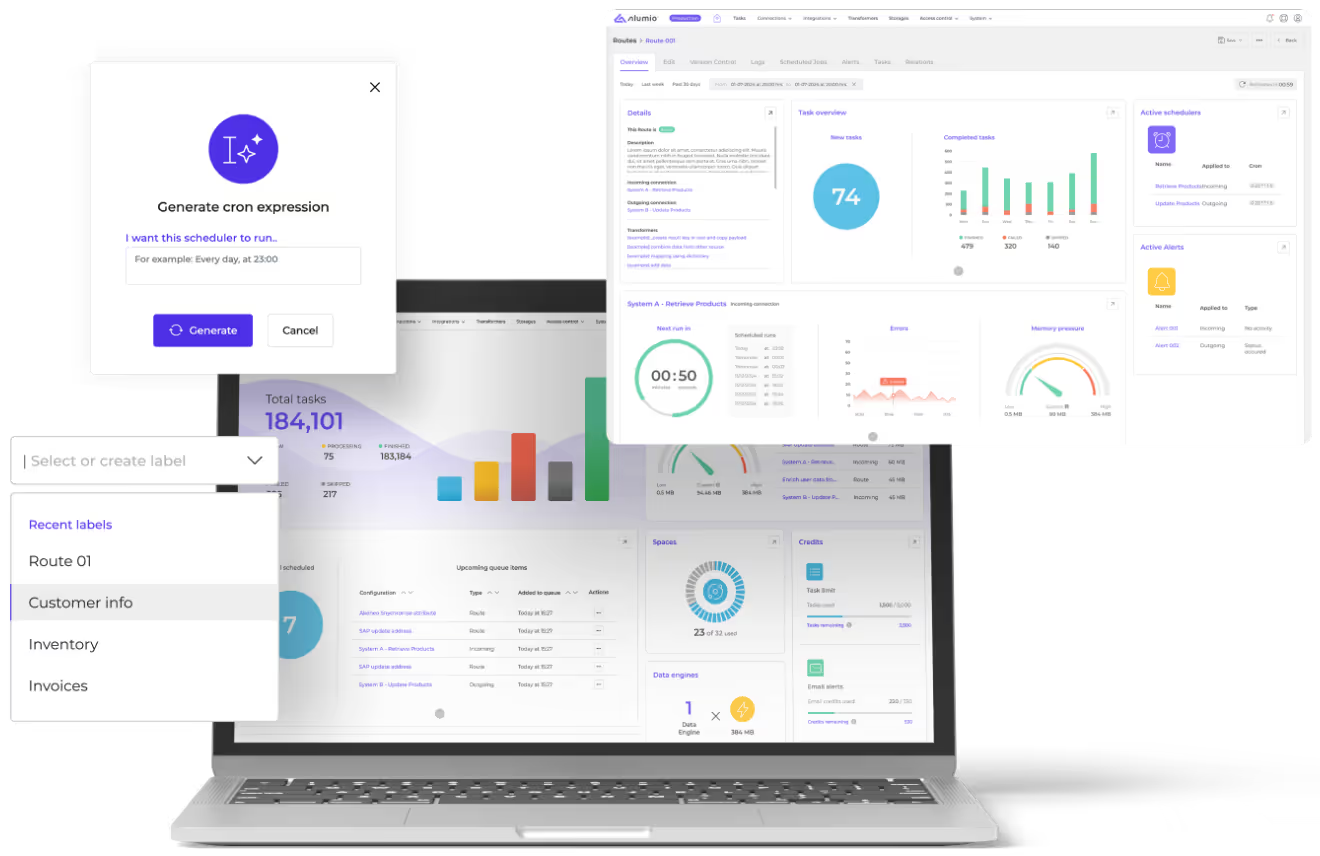
Laptop screen displaying the Alumio iPaaS dashboard, alongside pop-up windows for generating cron expressions, selecting labels and route overview.