

Connect plant systems and cloud platforms in one layer

Explore manufacturing
A Alumio vivid purple arrow pointing to the right, a visual representation of how to access more page material when clicking on it.
Go back

Cloud ERP vs on-premise: what manufacturers should keep local

By
Saad Merchant
Published on
July 31, 2026
Updated on
July 31, 2026
IN CONVERSATION WITH
Email icon
Email icon

A plant in Eindhoven runs production scheduling on a server inside the building, because a network hiccup during a shift change cannot stop a line. The same business runs group reporting, demand planning, and its customer portal in the cloud, because three sites and two currencies will not reconcile on a local box. The cloud ERP vs on-premise argument is settled in practice, and the answer most manufacturers reached is both. What stays unresolved is the data moving between the two. Local and cloud systems behave like one operation only if something keeps them in agreement, and most businesses find the gap when a work order exists in one and not the other. Running both well takes a defined point where data changes hands, a format each side accepts, and visibility when a flow stops. An integration platform-as-a-service (iPaaS) supplies all three from one cloud-native, API-driven layer. Get that layer right and the hosting decision stops being the risk.

How manufacturers split systems between cloud and on-premise

Manufacturing is the sector where on-premise never went away. Cloud is the default for new deployments now, but the installed base of local systems across plants, regulated production, and defense supply remains large and mostly deliberate. Most manufacturers are therefore not choosing between the two. They already run both and are deciding what moves next.

The division tends to follow one line: how badly a system needs to keep working when the network does not. Production scheduling, machine-level control, quality gates, and warehouse execution stay close to the floor. Group finance, demand planning, analytics, customer portals, and increasingly AI workloads run in the cloud, where compute is elastic and access is not tied to a building.

That division is sound engineering. It is also where the trouble starts, because the two sets of systems were bought separately, speak different formats, and were never given a common owner.

Why do manufacturers keep production systems on-premise?

An hour of stopped production costs more than any licensing saving a cloud migration might fund. That arithmetic, rather than caution, is what keeps critical systems inside the building. The reasoning breaks into three specifics.

Latency is the first. A scheduling or interlock decision sitting next to the equipment cannot wait on a round trip to a region several hundred milliseconds away. Autonomy is the second, since a plant needs to keep producing through a WAN outage, which rules out any dependency on a link leaving the site. Regulation is the third, because production and quality records in regulated sectors carry residency and retention obligations that are simpler to evidence locally.

Sunk investment in systems that work accounts for the rest. Some of that footprint is habit rather than requirement, and the genuine cases are narrower than they were five years ago. Several of them are still real.

What do manufacturers gain by moving planning and analytics to the cloud?

Comparability across sites is the largest gain. When each plant reports from its own local instance, a group-level question about output, scrap, or margin per line turns into a reconciliation exercise rather than a query.

Elastic compute is the second gain. Demand planning, scenario modeling, and quality analytics are bursty workloads that sit idle for most of the month, which is precisely what fixed local hardware handles badly. The third is that upgrades stop being projects scheduled around production windows.

AI belongs in this column too, though not as the headline. Models need pooled historical data across sites and years, structured consistently. That is a data problem before it is a model problem, which is why manufacturers pursuing AI usually end up moving their data layer first.

Why do local and cloud systems drift into separate silos?

Nobody owns the traffic between them. Plant IT owns what runs in the building and group IT owns what runs in the cloud, while the flows crossing from one to the other belong to whoever built the last connection.

What fills that gap is familiar. A point-to-point link per system pair, each written by a different person in a different year. A nightly file drop nobody monitors until the file is missing. A spreadsheet where someone squares plant output against group reporting every Monday. The symptom is two versions of the truth, where the plant manager and the operations director quote different production numbers from systems that both believe they are correct.

Fixing it means treating those flows as a component with an owner rather than a collection of accidents. The cost lands before the benefit does, which is the part worth being honest about. What it buys back is the manual checking, and the confidence that a change on one side will not quietly break something on the other.


Turn AI ambition into action

Portrait of Leonie Becher Merli, Business Development Manager at Alumio

Get a free assessment of your integration needs and next steps

Portrait of Leonie Becher Merli, Business Development Manager at Alumio

Ready to run local and cloud systems on one iPaaS instead of nightly file drops?

Ready to run local and cloud systems on one iPaaS instead of nightly file drops?

How an integration platform connects local and cloud systems

An integration platform sits between the two and holds the connection as configuration rather than code. Each system connects to it once, the platform reshapes data into the format the receiving side expects, and every flow is monitored in one place. Where each system is hosted stops mattering operationally, because coordination happens at the layer rather than at each pair of endpoints.

Pelican Products, the USA-based manufacturer of protective cases and portable lighting systems, is a working example. Its ERP is SAP ECC, an on-premise system that ships without the API endpoints needed to talk to cloud applications, and its webshop runs on Adobe Commerce. Working with its integration partner Corra, Pelican used the Alumio SAP API Plugin to install those endpoints natively in SAP ECC, then built the integration through the Alumio iPaaS. Product availability and pricing now synchronize with the ERP when an order is placed, replacing the standalone accounting setup that had been producing finance and inventory errors.

On the Alumio iPaaS, which is cloud-native and connects on-premise systems rather than being installed beside them, Routes handle scheduled and event-driven flows in both directions. Transformers reconcile the formats each side speaks, which matters when a local ERP talks in IDocs and a cloud platform expects REST. Storage buffers data when one side is briefly unreachable, so a dropped link does not become lost records. Logging and alerting cover every flow, making the connection the most visible part of the landscape rather than the least. When a system does eventually move, the same layer is what turns phased ERP modernization into a controlled sequence instead of a cutover.

Why cloud ERP vs. on-premise is now an integration question

The hosting decision still deserves care, system by system. What it no longer deserves is the weight manufacturers give it, because almost none of them will land entirely on one side, and the ones that try tend to move something that should have stayed put.

The more useful question is whether the business can run local and cloud systems together without paying for it in manual checking, contradictory numbers, and data quietly lost in transit. That answer depends on the hybrid integration approach in place, not on where any individual system is hosted.

Manufacturers who get that layer right stop relitigating cloud versus on-premise every budget cycle. The landscape holds together, and hosting returns to being a technical detail with a technical answer.

No items found.
Topics in this blog:

FAQ

Integration Platform-ipaas-slider-right
What is the difference between cloud ERP and on-premise ERP?

Cloud ERP runs on infrastructure managed by the vendor and is accessed over the network, with updates and scaling handled centrally. On-premise ERP runs on servers the business owns and operates, giving it control over configuration, data location, and upgrade timing. The practical difference for manufacturers is what happens during a network outage and who carries the maintenance burden.

Integration Platform-ipaas-slider-right
What is a hybrid ERP deployment?

A hybrid ERP deployment runs some modules or systems on local infrastructure and others in the cloud within one architecture. A common manufacturing pattern keeps production and shop-floor systems local for low latency, while reporting, planning, and analytics run in the cloud. It is increasingly the standard arrangement in regulated and multi-site operations rather than a transitional state.

Integration Platform-ipaas-slider-right
Which manufacturing systems should stay on-premise?

Systems that must keep operating when the connection to the outside does not, which typically means production scheduling, machine-level control, quality gates, and warehouse execution. Records carrying strict residency or retention obligations are often easier to evidence locally as well. Systems whose value comes from aggregation across sites, such as planning and analytics, rarely belong in that category.

Integration Platform-ipaas-slider-right
How does an integration platform keep an on-premise ERP consistent with cloud applications?

Consistency depends on one layer handling every exchange between them, rather than each application carrying its own copy of the logic. That layer converts data into the format each system expects, applies validation before a record is accepted, and buffers traffic when one side is unreachable so nothing is silently dropped. It also logs each exchange, which is what lets a team establish whether a given record arrived and when.

Integration Platform-ipaas-slider-right
Is cloud ERP cheaper than on-premise for manufacturers?

It shifts cost rather than removing it, trading capital expenditure on hardware and upgrade projects for a recurring subscription and a dependency on the network. Whether it lands cheaper depends on site count, how much local IT capacity already exists, and the cost of the downtime that network dependency introduces. The integration work between whatever stays and whatever moves is the line most often left out of the comparison.

Integration Platform-ipaas-slider-right
Does a hybrid manufacturing setup need an iPaaS?

An integration platform-as-a-service (iPaaS) is not required where one or two systems exchange data on a simple schedule and someone notices when it fails. It becomes the practical choice once several local and cloud systems must stay aligned, the flows are production-critical, and no single team owns the traffic between them. The signal is whether anyone can currently say, without opening both environments, whether every flow ran today.

Get a free assessment of your integration needs

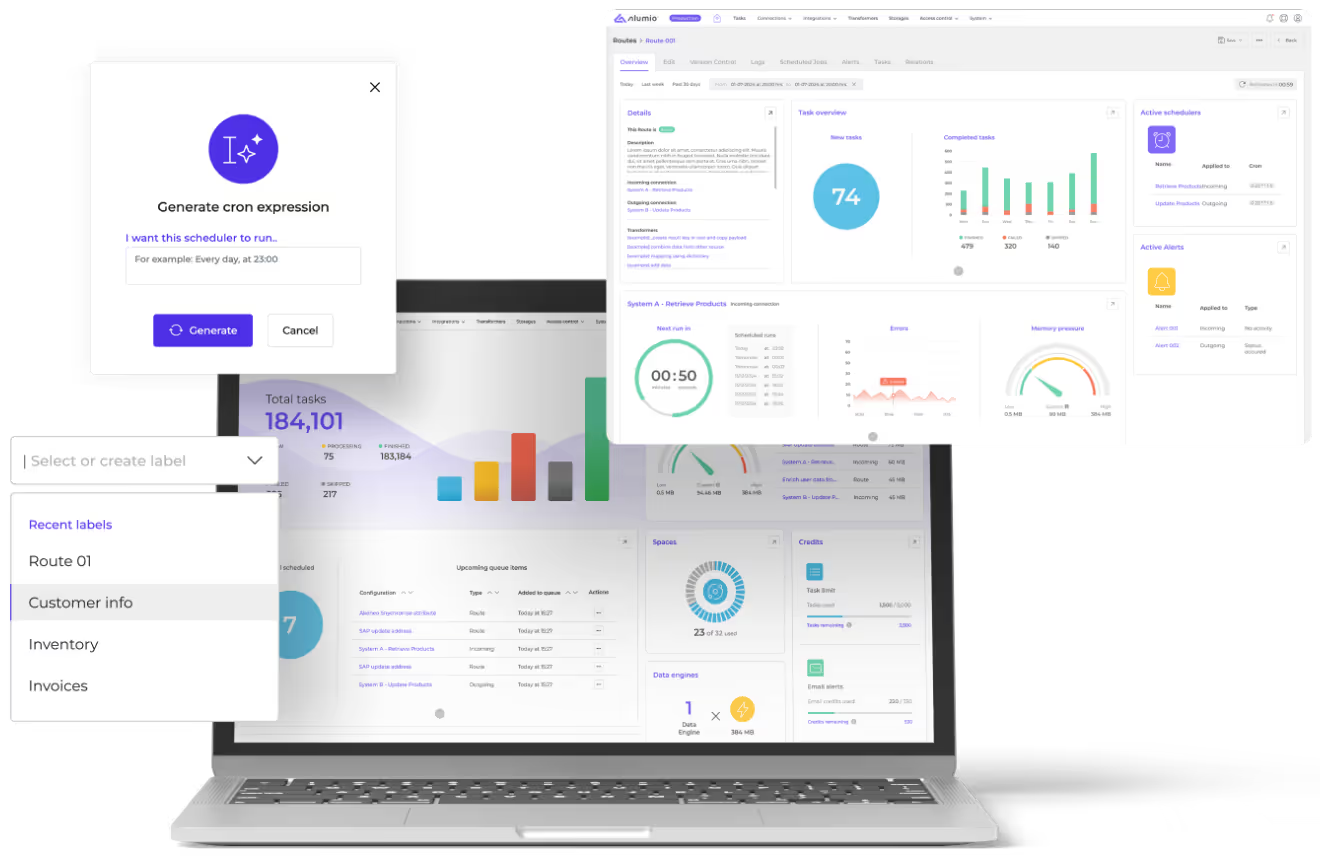
Laptop screen displaying the Alumio iPaaS dashboard, alongside pop-up windows for generating cron expressions, selecting labels and route overview.