A Alumio vivid purple arrow pointing to the right, a visual representation of how to access more page material when clicking on it.
Go back

Alumio Odoo Connector: Integrated business automation

By
Saad Merchant
Published on
March 18, 2025
Updated on
June 24, 2026
IN CONVERSATION WITH
Email icon
Email icon

Growth in the digital economy is linked to integrating a diverse range of applications to automate business processes. In this regard, Odoo delivers an all-in-one suite of business apps that offer robust ERP, CRM, POS features, and more, to help swiftly establish an integrated ecosystem. However, modern enterprises using Odoo may still need to connect other specialized SaaS solutions or new technologies to fulfill specific needs. At the same time, businesses with existing e-commerce ecosystems can benefit by modularly adopting Odoo to build a robust backend system to automate and expand operations. The Alumio iPaaS (integration Platform as a Service) provides an Odoo Connector that helps swiftly integrate Odoo with other best-of-breed apps, legacy systems, or data sources. Let’s explore the benefits!

Enable integrated business automation with the Alumio Odoo Connector

Odoo provides a vast suite of business apps that can be modularly installed and implemented in an integrated way. A low-code, API-driven integration platform like Alumio provides a rich library of Connectors and connectivity tools that help seamlessly integrate Odoo with other third-party applications and SaaS solutions.

Consider Heusinkveld, a leading Dutch manufacturer of sim racing products. They faced the challenge of integrating their WooCommerce web shop with Odoo’s open-source ERP system, while needing to filter and synchronize only specific products from their main inventory. By leveraging the Alumio iPaaS and its WooCommerce and Odoo Connectors, Heusinkveld could swiftly enable efficient, tailored data exchange between the systems. The result? Streamlined inventory management, reduced manual errors, and a faster, more responsive order process.

Read the full case study of how Heusinkveld used the Alumio iPaaS to integrate Odoo →

What is Odoo?

While Odoo can be defined as an open-source ERP, CRM and CMS, it’s actually a comprehensive suite of business apps that covers everything from accounting, inventory management, project management, to e-commerce. It also offers modules for e-commerce, Point of Sale, Shop Floor, Front Desk, and Kiosk management, as well as manufacturing. Its open-source, modular architecture means you can deploy only the applications you require, all while maintaining data consistency across departments.

The benefits of integrating Odoo

  • Open-source flexibility: Being open-source, Odoo offers high customizability to tailor the system to your specific business processes.
  • Real-time data & automation: Streamline workflows with automated processes and real-time data synchronization, which improves decision-making and reduces errors.
  • Cost-effective: Odoo’s integrated and modular approach helps reduce overall IT costs by minimizing redundant software and manual tasks.
  • Strong community & ecosystem: A vibrant global community of 100k+ developers and a marketplace of 40k community apps means you can continuously enhance and customize your Odoo experience.

Turn AI ambition into action

Portrait of Leonie Becher Merli, Business Development Manager at Alumio

Get a free assessment of your integration needs and next steps

Portrait of Leonie Becher Merli, Business Development Manager at Alumio

Seamless Odoo integration with Alumio iPaaS

As companies scale, they often find that even robust all-in-one solutions like Odoo cannot fully replace the need for specialized tools. Modern businesses increasingly rely on modular systems integrating best-of-breed SaaS applications (e.g., Shopify, Salesforce, or HubSpot) or legacy platforms — to address evolving operational demands, niche use cases, or industry-specific workflows.

The Alumio iPaaS Odoo Connector solves this by seamlessly bridging Odoo with external systems, enabling businesses to retain Odoo’s core strengths while leveraging specialized tools for growth. Let’s explore why integration is critical and how Alumio’s low-code iPaaS future-proofs your Odoo ecosystem.

Acting as a central, API-driven connectivity hub, the Alumio iPaaS provides a low-code, user-friendly interface and integration tools to connect popular solutions and custom endpoints. As such, it enables limitless connectivity between Odoo and other solutions like PIM, WMS, marketplaces, AI, ML, BI applications, and more. Integrating Odoo via the Alumio iPaaS entails several key benefits, such as:

  • Automated data synchronization:
    Enable real-time or scheduled syncing of critical business data such as orders, inventory, customer records, prices, and more, between Odoo and other applications
  • Seamless workflow automation:
    Automate repetitive tasks and streamline business processes, freeing up resources for strategic initiatives.
  • Enhanced scalability:
    Easily add new applications or expand existing integrations as your business grows, ensuring your IT ecosystem evolves with your needs.
  • Customization and flexibility:
    Tailor data mappings and transformation rules with Alumio’s intuitive low-code interface, making it easy to adapt to unique business requirements.
  • Improved operational efficiency:
    Reduce errors, eliminate redundant manual data entry, and achieve faster processing times—resulting in lower operational expenses.
  • Real-time visibility and monitoring:
    Monitor all integrations from a single dashboard, with instant alerts and comprehensive logging to quickly address any issues.
  • Enhanced security & compliance:
    Benefit from secure, API-driven integrations that adhere to modern compliance standards, protecting your sensitive data.

Why choose the Alumio iPaaS for your Odoo integrations?

As modern enterprises navigate the complexities of the digital economy, the ability to integrate a diverse range of applications becomes essential. Odoo’s modular, all-in-one suite lays the foundation for automating business operations, but integrating it with specialized tools via the Alumio iPaaS transforms it into a growth engine. Whether automating e-commerce workflows, unifying global data, or scaling with niche SaaS apps, Alumio ensures your Odoo ecosystem evolves as fast as your business. By integrating Odoo through Alumio’s secure, scalable, and low-code platform, you can streamline your operations, reduce manual workload, and focus on what matters most: growing your business.

679a3ad8229cfd4da54f1baa_678514e2365a322dfaf9eced_0Jy7Y_yMP0-M32IgOVtPbA1WoZsr5MD7slFzs-Gk0zA.png67851465cb4072842e46c84b_T8OtGoTkXIiDBnGg-rnT5ziBYen0twQ8gWtsw5TD12s.png
679a3ad8229cfd4da54f1baa_678514e2365a322dfaf9eced_0Jy7Y_yMP0-M32IgOVtPbA1WoZsr5MD7slFzs-Gk0zA.png6785165026ef770df89b0c4d_SEhoqJBJ5QAaMyHBXskDvV493D0XCZ_q_YiJKsKcxoo.png
679a3ad8229cfd4da54f1baa_678514e2365a322dfaf9eced_0Jy7Y_yMP0-M32IgOVtPbA1WoZsr5MD7slFzs-Gk0zA.png679a3adb64b8cf4eb34195fb_67851502030547779840b963_i7_-_T4ENMxvEuXqrNAimBJNF19VQcRx9bbZwMzboWw.png
679a3ad8229cfd4da54f1baa_678514e2365a322dfaf9eced_0Jy7Y_yMP0-M32IgOVtPbA1WoZsr5MD7slFzs-Gk0zA.png679a3af2f48db477d38d1bfe_6785160132bb7280a7e589f8_lMWGQ3U2bPnA79dhSvkewEGmCcRfTwQjPt_IBwjp4_g.png
Topics in this blog:

FAQ

Integration Platform-ipaas-slider-right
What is Odoo and what does it offer as a business platform?

Odoo is an open-source, all-in-one business application suite covering ERP, CRM, point of sale, e-commerce, inventory, manufacturing, accounting, HR, and more. Its modular architecture means businesses can implement only the apps they need while still operating within a unified data model. It is popular among growing businesses for its cost-effectiveness and breadth of built-in functionality, and among technical teams for its open-source extensibility.

Integration Platform-ipaas-slider-right
Why do businesses using Odoo still need an integration platform like Alumio?

Even with Odoo's complete built-in suite, most businesses using Odoo also run specialized best-of-breed systems alongside it: a dedicated headless e-commerce platform, a standalone PIM, a 3PL WMS, marketplace channels, or marketing automation tools that offer deeper capabilities than Odoo's native modules. Alumio integrates these external systems with Odoo through governed, config-first Routes, ensuring data flows reliably between Odoo and the surrounding ecosystem without custom Odoo module development for each new connection.

Integration Platform-ipaas-slider-right
How does the Alumio Odoo connector work?

The Alumio Odoo connector connects to Odoo's REST and XML-RPC APIs, handling authentication and the API communication layer. Integration teams then configure the data mapping and transformation logic in Alumio's Transformer components for their specific use case: synchronizing orders from a headless storefront into Odoo, pushing inventory from Odoo to a WMS, or routing product data from Odoo to a marketplace feed manager. All flows are monitored and logged centrally in Alumio.

Integration Platform-ipaas-slider-right
What are the most common Odoo integration use cases via Alumio?

The most common use cases are: connecting Odoo's inventory and order management to a headless e-commerce storefront (Shopify, Shopware, or a custom frontend); synchronizing Odoo with a dedicated PIM for product data enrichment; routing marketplace orders from ChannelEngine or Amazon into Odoo for processing; and connecting Odoo's CRM with a marketing automation platform for customer lifecycle management. Each of these requires transformation logic that Alumio handles without modifying Odoo's source code.

Integration Platform-ipaas-slider-right
How does Alumio compare to using custom Odoo modules for system integration?

Custom Odoo modules embed integration logic inside Odoo's codebase, making it tightly coupled to Odoo's version and release cycle. When Odoo updates, custom modules may require rework; when the connected system's API changes, the module must be updated by an Odoo developer. Alumio keeps the integration logic outside Odoo in a governed platform, so changes to either system are handled at the Alumio configuration level rather than requiring Odoo development expertise for each update.

Integration Platform-ipaas-slider-right
What business automation outcomes does connecting Odoo through Alumio enable?

Connecting Odoo through Alumio enables: automated order processing from all sales channels into Odoo without manual data entry, real-time inventory synchronization between Odoo and storefronts or WMS to prevent overselling, automated financial posting when orders are confirmed or shipped, and consistent customer data flowing between Odoo CRM and marketing tools. The cumulative effect is that the operations team processes more volume with the same headcount, and the integration landscape scales alongside the business without rebuilding connections each time a new system is added.

Get a free assessment of your integration needs

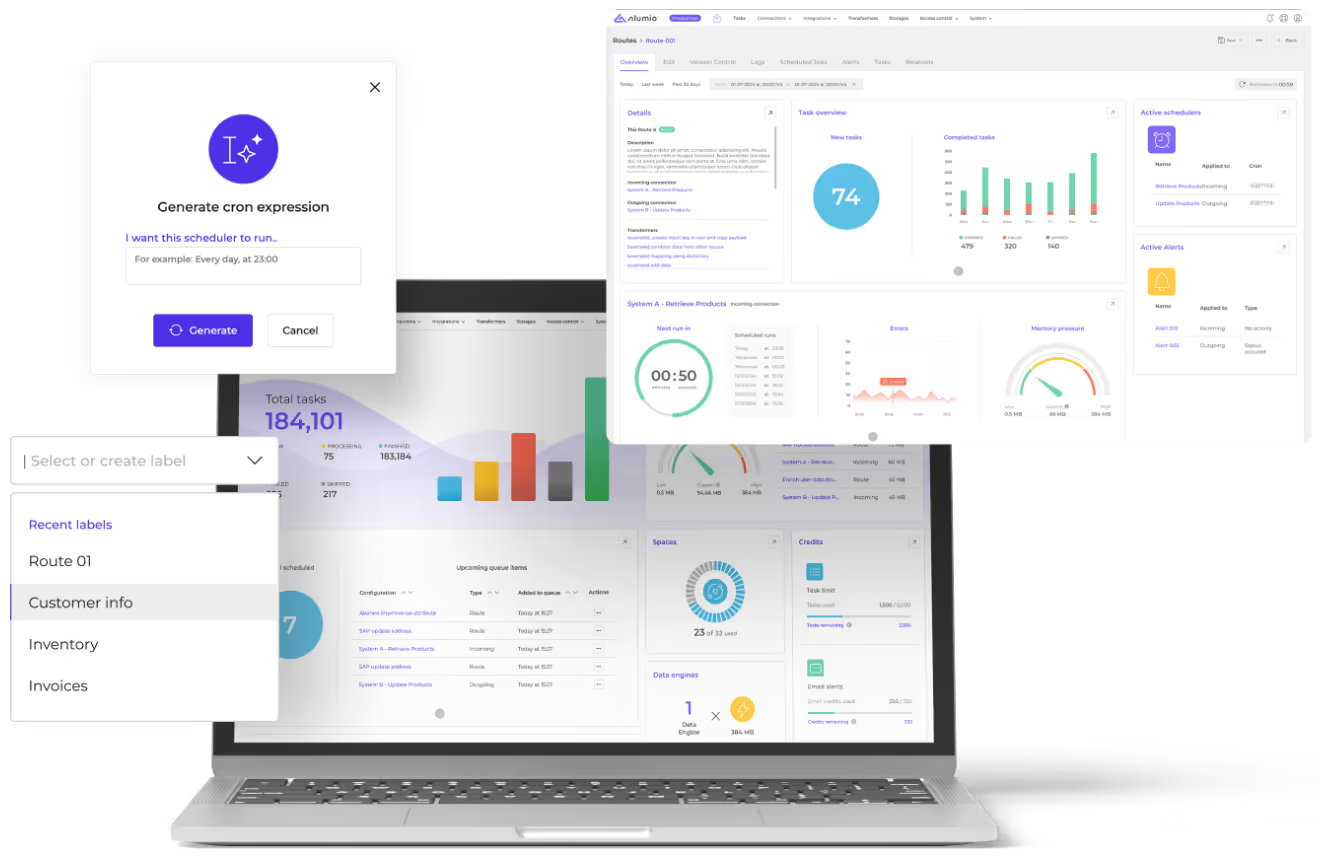
Laptop screen displaying the Alumio iPaaS dashboard, alongside pop-up windows for generating cron expressions, selecting labels and route overview.