


Integrate all your e-commerce data to be AI-ready.

Learn more
A Alumio vivid purple arrow pointing to the right, a visual representation of how to access more page material when clicking on it.
Go back

How to build AI-ready e-commerce architecture

By
Saad Merchant
Published on
June 19, 2026
Updated on
June 19, 2026
IN CONVERSATION WITH
Email icon
Email icon

Most e-commerce businesses can already run an AI tool. Far fewer can run an AI-first strategy, where AI does not just assist a task but drives decisions and actions across the whole operation. The gap between those two is not the AI. It is the architecture underneath it. An AI-first strategy needs to read and act on data from every system in real time, and most commerce stacks were built to serve pages, not to feed an autonomous layer making decisions across them. An AI-ready e-commerce architecture is one built so AI can reach the data it needs, when it needs it, and act on it safely. Getting there is less about adopting more AI and more about how the systems underneath connect, which is where an integration platform does the deciding work. This is what separates businesses experimenting with AI from businesses actually running on it.

What "AI-ready" really means for an e-commerce architecture

There is a difference between using AI and being AI-ready, and it is easy to miss. A business can bolt a recommendation engine onto its storefront or run a generative tool inside its PIM and feel like it has gone AI-first. It has not. It has added a feature.

An AI-first strategy is different in kind. It means AI sits at the center of how the business runs, making decisions about pricing, inventory, merchandising, and service, and acting on them across systems without a person moving data between steps. That only works if the architecture can feed AI a current, complete picture and let it act back on every system in real time.

Most architectures cannot do this, and the reason is structural. They were designed for people clicking through interfaces, not for an AI layer reading and writing across the whole stack at once. Preparing for AI-first is therefore an architecture project before it is an AI project, and it comes down to a few specific properties.

What makes an e-commerce architecture AI-ready

Three properties separate an architecture that can support AI-first from one that cannot. None of them is an AI feature. All of them are decisions about how the systems connect.

  • Decoupled and composable: when the storefront, PIM, ERP, OMS, and CRM are separate services connected through APIs rather than fused into one monolith, AI can read from and act on each one independently. This is the foundation that the shift from platforms to data backbones has been building toward, and AI-first is the reason it now matters more.
  • Real-time data flow: an AI making a pricing or inventory decision on last night's data export is acting on a business that no longer exists. AI-ready architectures move data as events happen, so the AI works from the current state, not yesterday's.
  • A layer AI can act through: AI does not just need to read data, it needs to write back. A control layer that lets AI trigger actions across systems, with permissions and logging, is what turns AI from an advisor into an operator.

A business with all three can put AI at the center and trust it to act. A business missing any one of them is limited to AI features around the edges, no matter how advanced the model.

Why most e-commerce stacks are not ready for AI-first

The typical commerce stack grew one integration at a time. A new tool got connected to the two or three systems it needed, point to point, and the result is a web of direct connections that works for people but not for an AI layer.

The problem is that AI needs one consistent view across every system at once. A web of point-to-point connections cannot give it that. Each connection carries data in its own format, on its own schedule, so the AI sees a slightly different version of the truth depending on which system it reads from. No single place holds the current, complete picture the AI would need to act on. An AI agent dropped into that environment does not get smarter. It makes faster decisions on inconsistent data, which is worse than slow decisions on good data.

This is why adding AI to an unprepared stack so often disappoints. The model is fine. The architecture cannot give it what it needs, so the AI ends up confined to the one corner where the data happens to be clean. The same trap shows up in AI product data management, where AI either extends across the whole catalog or stays stuck inside a single system depending on the integration layer underneath. Preparing the architecture is what lets AI move out of that corner.


Turn AI ambition into action

Portrait of Leonie Becher Merli, Business Development Manager at Alumio

Get a free assessment of your integration needs and next steps

Portrait of Leonie Becher Merli, Business Development Manager at Alumio

Ready to build an AI-ready architecture with a scalable integration backbone?

Ready to build an AI-ready architecture with a scalable integration backbone?

Why the integration layer decides AI-readiness

The three properties of an AI-ready architecture have one thing in common: they are all integration problems. Composability, real-time data, and a layer AI can act through are all decided by how systems connect, not by any single system. This is why the integration layer is where AI-readiness is won or lost.

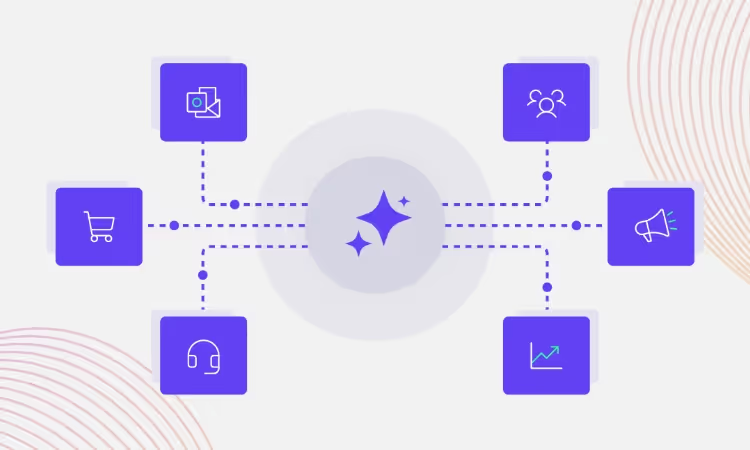
An integration platform, software that connects all of a business's systems through one managed layer instead of direct connections, is what makes those three properties real. It gives AI one consistent place to read from and act through, rather than a dozen partial views. The Alumio integration platform connects commerce, ERP, PIM, OMS, and CRM into one real-time layer, translates each system's data into a consistent form, and gives an AI layer a single governed place to read and act, with every action logged. That governance becomes more important as AI starts to act on its own, since an AI operating across live systems needs guardrails and an audit trail by default. It is what makes setups like AI agents running webshop operations safe to attempt, since the agent acts through a controlled layer rather than directly on every system. In most cases a business builds this with a certified integration partner, who sets up the connections and the governance model so the architecture arrives AI-ready rather than being retrofitted later.

Why AI-readiness is an architecture decision, not an AI one

The businesses that win with AI-first will not be the ones with the most AI. They will be the ones whose architecture lets AI act across the whole operation, on current data, safely. The models are largely the same ones everyone can reach. The advantage comes from whether the stack underneath can put them to work.

That reframes what preparing for AI actually involves. The decision that matters is not which AI tool to adopt next. It is whether the architecture underneath can feed AI a complete, current picture and let it act on every system without breaking. Get that foundation right, and each new AI capability becomes a configuration step rather than a rebuild.

The shift to AI-first is coming for commerce regardless of who is ready. The businesses that treated their architecture as the real decision will adopt it as a natural next step. The ones that bolted AI onto an unprepared stack will find their ambitions capped by foundations that were never built to carry them.

No items found.

FAQ

Integration Platform-ipaas-slider-right
What is an AI-ready e-commerce architecture?

An AI-ready e-commerce architecture is a commerce stack built so AI can reach the data it needs in real time and act on every system safely. It is defined by three properties: decoupled, composable systems connected through APIs; data that flows as events happen rather than in scheduled batches; and a managed layer AI can act through, with permissions and logging. The point is to let AI sit at the center of operations rather than work as a feature at the edge.

Integration Platform-ipaas-slider-right
What is the difference between using AI and being AI-first?

Using AI means adding an AI feature to an existing process, like a recommendation engine on a storefront. Being AI-first means AI drives decisions and actions across the whole business, from pricing to inventory to service, and acts on them across systems without a person moving data between steps. The first needs a tool. The second needs an architecture that can feed AI a complete, current picture and let it act back on every system.

Integration Platform-ipaas-slider-right
Why do most e-commerce stacks struggle with AI-first strategies?

Most stacks grew one point-to-point integration at a time, so no single place holds a current, consistent view of the business. An AI layer needs exactly that complete view to act well, and a web of direct connections cannot provide it. The AI ends up making fast decisions on inconsistent data, which is why adding AI to an unprepared stack so often disappoints.

Integration Platform-ipaas-slider-right
Do I need composable commerce to be AI-ready?

Composability helps a great deal, because decoupled systems connected through APIs let AI read from and act on each one independently. It is the architectural direction that makes the other AI-ready properties achievable. That said, full re-platforming is not always necessary. An integration platform can connect existing systems into one real-time layer, which delivers much of the same AI-readiness without rebuilding everything at once.

Integration Platform-ipaas-slider-right
How does an integration platform make an architecture AI-ready?

An integration platform connects all of a business's systems through one managed layer, so AI has a single consistent place to read from and act through instead of many partial views. It moves data in real time, translates each system's format into a consistent form, and logs every action AI takes. This is what turns the three AI-ready properties from goals into something that actually works in production.

Integration Platform-ipaas-slider-right
Is an AI-ready architecture only worth it for large enterprises?

No. The architecture that supports AI-first is valuable at any size, because the same connected, real-time foundation also reduces manual work and keeps systems in sync today. Mid-market businesses often see the benefit faster, since they have fewer legacy constraints to work around. The investment pays off before any AI-first strategy is switched on, and then makes that strategy possible when the business is ready for it.

Get a free assessment of your integration needs

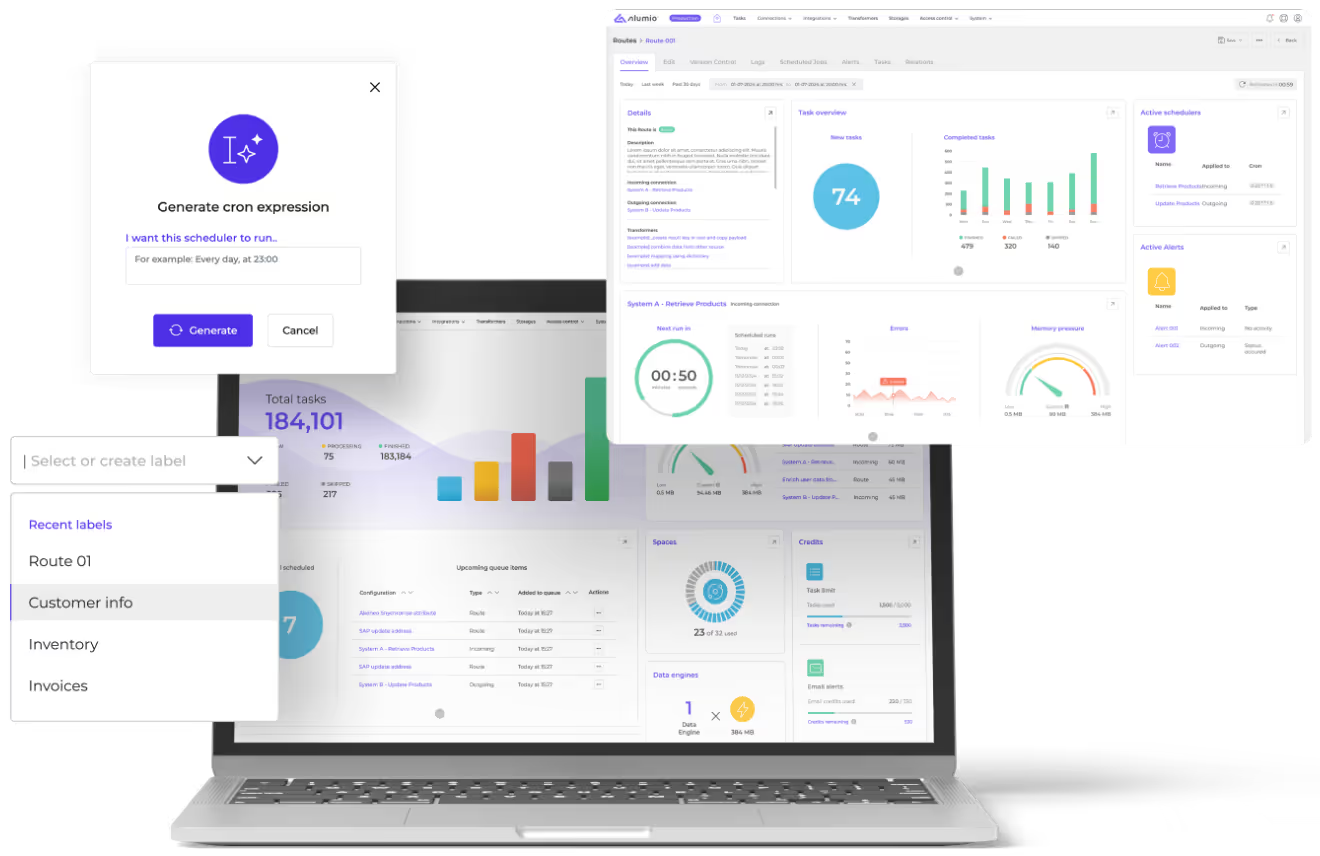
Laptop screen displaying the Alumio iPaaS dashboard, alongside pop-up windows for generating cron expressions, selecting labels and route overview.